• Welcome to TalkWeather!
    We see you lurking around TalkWeather! Take the extra step and join us today to view attachments, see less ads and maybe even join the discussion.
    CLICK TO JOIN TALKWEATHER

Significant Tornado Events

And the tornado was only at EF3-EF4 intensity as this was recorded. The lightning show along with it just makes it so intense to watch. The trees even violently sway too if you look closely. I'm not sure if you can see the tornado in this at all
Officially it was only at EF3-EF4 intensity, but really it was likely at EF5 intensity for most of its path.
 
That outbreak has long been a source of fascination for me, as really the only outbreak in the known record to affect the entire upper Midwest and western Great Lakes region, including southern Wisconsin, with (effectively, if not always officially) intense to violent tornadoes.

Several days out (even before 3/31 happened), it looked like 4/4/2023 might have that level of potential, with a huge area of double-digit 3KM EHI progged from a triple point in central Iowa along a warm front extending to western Lake Erie, but as we know that's not how it transpired.

Honestly I feel like something has changed meteorologically these last few years where an outbreak like it is more plausible? Not only has this year been dominantly upper midwest but we also got extremely close to ending the Michigan violent drought.
 
A random thought I just had while looking at the new April 27 thread since it got me thinking more about 2011 in general:

It’s kind of crazy how May 24, 2011 was the last real full-fledged outbreak we’ve had with multiple supercells that produced violent tornadoes, several of which were particularly high-end, in Oklahoma.

In hindsight, that event is beginning to feel more like a “generational” event for that area rather than a once or twice in a decade kind of event like I would have thought at the time. I don’t mean generational in the same way we discuss 1974 and 2011, but moreso how intense/violent the tornadoes were that day with multiple supercells rather than 1-2 cyclic ones.
 
Last edited:
A random thought I just had while looking at the new April 27 thread since it got me thinking more about 2011 in general:

It’s kind of crazy how May 24, 2011 was the last real full-fledged outbreak we’ve had with multiple supercells that produced violent tornadoes, several of which were particularly high-end in Oklahoma.

In hindsight, that event is beginning to feel more like a “generational” event for that area rather than a once or twice in a decade kind of event like I would have thought at the time. I don’t mean generational in the same way we discuss 1974 and 2011, but moreso how intense/violent the tornadoes were that day with multiple supercells rather than 1-2 cyclic ones.
It was also the last time a 45% tornado risk really verified. The two times since significantly underperformed.
 
It’s kind of crazy how May 24, 2011 was the last real full-fledged outbreak we’ve had with multiple supercells that produced violent tornadoes, several of which were particularly high-end in Oklahoma.

In hindsight, that event is beginning to feel more like a “generational” event for that area rather than a once or twice in a decade kind of event like I would have thought at the time. I don’t mean generational in the same way we discuss 1974 and 2011, but moreso how intense/violent the tornadoes were that day with multiple supercells rather than 1-2 cyclic ones.

It was also the last time a 45% tornado risk really verified. The two times since significantly underperformed.

IIRC 4/14/12 had one. A nocturnal EF3 impacted Woodward, OK with several fatalities. Another supercell tracked out of Oklahoma into Kansas and an EF3 hit in Wichita around the same time. Earlier and to the north, the Kanapolis Lake EF4 threatened to hit Salina. It's mostly forgotten, but (it's almost a cliché for Plains outbreaks at this point) another nocturnal EF3 wedge also occurred near Greensburg.

However, that *was* just a year later. It does seem like the Plains used to get outbreaks of that caliber on a semi-regular basis through the 1990s until then, and then they just kind of stopped. There have been plenty of days that seemed to have the potential, but then some subtle issue with wave timing, storm mode or capping significantly mitigated things.
 
IIRC 4/14/12 had one. A nocturnal EF3 impacted Woodward, OK with several fatalities. Another supercell tracked out of Oklahoma into Kansas and an EF3 hit in Wichita around the same time. Earlier and to the north, the Kanapolis Lake EF4 threatened to hit Salina. It's mostly forgotten, but (it's almost a cliché for Plains outbreaks at this point) another nocturnal EF3 wedge also occurred near Greensburg.

However, that *was* just a year later. It does seem like the Plains used to get outbreaks of that caliber on a semi-regular basis through the 1990s until then, and then they just kind of stopped. There have been plenty of days that seemed to have the potential, but then some subtle issue with wave timing, storm mode or capping significantly mitigated things.
For some reason I always forget that one!

Interestingly enough, the initial day 1 had the 45 in Nebraska, which barely saw any activity at all. Later outlooks shifted it southward. Overall a pretty interesting event from both the tornado outbreak perspective and the Spc outlook perspective
 
However, that *was* just a year later. It does seem like the Plains used to get outbreaks of that caliber on a semi-regular basis through the 1990s until then, and then they just kind of stopped. There have been plenty of days that seemed to have the potential, but then some subtle issue with wave timing, storm mode or capping significantly mitigated things.
This is something I feel like a lot of other users, besides you and myself, have noticed on here as well. Especially with April 1991 and May 3rd 1999 occurring relatively close to each other. Like you said, that sort of activity continued to around 2012/2013.

Since then, I don’t know how to describe it, classic Oklahoma/Southern Plains just seem to get really janky set ups now.

4/26/24 had that classic feel to it, but it was mainly concentrated in Nebraska.
 
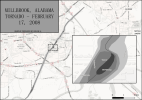
MILLBROOK.png
Fujita-ish Millbrook map I made. The path is very odd; SW of the Prattville Walmart it turns sharply ENE before straightening back out; this is where the only verifiable area of EF3 damage I was able to locate occurred (please pardon the quality):
1786221240314.png1786221251820.png
I'm honestly really starting to like QGIS; I might have to start using it more when posting on the forum.
 
View attachment 54590
Fujita-ish Millbrook map I made. The path is very odd; SW of the Prattville Walmart it turns sharply ENE before straightening back out; this is where the only verifiable area of EF3 damage I was able to locate occurred (please pardon the quality):
View attachment 54591View attachment 54592
I'm honestly really starting to like QGIS; I might have to start using it more when posting on the forum.
Pretty wild how this occurred mere weeks after Super Tuesday.

Piggybacking off of earlier and how we were discussing Oklahoma, Alabama has been kind of quiet recently as well. Wasn’t the last violent tornado there in 2019?
 
This is something I feel like a lot of other users, besides you and myself, have noticed on here as well. Especially with April 1991 and May 3rd 1999 occurring relatively close to each other. Like you said, that sort of activity continued to around 2012/2013.

Since then, I don’t know how to describe it, classic Oklahoma/Southern Plains just seem to get really janky set ups now.

4/26/24 had that classic feel to it, but it was mainly concentrated in Nebraska.

Even thought it didn't fully perform to potential, I'd also argue Arnett day in 2025 with the nasty cyclic supercell was a true plains outbreak, along with Katie-Wynnewood day in 2016. I do wonder if there is some sort of inverse recency bias at play for as to why the plains seem quiet.
 
Piggybacking off of earlier and how we were discussing Oklahoma, Alabama has been kind of quiet recently as well. Wasn’t the last violent tornado there in 2019?
Officially yes, but unofficially you've had tornadoes like Gordo that were intense at the bare minimum. It's really (in my opinion) a lack of tornadoes hitting populated areas.
 
It’s very interesting to me because I think ever since the start of 2020 weve had a violent rated tornado in 3 of the 6 years in, Mississippi, 2020, 2023 2025. Seems like some of our bigger events this decade for the Deep South have been latched on Mississippi rather than Alabama.
 
That outbreak has long been a source of fascination for me, as really the only outbreak in the known record to affect the entire upper Midwest and western Great Lakes region, including southern Wisconsin, with (effectively, if not always officially) intense to violent tornadoes.

Several days out (even before 3/31 happened), it looked like 4/4/2023 might have that level of potential, with a huge area of double-digit 3KM EHI progged from a triple point in central Iowa along a warm front extending to western Lake Erie, but as we know that's not how it transpired.
What I’m about to say may be a hot take, but I’m going to get it out there.

When 4/3/74 originally happened, Fujita mentioned off hand it was a 1 in 500 year outbreak. While at the time it seemed like it, you can also draw parallels to the enigma, 1932 deep south outbreak, and of course 4/27/11 as historical comparisons. Yes, the geographies impacted may slightly vary and overlap, but 4 all have similarities.

Palm Sunday 1965 is a complete aberration historically speaking. Yes, you had a previous Palm Sunday impact similar areas in 1920, but not in the order of magnitude that occurred in 1965. An outbreak of half the magnitude in that region hasn’t been since. Even amongst our, albeit spotty, tornado record, nothing in that region prior to 1965 seems to even come close to paralleling it.

Even with that area of the country being very active through the 1960s, that day was just incredible. The collective violence of tornados on that day, in my mind even, surpasses 4/3/74 in some aspects. Almost every single tornado, even the very underrated Wisconsin storms, were very powerful. While most super outbreaks all feature a very noticeable north-eastward pattern to their tracks, all the storms on that day moved due east. The only real analog that comes to my mind is the June 2nd 1990. And it still isn’t even close to Palm Sunday. The storms on June 2nd 1990 featured similar movement patterns, and impacted Indiana and Illinois. However, it still doesn’t hold a candle to Palm Sunday. I truly think it, and not 4/3/74, is the 1 in 500 year outbreak.

Edit: Also, had the trough geometry on 4/27/11 been slightly different and in turn able to advect an EML over the rest of Tennessee, Kentucky, and southern Ohio and Indiana, you would’ve had a violent tornado environment with similar aerial extent as 4/3/74. Just again showing how quirky Palm Sunday 1965 is.
 
Last edited:
I think people fail to grasp how historic 3/14 really was. Practically the best super outbreak environment I've ever seen since 4/27 given that storm mode was actually in favor, but the fact it was mid march limited moisture return and a larger warm sector and even then, we managed many high end tornadoes that night. I think if that was a month later, some of those 4s are 5s and you probably have a even more incredible outbreak given longer duration of the warm sector.
 
IIRC 4/14/12 had one. A nocturnal EF3 impacted Woodward, OK with several fatalities. Another supercell tracked out of Oklahoma into Kansas and an EF3 hit in Wichita around the same time. Earlier and to the north, the Kanapolis Lake EF4 threatened to hit Salina. It's mostly forgotten, but (it's almost a cliché for Plains outbreaks at this point) another nocturnal EF3 wedge also occurred near Greensburg.

However, that *was* just a year later. It does seem like the Plains used to get outbreaks of that caliber on a semi-regular basis through the 1990s until then, and then they just kind of stopped. There have been plenty of days that seemed to have the potential, but then some subtle issue with wave timing, storm mode or capping significantly mitigated things.
Absolutely agree with you April 14, 2012. Honestly, you could argue that event was a “generational” or “super” outbreak for the region, but we just got incredibly lucky that almost none of the intense to violent potential tornadoes that occurred impacted anything at all. There’s A LOT of tornadoes from that event that are either rated EF-U or EF 0 to 1 because they quite literally hit nothing for miles. If things break a bit differently with the tracks from that day, I think that you’re talking about an event that at least approaches the April 26, 1991 outbreak or exceeds it in my opinion. The shear number of cyclic tornadic supercells and tornadoes produced that day puts it up there with almost any historical event. There’s A LOT sequence produced 113 tornadoes, most of which occurred on the 14th into the early morning portion of the 15th.

April 14, 2012 is probably the most underrated and forgotten about outbreak this century. This would be a great outbreak for Trey to do a video on if he hasn’t already. https://en.wikipedia.org/wiki/List_of_tornadoes_in_the_outbreak_of_April_13–16,_2012
 
What I’m about to say may be a hot take, but I’m going to get it out there.

When 4/3/74 originally happened, Fujita mentioned off hand it was a 1 in 500 year outbreak. While at the time it seemed like it, you can also draw parallels to the enigma, 1932 deep south outbreak, and of course 4/27/11 as historical comparisons. Yes, the geographies impacted may slightly vary and overlap, but 4 all have similarities.

Palm Sunday 1965 is a complete aberration historically speaking. Yes, you had a previous Palm Sunday impact similar areas in 1920, but not in the order of magnitude that occurred in 1965. An outbreak of half the magnitude in that region hasn’t been since. Even amongst our, albeit spotty, tornado record, nothing in that region prior to 1965 seems to even come close to paralleling it.

Even with that area of the country being very active through the 1960s, that day was just incredible. The collective violence of tornados on that day, in my mind even, surpasses 4/3/74 in some aspects. Almost every single tornado, even the very underrated Wisconsin storms, were very powerful. While most super outbreaks all feature a very noticeable north-eastward pattern to their tracks, all the storms on that day moved due east. The only real analog that comes to my mind is the June 2nd 1990. And it still isn’t even close to Palm Sunday. The storms on June 2nd 1990 featured similar movement patterns, and impacted Indiana and Illinois. However, it still doesn’t hold a candle to Palm Sunday. I truly think it, and not 4/3/74, is the 1 in 500 year outbreak.

Edit: Also, had the trough geometry on 4/27/11 been slightly different and in turn able to advect an EML over the rest of Tennessee, Kentucky, and southern Ohio and Indiana, you would’ve had a violent tornado environment with similar aerial extent as 4/3/74. Just again showing how quirky Palm Sunday 1965 is.
Palm Sunday 1965 had a very unique trough geometry.
For one, it was a positive tilt, which isn’t exactly what you would expect for a borderline super outbreak.

The trough in question had two main parts to it, the back edge was in the process of becoming a cut off low, this was due to anomalously strong ridging that rapidly built in behind the trough, which made it into a high amplitude type.

The leading edge of the trough that was ahead of the ridge progressed onwards, eventually, you have this sprawling, elongated trough that’s in the process of getting split apart, (which it eventually did after the outbreak).

You really only see this during strong La-Niñas and in the winter (where you almost always have a crashing cold front spilling down the central US), not in the spring, which is what really made this day unique. You can also see a very strong ridge over the gulf, another classic La-Niña feature.

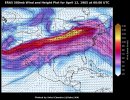
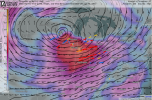
The pressure gradient between this southeastern ridge and the Jet stream which was constructively interfering with the subtropical jet, plus the elongated geometry of the tough, resulted in one of the strongest OWS jet streaks on record.
1786241737800.jpeg
The leading short wave trough, predictably bombed out with a central surface pressure in the 980mb range, this combined with the 130+knot jet streak over head, resulted in a expansive LLJ of 50+knots over the entire north end of the OWS.
Thanks to this trough unique orientation, the LLJ, (which usually is always way out ahead of the dry line/cold front and highest instability, was largely behind the front and right in the area of highest instability.
1786242525414.png
 
What I’m about to say may be a hot take, but I’m going to get it out there.

When 4/3/74 originally happened, Fujita mentioned off hand it was a 1 in 500 year outbreak. While at the time it seemed like it, you can also draw parallels to the enigma, 1932 deep south outbreak, and of course 4/27/11 as historical comparisons. Yes, the geographies impacted may slightly vary and overlap, but 4 all have similarities.

Palm Sunday 1965 is a complete aberration historically speaking. Yes, you had a previous Palm Sunday impact similar areas in 1920, but not in the order of magnitude that occurred in 1965. An outbreak of half the magnitude in that region hasn’t been since. Even amongst our, albeit spotty, tornado record, nothing in that region prior to 1965 seems to even come close to paralleling it.

Even with that area of the country being very active through the 1960s, that day was just incredible. The collective violence of tornados on that day, in my mind even, surpasses 4/3/74 in some aspects. Almost every single tornado, even the very underrated Wisconsin storms, were very powerful. While most super outbreaks all feature a very noticeable north-eastward pattern to their tracks, all the storms on that day moved due east. The only real analog that comes to my mind is the June 2nd 1990. And it still isn’t even close to Palm Sunday. The storms on June 2nd 1990 featured similar movement patterns, and impacted Indiana and Illinois. However, it still doesn’t hold a candle to Palm Sunday. I truly think it, and not 4/3/74, is the 1 in 500 year outbreak.

Edit: Also, had the trough geometry on 4/27/11 been slightly different and in turn able to advect an EML over the rest of Tennessee, Kentucky, and southern Ohio and Indiana, you would’ve had a violent tornado environment with similar aerial extent as 4/3/74. Just again showing how quirky Palm Sunday 1965 is.
As we get a larger sample size to work with, I think this is very likely the case. Palm Sunday 1965 is absolutely a super outbreak by virtually every metric. It’s essentially April 27, 2011, but for the Midwest. It may be more common than a once in a 500 year event, but it’s probably closer to a once in a century event for the region.

Also, as crazy as April 27, 2011 was, we have historical outbreaks in the region that seem to suggest that something like it has happened in that area at least once every 30-40 years. It very likely still stands above those previous historical events, but it’s hard to say that with complete certainty.

Each of these three events have unique aspects that make them arguably the most impressive outbreak we’ve ever seen.

Along the lines of your point about 1965, other outbreaks that I think we would consider to be “super” or “generational” for the region affected are May 31, 1985 (you could argue that might be an even higher likelihood of a once in a 500 year event IMO) and March 28, 1984 Carolinas outbreak.
 
related to what we are all talking about for the Mets in here: which of these events would you consider to have been the “most optimal” environment ever for violent tornadoes? I would be curious if there are ways to simulate outcomes for events like this to see how many play out just like this or what elements could come into play to either reduce or, heaven forbid, even enhanced the threat further.

Just from my reading in the past, it’s felt like April 27, 2011 has become seen as the gold standard.
 
related to what we are all talking about for the Mets in here: which of these events would you consider to have been the “most optimal” environment ever for violent tornadoes? I would be curious if there are ways to simulate outcomes for events like this to see how many play out just like this or what elements could come into play to either reduce or, heaven forbid, even enhanced the threat further.

Just from my reading in the past, it’s felt like April 27, 2011 has become seen as the gold standard.
Not a met, but I’ll answer anyways.
At the end of the day, tornadoes care about shear above anything else.
All super outbreaks have the same general kinematics, (high shear/low to moderate cape), completed with a stout mid level inversion layer.
The requirement of high vertical instability (LLLR of 7+c/km and 1000+j/kg cape) ceases to matter once you have a LLJ velocity exceeding 45knots coinciding with environment SRH values of 400+. As long as you have it (warm air under cold air) LLLR can be under 5c/km and cape being sub 1000j/kg, it doesn’t matter.
Obviously though, you need a strong forcing mechanism superimposed over a diffuse enough front with a stout mid level inversion layer to get the ideal storm mode to take advantage of these kinematics.
It’s extremely difficult to get a trough orientation that would get you a jet streak maximum over the OWS (which is what’s mainly responsible for having a strong LLJ) plus having all of the aforementioned elements come into play.
The vast majority “potential super outbreak” days, like March 15th, 2025 for example, have most of these kinematics in place, but it either ends up being a problem with the inversion layer, and the forcing mechanism; usually resulting in messy storm modes.
March 14th, 2025, really just needed a more expansive OWS and we easily would’ve had a super outbreak on our hands that night. It’s important to keep in mind that the Palm Sunday outbreak really didn’t have expansive storm coverage.
Unlike the 1974 or 2011 super outbreaks, that had confluence banding all throughout their much more expansive OWS which storms initiated on, Palm Sundays storms were limited to right along the dryline.
However, unlike the Pi day outbreak, Palm Sunday had a OWS that expanded out eastward far ahead of the storms; which gave them ample space to continuously cycle tornado after tornado, a luxury the Pi day outbreak didn’t have fortunately.
 
Back
Top