

I know there are other candidates, but I can’t think of a single instance of damage I would like to see calculated “Enderlin style” more than this one. Please let us know if you send this out to someone who is able to approach it with that kind of methodology.Because of Enderlin, I think I’m realizing just how many tornadoes hit very large tanks/train cars, with those points of damage either not being rated or just ignored overall. In this case Marshall luckily confirmed their existence, so I was able to find them on Earth pretty easily. In his survey of the event he never gives them an EF rating, just mentioning that they were displaced.
Navigation
Install the app
How to install the app on iOS
Follow along with the video below to see how to install our site as a web app on your home screen.
Note: This feature may not be available in some browsers.
More options
-
Welcome to TalkWeather! We see you lurking around TalkWeather! Take the extra step and join us today to view attachments, see less ads and maybe even join the discussion. CLICK TO JOIN TALKWEATHER
You are using an out of date browser. It may not display this or other websites correctly.
You should upgrade or use an alternative browser.
You should upgrade or use an alternative browser.
Significant Tornado Events
- Thread starter locomusic01
- Start date

Eoline
Member
I’m going to try to reach out to Ethan Moriarty (who did the initial Enderlin train car calculations prior to the upgrade) and probably a few others who understand how to calculate windspeeds in this fashion.I know there are other candidates, but I can’t think of a single instance of damage I would like to see calculated “Enderlin style” more than this one. Please let us know if you send this out to someone who is able to approach it with that kind of methodology.
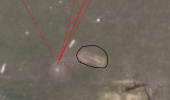
I’ll also note that there is a noticeable dip of some kind in one of the spots where the tanks originally came from; that may indicate they were anchored into the ground or at least embedded to a degree.
Last edited:

joshoctober16
Member
interesting new info.
the so call start point of the pampa tornado that we all tougth ... is likely the middle or the 2 out of 3 point of its life.
the pampa tornado was on the ground for a much much longer time , i am unsure when it first touched down , however this video i found shows it was a multi vortex way out of the town of pampa.
the so call start point of the pampa tornado that we all tougth ... is likely the middle or the 2 out of 3 point of its life.
the pampa tornado was on the ground for a much much longer time , i am unsure when it first touched down , however this video i found shows it was a multi vortex way out of the town of pampa.

CheeselandSkies
Member
I know I brought up 5/3/99 recently as a point of reference for about as bad as Southern/Central Plains outbreaks can get (at least, in documented history).
Long-time chaser Blake Naftel continues to drop an absolute gold mine of content for tornado history buffs on both his personal and "Ancient Air Theatre" YouTube channels. This is an interview with retired SPC meteorologist Roger Edwards, and current Operations Chief Rich Thompson, who chased together that day.
Remarkably, their web page about that chase is still online. I probably first read it as a teenager well over 20 years ago.
Long-time chaser Blake Naftel continues to drop an absolute gold mine of content for tornado history buffs on both his personal and "Ancient Air Theatre" YouTube channels. This is an interview with retired SPC meteorologist Roger Edwards, and current Operations Chief Rich Thompson, who chased together that day.
Remarkably, their web page about that chase is still online. I probably first read it as a teenager well over 20 years ago.

Kds86z
Member
I know I brought up 5/3/99 recently as a point of reference for about as bad as Southern/Central Plains outbreaks can get (at least, in documented history).
Long-time chaser Blake Naftel continues to drop an absolute gold mine of content for tornado history buffs on both his personal and "Ancient Air Theatre" YouTube channels. This is an interview with retired SPC meteorologist Roger Edwards, and current Operations Chief Rich Thompson, who chased together that day.
Remarkably, their web page about that chase is still online. I probably first read it as a teenager well over 20 years ago.
Thank you for sharing. Two absolute legends. Going to give that a watch.
Maybe it’s because I watched the storm
Stories 5/3/99 episode over and over as a kid, but May 3rd is one of those days (like 4/27/11) where you see a video of one of the storms and you can tell right away which outbreak it was from. Just has that distinct aesthetic to it.

WeathermanLeprechaun
Member
I know I brought up 5/3/99 recently as a point of reference for about as bad as Southern/Central Plains outbreaks can get (at least, in documented history).
Long-time chaser Blake Naftel continues to drop an absolute gold mine of content for tornado history buffs on both his personal and "Ancient Air Theatre" YouTube channels. This is an interview with retired SPC meteorologist Roger Edwards, and current Operations Chief Rich Thompson, who chased together that day.
Remarkably, their web page about that chase is still online. I probably first read it as a teenager well over 20 years ago.
Blake Naftel is a top notch guy for archiving all the classic big spring/summer days throughout the 80s-2000s as chasing grew particularly popular. The videos are always great and rather obscure views of otherwise known tornadoes.
Eoline
Member
I know I've been talking about these too much, but whatever, I think it's interesting.I’m going to try to reach out to Ethan Moriarty (who did the initial Enderlin train car calculations prior to the upgrade) and probably a few others who understand how to calculate windspeeds in this fashion.
I’ll also note that there is a noticeable dip of some kind in one of the spots where the tanks originally came from; that may indicate they were anchored into the ground or at least embedded to a degree.
I've been able to find a few drag marks and potential impact marks, but none are high-definition to the point where it's possible to concretely denote them.
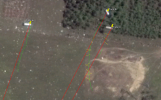
Of all the tanks that I think were most likely to have been sustained in the air, it has to be "A" (the one that was found 0.7 miles away in downtown Vilonia). Depending on either the potential drag mark I found or the path I outlined it would've either gone above a large grove of trees (I can't find any tank-shaped splits in the forest) or a line of trees (I can't find any trees that were displaced northward, which would indicate an impact with the tank). Tank A based off what I've found appears to have been dislodged, dragged northeast about ~143 feet, and then set aloft before potentially being dragged as it rocketed towards the shopping center where it rested behind. I'll look more tomorrow to rule out the possibility it hit one of the homes on Cemetery Street.
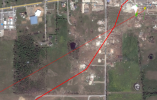
Again, sorry for posting about this so much, I'm just nerding out as I've finally found something tank-related that hasn't been talked about a million times.
Last edited:
SweptSlab5
Member
Im extremely late, (Medical stuff + Homework and life) but would Tuscaloosa be a candidate for this? It ripped apart a train bridge and carried train cars and bridge trestles very far.I know there are other candidates, but I can’t think of a single instance of damage I would like to see calculated “Enderlin style” more than this one. Please let us know if you send this out to someone who is able to approach it with that kind of methodology.
Kds86z
Member
An academic study and calculation was done for that bridge many years ago actually. Conclusion was that winds of around 220 MPH impacted the bridge. If the math that was used was legitimate, Tuscaloosa needs to be upgraded to EF5, and should have been a long time ago.Im extremely late, (Medical stuff + Homework and life) but would Tuscaloosa be a candidate for this? It ripped apart a train bridge and carried train cars and bridge trestles very far.
Last edited:
Keep us updated! This is exciting stuff. Really hoping there’s enough information to allow for someone like Ethan to get some solid calculations.I know I've been talking about these too much, but whatever, I think it's interesting.
I've been able to find a few drag marks and potential impact marks, but none are high-definition to the point where it's possible to concretely denote them.
View attachment 49700
Of all the tanks that I think were most likely to have been sustained in the air, it has to be "A" (the one that was found 0.7 miles away in downtown Vilonia). Depending on either the potential drag mark I found or the path I outlined it would've either gone above a large grove of trees (I can't find any tank-shaped splits in the forest) or a line of trees (I can't find any trees that were displaced northward, which would indicate an impact with the tank). Tank A based off what I've found appears to have been dislodged, dragged northeast about ~143 feet, and then set aloft before potentially being dragged as it rocketed towards the shopping center where it rested behind. I'll look more tomorrow to rule out the possibility it hit one of the homes on Cemetery Street.
View attachment 49701
Again, sorry for posting about this so much, I'm just nerding out as I've finally found something tank-related that hasn't been talked about a million times.
Eoline
Member
Nothing yet but I do have Marshall's email so I might ask him about it (his study has a few paragraphs on the tank, which is where I initially found out about them). Usually I try to avoid emailing the damage-related experts (people who are well-known in the community and have years/decades of experience) as I feel like I'm jumping the gun, but I think this is a reasonable exception.Keep us updated! This is exciting stuff. Really hoping there’s enough information to allow for someone like Ethan to get some solid calculations.
You actually have something legit here. I’d go for it.Nothing yet but I do have Marshall's email so I might ask him about it (his study has a few paragraphs on the tank, which is where I initially found out about them). Usually I try to avoid emailing the damage-related experts (people who are well-known in the community and have years/decades of experience) as I feel like I'm jumping the gun, but I think this is a reasonable exception.
Kds86z
Member
I hope they upgrade.An academic study and calculation was done for that bridge many years ago actually. Conclusion was that winds of around 220 MPH impacted the bridge. If the math that was used was legitimate, Tuscaloosa needs to be upgraded to EF5, and should have been a long time ago.
Eoline
Member
What I'm hoping the calculations come back with is non-idealized winds in the EF5 range (ie, including the fact it rolled for 130-or-so feet and that there were 3-4 points where it possibly hit the ground, including once near the row of swept homes on Cemetery Street). This would override the ambiguity of the 190 homes and basically verify that the tornado was indeed of EF5 intensity. Moriarty's calculations are usually instantaneous and idealized (nothing wrong with that; Moriarty does great work). Marshall might be different. Still waiting to hear back from Moriarty, and I'll email Marshall shortly.You actually have something legit here. I’d go for it.
Vilonia is one of the strongest EF4s we've ever seen, and any evidence pointing to it's true intensity would be amazing.
Last edited:

Christopher Robert
Member

TH2002
Member
- Messages
- 4,986
- Reaction score
- 11,169
- Location
- California, United States
- Special Affiliations
- SKYWARN® Volunteer
Some alternate angles of EF4 and EF5 damage in Joplin.
Homes northeast of St. John's, some leveled, others swept clean:
Commercial buildings northwest of the hospital, with damage in this area rated EF4/EF5. This was also among the first EF5-rated damage the tornado produced:


Scouring (behind the car):
Photos of these homes have been posted in this thread before, but here are some close-ups of the second home to be slabbed south of Parr Hill Park (this one was actually more swept than the first one). This is among the most 'textbook' EF5 damage the tornado produced:
Homes northeast of St. John's, some leveled, others swept clean:
Commercial buildings northwest of the hospital, with damage in this area rated EF4/EF5. This was also among the first EF5-rated damage the tornado produced:
Scouring (behind the car):
Photos of these homes have been posted in this thread before, but here are some close-ups of the second home to be slabbed south of Parr Hill Park (this one was actually more swept than the first one). This is among the most 'textbook' EF5 damage the tornado produced:
WeathermanLeprechaun
Member
I know this is slightly old, but i just made a post 30 minutes ago regarding your evidence on r/tornado to see so far what they would think about it. So far, it's went as it usually does on any post with actual effort. "if it was, it would've been rated as such" was one particular comment. After o copy and pasted this post word for word, making sure i didn't misattribute anything and mix up your words lol. We will see. It's 50/50 positive feedback. Hopefully, someone looks to it with a open mind and actually leaves a decent comment. This is a incredible deep dive by the way and it's why i posted it if you didn't mind! This is compelling evidenceA few things to note here, Tim Marshal actually did not give this an official rating, you may be referring to the 170 mph statement in his damage report. This was not supposed to be referring to the church, rather for a future di. (Which the dod and damage windspeed for all walls collapsed has changed). As far as how I would rate it, I did a deep analysis into its construction using information from Tim Marshal and structural details: here is a copy of what I wrote roughly.
The Presbyterian Church in Mayfield consisted of three buildings, one being a metal building system on the west side. The original sanctuary structure was on the southern side and north of that was a 2 story masonry bearing building housing offices and classrooms. The EF5 damage happened to the original sanctuary. The sanctuary itself was built some time between 1916-1920. It was a 1 and 2 story brick structure with a basement beneath. The building was in very good condition especially compared to the older downtown buildings, the bricks were properly fired and very hard, and the cement mortar was also in good condition bonding the courses of masonry together. The walls were four wythes thick (16 inches), of classic unreinforced traditional masonry, the outer wythe was a typical running common bond that was bonded to the backing wythes forming a strong collar joint. Six large buttresses on either side of the east and west load bearing walls provided significant lateral reinforcement and stiffness. The basement level was divided from the superstructure of the building by a large concrete bond beam, windows were arched. The roof structure was a steel a-frame design of steel roof trusses that were bolted into anchor plates embedded within the mortar joints of the masonry walls. The bonding generally was good. Though obviously an english bond is strongest the four wythes of the walls are extremely heavy and resistant to the windforces with the buttresses and roof trusses. Also of note is that wall top plates were well anchored into masonry mortar joints with long anchor bolts, and joists were also well anchored which is not something u often see in older construction which is neat. The church sanctuary suffered complete destruction down to the concrete bond beam, on the CEF scale for C-HC, this would warrant EF5, on the IF scale, this would be Sturdiness E-F, for total destruction also IF5, on the revision for CARB, this would also be EF5. Not only does this 100% deserve EF5, it is a much higher damage indicator than most of the actual EF5s.
The corrosion of the baseplates is for the MBS which would be rated as a separate building.
I’m sure you’ve realized by now it’s like carrying water in a basket. R/Tornado (and all of reddit for that matter) is an absolute dumpster fire for any kind of discussion involving the tiniest bit of nuance. Just a complete cesspool. In between people taking photos of just average clouds and asking if it’s a funnel cloud and kids attempting to masquerade as “engineers”, it’s just a complete void of any kind of critical thinking or analysis.I know this is slightly old, but i just made a post 30 minutes ago regarding your evidence on r/tornado to see so far what they would think about it. So far, it's went as it usually does on any post with actual effort. "if it was, it would've been rated as such" was one particular comment. After o copy and pasted this post word for word, making sure i didn't misattribute anything and mix up your words lol. We will see. It's 50/50 positive feedback. Hopefully, someone looks to it with an open mind and actually leaves a decent comment. This is an incredible deep dive by the way and it's why i posted it if you didn't mind! This is compelling evidence