Is there a photo of the tornado on the live cameras? Might be able to use them for something.
Tornado coverage of interest starts around 35 minutes
Follow along with the video below to see how to install our site as a web app on your home screen.
Note: This feature may not be available in some browsers.
Is there a photo of the tornado on the live cameras? Might be able to use them for something.

yes i know that , seems like dodge city 2016 is a example of a cycloidal scouring made by non suction vortices , however some are made by suction vortices , like el reno 2013 , Smithville 2011."If it's not public it doesn't count". I don't have Discord for multiple reasons. You could do worse than to copy the information either here or into a PM.
Furthermore, he would have to engage with the very small but very important literature about how the marks are created.
Ground deposition markings don't require suction vortices.
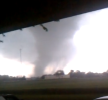
el reno 2013 had one big cycloidal mark, it wasn't a full one , but it was there.yes, an academic peer reviewed paper. he doesn't have much of a background, so i understand the skepticism, but all the results ive seen seem to align perfectly with the EF scale (his 3 sec wind gust estimates always match nearby EF scale damage).
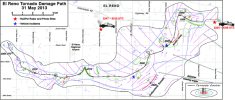
His work also aligns with mobile radar. While El Reno didn't have any calculable cycloidals, it did have ground markings that resemble the beginning of a cycloidal. I believe he worked backwards with the translation speed and tangential velocity on mobile radar to create what a cycloidal would have looked like if el reno produced one. this hypothetical cycloidal nearly perfectly aligned with the ground marking. (see below)
View attachment 46655View attachment 46656
anyway, im not trying to flood this entire thread with cycloid stuff, so ill stop after this msg lol
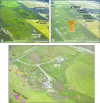
I’m familiar with Smithville’s ground scouring but I would like to see a photo of these cycloidal marks. I was not aware they existed.he found Robinson had 241mph tangential velocities, where as Smithville had 196 - 238 i believe (median of 217, although this was a little before Smithville's peak in intensity).
I’m familiar with Smithville’s ground scouring but I would like to see a photo of these cycloidal marks. I was not aware they existed.
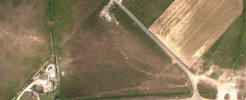
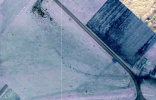
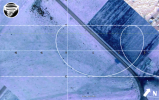
Which @joshoctober16 seems to have disproven earlier in this thread, showing blowdown across the alleged gap:Image credit to Saltical of course. he also discovered that Smithville was actually 2 tornadoes.
View attachment 45545
in this spot there is some trees down.
I believe there was also blowdown between New Wren and Smithville, which were definitely seperate tornadoes. blowdown isn't always tornadic. There is lots of proof that Smithville was 2 tornadoes.Which @joshoctober16 seems to have disproven earlier in this thread, showing blowdown across the alleged gap

I wrote Robinson’s Wikipedia article and in my research I can 100% say it was not stronger than Smithville. Incredibly strong? Yes. Smithville strong? Absolutely not. As for Smithville, I personally believe they were one tornado but it’s debatable.I'm going to need to see a lot more hard evidence before I believe that a) Robinson was a stronger tornado than Smithville and b) that a 0.41 mile "gap" in damage is representative of two distinct tornadoes with a storm moving 65+ mph.
im very 50/50 on smithville being 2 tornadoes.Which @joshoctober16 seems to have disproven earlier in this thread, showing blowdown across the alleged gap:
This anonymous unqualified person sounds like a strong enthusiast but one who seeks evidence to fit his ideas, rather than letting it shape his ideas. I certainly don't see anything that indicates he's read that thesis I linked.
If you're not going to post any of the fundamental basis - like formulae and mechanisms - as to how he's coming to these conclusions, then I'm not going to give them much credence.
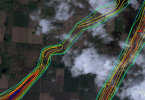
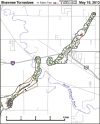
i think your talking about the wrong part of its life , there is a other loop / possible cycle AFTER it hit Smithville.I believe there was also blowdown between New Wren and Smithville, which were definitely seperate tornadoes. blowdown isn't always tornadic. There is lots of proof that Smithville was 2 tornadoes.
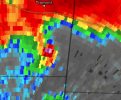
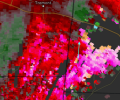
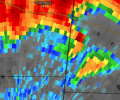
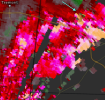
"Using radar data I can confirm the time and location of the couplet at multiple points throughout the life cycle of the supercell. And using this data I can determine the forward speeds of the tornadoes between those radar scans. By using this info, I noticed an anomaly in the forward speeds The forward speed of the supposed single Smithville tornado averaged 50-70 mph throughout scans, except for at one location There is a 0.41mi gap in the damage path present before the stateline. The couplet travelled >2000m in 40s, in order to do so the Smithville tornado would've had to move at speeds up to 139 mph to cover that ground in the given time. The only logical solution is that a handoff occured with the new circulation developing further east out in front of the old circulation which is now dissipating at this point"
also, i believe the area of the cycle has a very strange deviation, almost like a Z. this type of movement would be very unlikely from a fast moving tornado like Smithville.
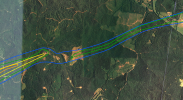
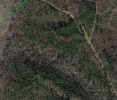
i could see multiple reasons for Robinson to have a higher cycloidal rating.I wrote Robinson’s Wikipedia article and in my research I can 100% say it was not stronger than Smithville. Incredibly strong? Yes. Smithville strong? Absolutely not. As for Smithville, I personally believe they were one tornado but it’s debatable.
i think you missed the part about it needed to have sped up to ~139mph in order for it to be one tornadoRe: the two tornadoes thing, a 0.41 mile damage "gap" with an odd pattern could easily just mean separate multiple vortices within the same tornadic circulation, especially one that is fast moving.
I take it that you've looked at the Smithville radar data yourself, and you're not just repeating what someone else has written? And that you're accounting for the degraded quality of the velocity data from Columbus at the time in question, and that the position of the debris ball is not consistent with this supposed occurance?i think you missed the part about it needed to have sped up to ~139mph in order for it to be one tornado

You do realize that multiple vortices can translate very quickly around the boundaries of the parent circulation? It's one of the reasons they are very destructive. Consider a tornado moving 70 mph, that sub-vortex could also move 70 mph around the circulation and, for when the two velocities are aligned directionally, achieves a combined, ground relative speed of 140 mph.i think you missed the part about it needed to have sped up to ~139mph in order for it to be one tornado
He's referring to the claim of the pseudonymous Discord researcher that the couplet itself jumped forward as the tornado crossed the state line, and that it needed to travel 139 mph between locations to do so.You do realize that multiple vortices can translate very quickly around the boundaries of the parent circulation? It's one of the reasons they are very destructive. Consider a tornado moving 70 mph, that sub-vortex could also move 70 mph around the circulation and, for when the two velocities are aligned directionally, achieves a combined, ground relative speed of 140 mph.
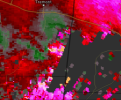
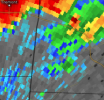
I guess i can put this here.