Sanborn insurance maps. They contain historic plans of buildings and are very helpful in tornado damage and analysis, for example tri-state.Ge
Where did you find the plan for the building at? Very interesting stuff and awesome work altogether, you make a solid argument. I always have been impressed by that particular DI, but didn’t really consider it for an EF5 candidate until now.
Navigation
Install the app
How to install the app on iOS
Follow along with the video below to see how to install our site as a web app on your home screen.
Note: This feature may not be available in some browsers.
More options
-
Welcome to TalkWeather! We see you lurking around TalkWeather! Take the extra step and join us today to view attachments, see less ads and maybe even join the discussion. CLICK TO JOIN TALKWEATHER
You are using an out of date browser. It may not display this or other websites correctly.
You should upgrade or use an alternative browser.
You should upgrade or use an alternative browser.
Significant Tornado Events
- Thread starter locomusic01
- Start date

TH2002
Member
- Messages
- 4,986
- Reaction score
- 11,169
- Location
- California, United States
- Special Affiliations
- SKYWARN® Volunteer
I've wondered about the church in downtown Mayfield for years, but ok, you've fully convinced me. So I'm just gonna say it...A few things to note here, Tim Marshal actually did not give this an official rating, you may be referring to the 170 mph statement in his damage report. This was not supposed to be referring to the church, rather for a future di. (Which the dod and damage windspeed for all walls collapsed has changed). As far as how I would rate it, I did a deep analysis into its construction using information from Tim Marshal and structural details: here is a copy of what I wrote roughly.
The Presbyterian Church in Mayfield consisted of three buildings, one being a metal building system on the west side. The original sanctuary structure was on the southern side and north of that was a 2 story masonry bearing building housing offices and classrooms. The EF5 damage happened to the original sanctuary. The sanctuary itself was built some time between 1916-1920. It was a 1 and 2 story brick structure with a basement beneath. The building was in very good condition especially compared to the older downtown buildings, the bricks were properly fired and very hard, and the cement mortar was also in good condition bonding the courses of masonry together. The walls were four wythes thick (16 inches), of classic unreinforced traditional masonry, the outer wythe was a typical running common bond that was bonded to the backing wythes forming a strong collar joint. Six large buttresses on either side of the east and west load bearing walls provided significant lateral reinforcement and stiffness. The basement level was divided from the superstructure of the building by a large concrete bond beam, windows were arched. The roof structure was a steel a-frame design of steel roof trusses that were bolted into anchor plates embedded within the mortar joints of the masonry walls. The bonding generally was good. Though obviously an english bond is strongest the four wythes of the walls are extremely heavy and resistant to the windforces with the buttresses and roof trusses. Also of note is that wall top plates were well anchored into masonry mortar joints with long anchor bolts, and joists were also well anchored which is not something u often see in older construction which is neat. The church sanctuary suffered complete destruction down to the concrete bond beam, on the CEF scale for C-HC, this would warrant EF5, on the IF scale, this would be Sturdiness E-F, for total destruction also IF5, on the revision for CARB, this would also be EF5. Not only does this 100% deserve EF5, it is a much higher damage indicator than most of the actual EF5s.
The corrosion of the baseplates is for the MBS which would be rated as a separate building.
Mayfield was an EF5.
I honestly wonder if the movement of concrete floor slabs from the Bremen home (one of which reportedly traveled "a few hundred yards") could also be considered EF5 evidence as well.
@HAwkmoon already explained above, but I'm gonna add more anyway...Can you provide an aerial of the Church pre-tornado? I'm not sure if the situation is that all three sections are separate buildings or if the situation is that they're all sections of the same building. EF5 candidacy hinges on that IMO.
They were all technically separate buildings. While the main sanctuary and Christian Education Center (two story masonry office building) were very interconnected and could arguably be considered one structure, they would still likely go on the DAT with separate DI's had the survey been done properly.
The Ministries Center (metal building system) was not connected to the main sanctuary, only to the office building via a small passageway.
For reference:
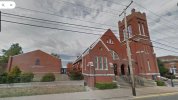
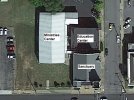
See above.Hmmm...
@TH2002, @buckeye05, what do we think of this here? Three separate structures constructed individually and then connected after the fact, one of which if taken on its own would quite possibly be a home run EF5 DI.

Not sure if you saw my analysis of the railroad trestle that was ripped loose and tossed, but it might be even more impressive than the train cars.Interesting to read all this stuff given how Enderlin was rated EF5 solely for the train car damage; based on that logic Tuscaloosa should've been rated EF5 based on this damage alone.
There might be enough info here to make a calculation on the Tuscaloosa Railroad Bridge. Either way, I found some really detailed pics of it.
The bridge was 564 feet long and rose 120 feet above the streambed.
The one that needs looked as weighed 34 tons and was rotated and thrown approximately 100 feet straight up hill. I believe it's the shortest one on the far right.
Here's the before and after
View attachment 46985
View attachment 46986
Here's as many angles as I can get of it.
View attachment 46987
View attachment 46988
View attachment 46989
View attachment 46990
View attachment 46991
View attachment 46994
Based on these photos it looks like the trestle was probably 40 feet tall. Assuming the 4 outer steel columns are a foot wide that'd make the starting surface area about 640 square feet. Not sure how to calculate all the inner beams and cross sections. Probably can just do a rough estimate and doesn't have to be too precise. I wonder what forces were required to loft it that far without even considering the concrete pilings it was anchored to.
Another interesting tidbit about this area:
"More than 600 feet of steel track was lost, much of which was left warped and trailing into the forest. Kevin Laws, the Science and Operations Officer at the NWS in Birmingham, stated in episode 797 of the Weather Brains podcast that 'I've never seen railroad tracks that were bent into big U-shapes. They were actually touching end to end ... the train ties, the wood pieces that go under the track ... they were being dug up out of the ground and slung fifteen miles away, that's just incredible.' "
View attachment 46992
View attachment 46993

speedbump305
Member
I think it’s very likely the 190 MPH home in Bremen could be considered an EF5 candidate now. Even though it had very odd construction, the movement of the concrete floor slabs and being carried a few hundred yards is very impressive and the surrounding area had all the contextual evidence pointing to EF5. Scouring, rowing, granulation, debarking/root balling and vehicle thrown/severely mangled.I've wondered about the church in downtown Mayfield for years, but ok, you've fully convinced me. So I'm just gonna say it...
Mayfield was an EF5.
I honestly wonder if the movement of concrete floor slabs from the Bremen home (one of which reportedly traveled "a few hundred yards") could also be considered EF5 evidence as well.
@HAwkmoon already explained above, but I'm gonna add more anyway...
They were all technically separate buildings. While the main sanctuary and Christian Education Center (two story masonry office building) were very interconnected and could arguably be considered one structure, they would still likely go on the DAT with separate DI's had the survey been done properly.
The Ministries Center (metal building system) was not connected to the main sanctuary, only to the office building via a small passageway.
For reference:
View attachment 49443
View attachment 49447
See above.
I honestly wonder if the movement of concrete floor slabs from the Bremen home (one of which reportedly traveled "a few hundred yards") could also be considered EF5 evidence as well.
Most people argue the gravel base beneath the slab disqualifies it because it was easier for wind to get underneath and displace it, but this ignores the fact the slab was poured into a filled, reinforced CMU perimeter. I think the only way it could've been lifted the way it was is if it was still attached to the house and everything was lofted at once. This theory is supported by the fact the CMU perimeter is still attached in many places to the slab. If the house wasn't securely attached to the slab, I believe the slab would've been left behind. It's less a question of what winds were required to topple the home, and more what winds were required to loft it as one large compact object.
The home being lofted whole with the slab still attached is the most extreme possible DI. It's more impressive than if it left behind a bare slab with sill plates and anchor bolts. I'm 100% convinced if the house was built on rebar reinforced stem walls, those would've been broken. A typical slab with anchor bolts would've been scoured like homes from BCM or Smithville. However, when it comes to surveying tornadoes the default is and will always be "different construction=worse construction", so this house will never get a fair analysis.
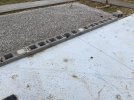
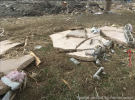
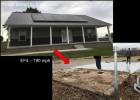
speedbump305
Member
I’ve always found the amount of scoured vegetation on the slab and around the home to be very impressive. Very evident that EF5 winds occurred here.Most people argue the gravel base beneath the slab disqualifies it because it was easier for wind to get underneath and displace it, but this ignores the fact the slab was poured into a filled, reinforced CMU perimeter. I think the only way it could've been lifted the way it was is if it was still attached to the house and everything was lofted at once. This theory is supported by the fact the CMU perimeter is still attached in many places to the slab. If the house wasn't securely attached to the slab, I believe the slab would've been left behind. It's less a question of what winds were required to topple the home, and more what winds were required to loft it as one large compact object.
The home being lofted whole with the slab still attached is the most extreme possible DI. It's more impressive than if it left behind a bare slab with sill plates and anchor bolts. I'm 100% convinced if the house was built on rebar reinforced stem walls, those would've been broken. A typical slab with anchor bolts would've been scoured like homes from BCM or Smithville. However, when it comes to surveying tornadoes the default is and will always be "different construction=worse construction", so this house will never get a fair analysis.
View attachment 49448
View attachment 49450
View attachment 49451
TH2002
Member
- Messages
- 4,986
- Reaction score
- 11,169
- Location
- California, United States
- Special Affiliations
- SKYWARN® Volunteer
The Bremen home's construction wasn't that bad. In essence, it was a CMU foundation home, but with extra bells and whistles.Most people argue the gravel base beneath the slab disqualifies it because it was easier for wind to get underneath and displace it, but this ignores the fact the slab was poured into a filled, reinforced CMU perimeter. I think the only way it could've been lifted the way it was is if it was still attached to the house and everything was lofted at once. This theory is supported by the fact the CMU perimeter is still attached in many places to the slab. If the house wasn't securely attached to the slab, I believe the slab would've been left behind. It's less a question of what winds were required to topple the home, and more what winds were required to loft it as one large compact object.
The home being lofted whole with the slab still attached is the most extreme possible DI. It's more impressive than if it left behind a bare slab with sill plates and anchor bolts. I'm 100% convinced if the house was built on rebar reinforced stem walls, those would've been broken. A typical slab with anchor bolts would've been scoured like homes from BCM or Smithville. However, when it comes to surveying tornadoes the default is and will always be "different construction=worse construction", so this house will never get a fair analysis.
View attachment 49448
View attachment 49450
View attachment 49451
A typical block foundation home consists of a largely empty crawlspace (or basement) with a wooden subfloor resting on top. Sometimes the subfloors are anchored, but in many cases there is no anchoring and they're "attached" by gravity alone. Instead of having a typical empty crawlspace and wooden subfloor, the Bremen home had a gravel fill in the foundation with concrete floor slabs resting on the gravel.
Here's a photo of what you traditionally see:
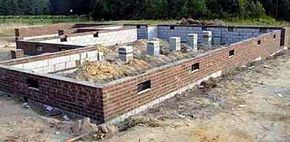
*the above photo is not a tornado damage photo, but it gets my point across. The crawlspace is mostly empty, and the subfloor is supported by both the foundation itself and the extra columns of concrete blocks in the middle. Homes with poured concrete foundations can have those columns for subfloor support as well, especially if they have crawlspaces instead of basements, but it's usually seen on homes with CMU foundations.
When these homes are hit by tornadoes, the failure point is usually the foundation itself (the home begins to slide, the downwind foundation wall collapses, and the rest is history). But in the case of the Bremen home, my questions are these: Was the gravel fill effective at keeping the foundation itself from being the main failure point? The foundation failed in some areas, sure, but was that more the result of the concrete floor slabs themselves and the anchored wood framing being torn out? That would really be what settles it for me.
And FWIW, Ethan Moriarty specifically used the Bremen home to call the Mayfield tornado a plausible EF5.
speedbump305
Member
That’s why i’m actually more leaning towards Mayfield having its rating changed. I will admit, I have very much disagreed with Ethan on a lot of his takes/opinions, but I can’t just ignore the fact that with the background in engineering he has, believes the home to be a potential EF5 candidate. I may be overhyping it a bit and I apologize if I am, but that has always lingered in the back of my mind.The Bremen home's construction wasn't that bad. In essence, it was a CMU foundation home, but with extra bells and whistles.
A typical block foundation home consists of a largely empty crawlspace (or basement) with a wooden subfloor resting on top. Sometimes the subfloors are anchored, but in many cases there is no anchoring and they're "attached" by gravity alone. Instead of having a typical empty crawlspace and wooden subfloor, the Bremen home had a gravel fill in the foundation with concrete floor slabs resting on the gravel.
Here's a photo of what you traditionally see:
*the above photo is not a tornado damage photo, but it gets my point across. The crawlspace is mostly empty, and the subfloor is supported by both the foundation itself and the extra columns of concrete blocks in the middle. Homes with poured concrete foundations can have those columns for subfloor support as well, especially if they have crawlspaces instead of basements, but it's usually seen on homes with CMU foundations.
When these homes are hit by tornadoes, the failure point is usually the foundation itself (the home begins to slide, the downwind foundation wall collapses, and the rest is history). But in the case of the Bremen home, my questions are these: Was the gravel fill effective at keeping the foundation itself from being the main failure point? The foundation failed in some areas, sure, but was that more the result of the concrete floor slabs themselves and the anchored wood framing being torn out? That would really be what settles it for me.
And FWIW, Ethan Moriarty specifically used the Bremen home to call the Mayfield tornado a plausible EF5.
Curious @TH2002 where that quote about there being engineers assessing the Holt railroad trestle came from? That would certainly strengthen the case for Tuscaloosa being a 5, if so. I firmly believe that the lofting of that trestle up the hill was EF5 damage, but it would be nice to see calculations for that.Interesting to read all this stuff given how Enderlin was rated EF5 solely for the train car damage; based on that logic Tuscaloosa should've been rated EF5 based on this damage alone.
Also, that deep dive on the First Presbyterian Church in Mayfield is great. The damage to that building was incredible to me and stood out like a sore thumb amongst all of the other destruction in downtown.
speedbump305
Member
The damage to the whole downtown area of Mayfield was truly remarkable. Several concrete/masonry buildings were heavily damaged or completely destroyed. It was definitely a tier above other tornadoes that have struck downtown’s such as Cullman, West Liberty, and Sulpher.Curious @TH2002 where that quote about there being engineers assessing the Holt railroad trestle came from? That would certainly strengthen the case for Tuscaloosa being a 5, if so. I firmly believe that the lofting of that trestle up the hill was EF5 damage, but it would be nice to see calculations for that.
Also, that deep dive on the First Presbyterian Church in Mayfield is great. The damage to that building was incredible to me and stood out like a sore thumb amongst all of the other destruction in downtown.
TH2002
Member
- Messages
- 4,986
- Reaction score
- 11,169
- Location
- California, United States
- Special Affiliations
- SKYWARN® Volunteer
It's from a research paper @locomusic01 posted a while back. The paper in question is here...Curious @TH2002 where that quote about there being engineers assessing the Holt railroad trestle came from? That would certainly strengthen the case for Tuscaloosa being a 5, if so. I firmly believe that the lofting of that trestle up the hill was EF5 damage, but it would be nice to see calculations for that.
Also, that deep dive on the First Presbyterian Church in Mayfield is great. The damage to that building was incredible to me and stood out like a sore thumb amongst all of the other destruction in downtown.
While it mostly focuses on treefall patterns, here's the bit in question:
Nevertheless, the best-fit vortex is shown with Rmax = 200 m (estimated from aerial photography), Vtan = 36 m s−1, Vr = 76 m s−1, and peak winds near 99 m s−1. The results suggest that the tornado was of EF5 intensity during this stage of its life, despite the EF4 rating assigned by the NWS. The EF4 rating may be attributable to a lack of EF-scale damage indicators in this section of the track, as shown in Fig. 3c. Of interest is that the tornado destroyed a railroad bridge during this period, as noted in Fig. 3c, implying very high wind speeds, but this indicator could not be used in the NWS assessment (K. Laws, NWS Birmingham, 2012, personal communication). Again, strong radial near-surface winds were needed to produce the best-fit tree-fall pattern.
Specifically, 99 m/s translates to roughly 222 mph.
I did a little more digging. This was a case of the concrete slab being poured within the CMU walls. It was concrete poured on top of gravel with no space in between, and the CMU perimeter acting as the mold. The fused CMU in my second pic seems like evidence of that. I've gathered some more evidence as well.The Bremen home's construction wasn't that bad. In essence, it was a CMU foundation home, but with extra bells and whistles.
A typical block foundation home consists of a largely empty crawlspace (or basement) with a wooden subfloor resting on top. Sometimes the subfloors are anchored, but in many cases there is no anchoring and they're "attached" by gravity alone. Instead of having a typical empty crawlspace and wooden subfloor, the Bremen home had a gravel fill in the foundation with concrete floor slabs resting on the gravel.
Here's a photo of what you traditionally see:
*the above photo is not a tornado damage photo, but it gets my point across. The crawlspace is mostly empty, and the subfloor is supported by both the foundation itself and the extra columns of concrete blocks in the middle. Homes with poured concrete foundations can have those columns for subfloor support as well, especially if they have crawlspaces instead of basements, but it's usually seen on homes with CMU foundations.
When these homes are hit by tornadoes, the failure point is usually the foundation itself (the home begins to slide, the downwind foundation wall collapses, and the rest is history). But in the case of the Bremen home, my questions are these: Was the gravel fill effective at keeping the foundation itself from being the main failure point? The foundation failed in some areas, sure, but was that more the result of the concrete floor slabs themselves and the anchored wood framing being torn out? That would really be what settles it for me.
And FWIW, Ethan Moriarty specifically used the Bremen home to call the Mayfield tornado a plausible EF5.
Notice how it appears the gravel is level with the top of the first two layers of CMU in this pic. Based on the sidewalk position this picture is facing the front of the house where the porch was. The porch in the before picture of the house is only 3 CMU blocks high.
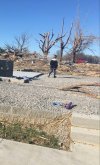
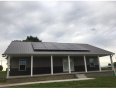
Here is a picture I found that the home owner shared from the construction of the house
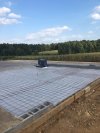
And another angle where you can see how the stairs are level with the gravel.
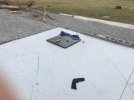
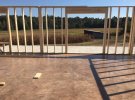
Here's a post with more pictures
Another interesting find is it does look like the home itself was wood frame construction rather than being fully built of reinforced CMU like I originally thought.

Lake Martin EF4
Member
Aight, with TH2002's statement....I think that, at last, we may have finally located the slam dunk EF5 DI from Mayfield we've spent the past 4+ years looking for.Mayfield was an EF5.
It's hard to believe the surveyors who have been doing this for 30+ years don't have access to the same info we do, and the knowledge to utilize it. Just because it took us "outsiders" 4 years to uncover doesn't mean it's unknown information. I just don't understand it. Why are clear cut EF5 DIs being so aggressively ignored? Sure, some of them aren't explicitly covered by the scale, but it's not like those DIs have been missing either.Aight, with TH2002's statement....I think that, at last, we may have finally located the slam dunk EF5 DI from Mayfield we've spent the past 4+ years looking for.
speedbump305
Member
I remember hearing the water tower was poorly anchored. I can dig up a picture that I remember having that showed the anchoring system.Wasn't there also the water tower, which was well built enough to earn an EF5 rating? Correct me if I'm wrong but I thought AmericanWX found that the damage done to it was worthy of an ef5 DI.
TH2002
Member
- Messages
- 4,986
- Reaction score
- 11,169
- Location
- California, United States
- Special Affiliations
- SKYWARN® Volunteer
I did a little more digging. This was a case of the concrete slab being poured within the CMU walls. It was concrete poured on top of gravel with no space in between, and the CMU perimeter acting as the mold. The fused CMU in my second pic seems like evidence of that. I've gathered some more evidence as well.
Notice how it appears the gravel is level with the top of the first two layers of CMU in this pic. Based on the sidewalk position this picture is facing the front of the house where the porch was. The porch in the before picture of the house is only 3 CMU blocks high.
View attachment 49454View attachment 49455
Here is a picture I found that the home owner shared from the construction of the house
View attachment 49453
And another angle where you can see how the stairs are level with the gravel.
View attachment 49456
Here's a post with more pictures
You're essentially correct. Like I said, it was pretty much a CMU foundation home, but with a gravel fill in the foundation perimeter instead of a crawlspace or basement. The concrete floor slabs were poured on top of the gravel, with the CMU perimeter serving as a 'mold' or 'template' of sorts.Another interesting find is it does look like the home itself was wood frame construction rather than being fully built of reinforced CMU like I originally thought.
View attachment 49458
I say concrete floor slabs because that's what they were - floor slabs. The wood framing would have been anchored to the concrete blocks, not the slabs.
Just gonna go on a whim and say I also don't buy the argument that the gravel fill allowed wind to get underneath and uplift the floor slabs. If there was no actual foundation and they were just sitting on a pile of loose gravel, then sure... but the CMU foundation perimeter would have likely prevented that.
Bottom line - I'm changing my stance on this home too. Is EF4 egregious? No. At the same time, is it an EF5 candidate? Yes.
speedbump305
Member
NWS Paducah’s new year’s resolution: Upgrade Mayfield to EF5 lol.You're essentially correct. Like I said, it was pretty much a CMU foundation home, but with a gravel fill in the foundation perimeter instead of a crawlspace or basement. The concrete floor slabs were poured on top of the gravel, with the CMU perimeter serving as a 'mold' or 'template' of sorts.
I say concrete floor slabs because that's what they were - floor slabs. The wood framing would have been anchored to the concrete blocks, not the slabs.
Just gonna go on a whim and say I also don't buy the argument that the gravel fill allowed wind to get underneath and uplift the floor slabs. If there was no actual foundation and they were just sitting on a pile of loose gravel, then sure... but the CMU foundation perimeter would have likely prevented that.
Bottom line - I'm changing my stance on this home too. Is EF4 egregious? No. At the same time, is it an EF5 candidate? Yes.
TH2002
Member
- Messages
- 4,986
- Reaction score
- 11,169
- Location
- California, United States
- Special Affiliations
- SKYWARN® Volunteer
They won't. If it did get upgraded to EF5, this would happen:NWS Paducah’s new year’s resolution: Upgrade Mayfield to EF5 lol.