TH2002
Member
- Messages
- 4,988
- Reaction score
- 11,179
- Location
- California, United States
- Special Affiliations
- SKYWARN® Volunteer
Let me start by saying I apologize for being so harsh towards you initially. I actually enjoyed reading your first couple posts on here, and hope you keep up the awesome contributions.Hi everyone,
I noticed some discussions were being brought up about some of my analysis on the Rochelle, IL EF4. I'd be glad to share more about my analysis of the event and why I believe from a structural standpoint, Rochelle does not fall into the EF5 criteria.
As ColdFront noted, it does seem to be a recurring event where people paraphrase my analysis without the detailed information that verifies my conclusions. I did also see some discussion on the Holly Springs tornado which I do not know much about, but I do have important observations to share with some of you regarding the structural flaws in the swept slab-on-grade home. I'll share my observations on those after I finish writing this message if you are interested (and if I'm not burnt out after writing this message for over an hour).
To begin, while I am most known for my cycloidal analysis formulas and methodology, my first major project was strictly focused on the Rochelle tornado. I ended up spending essentially a full year focused on an analysis of the lifespan of the tornado and damage path. A while ago I created this playlist containing many unseen videos of the tornado. I made a short synced video of the tornado's lifecycle around the Skare Park region here as well. Much of my research of the event was included in a video I helped produce with High Risk Chris here.
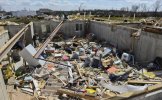
I won't be able to include all of the residences I surveyed as I spent an absurd amount of time documenting the entire event and I don't have time to share everything. I will focus on the residence at 10386 E Kuehl Court in Skare Park as it is typically the most discussed residence of the event and most commonly used to argue EF5 intensity.
Firstly, I understand the argument of not being able to confidently analyze a residence due to the lack of images. However, with this particular residence (as well as the swept residence next to it), I was able to find multiple other images of the residence and foundation. For the residence at 10386 E Kuehl Ct, I was able to find enough images of the residence to confidently remodel the foundation for a better analysis of the event. I spent multiple weeks analyzing and modeling the foundation of the home including any sill plates, anchor bolts, nuts, washers, siding, studs, and any other major observations of the foundation so I could confidently observe all angles of the foundation to best determine the structural integrity of the residence from a forensic analysis perspective.
View attachment 49280
With this to help in the forensic analysis of the residence, I was able to write a seven page paper of the residence observing five different failures occurring at the residence. I presented my work to Mechanical Engineer Ethan Moriarty who verified my observations and conclusions. I was able to identify these five major failures at this residence:
(1) Failure of walkout basement walls due to numerous windows leading to the collapse of the backside of the structure.
(2) Failure of wall to floor joist connections allowing the home to slide off the foundation.
(3) Failure of support beams inside the foundation that allowed for the floor joist to collapse inward into the basement.
(4) Failure of the concrete walkway due to brick veneer and wooden-framed walls failing and sliding the concrete to the southeast.
(5) Failure of reinforced concrete walls along the eastern side of the foundation potentially aided by high-speed projectiles.
In short, I observed many structural flaws within this residence that kept it from receiving an EF5 rating in my survey. If you would like to read my paper, I'd be glad to share it with all of you. I just have to edit and format it for clarity and readability purposes.
Now to speak on some specific parts of this residence I noticed some of you talking about as I was writing. I noticed many of you pointing out how the lack of nuts and washers on a bolt may represent the tornado's intensity rather than a lack of care in the design of the home. However, the reason these bolts did not have nuts or washers is because there was no reason for them to have any. Why? Due to poor planning and construction, these bolts were placed incorrectly and were not even on a sill plate.
View attachment 49281
Now regarding the moved walkway.
Using the 3D model, we can gather exact dimensions for the sidewalk rather than assuming some. This means our answer will more accurately resemble what actually happened. Note in the above image how the moved sidewalk is actually above the gravel sill plates rather than embedded into the dirt. Upon failure of the exterior walls and floor joist, these large chunks of the structure rammed directly into the sidewalk. This caused the sidewalk to be dragged across the gravel and ultimately push the concrete slabs to the south into the dirt.
But what if the wind was the sole force acting on the slab? Using exact geometries and the drag force equation, we can determine the wind velocity required to overcome the force due to friction acting on the slab. Since I calculated this a while back, I do not have the paper on me. If you'd like, I can go back and find it. This number I calculated was also verified by Ethan Moriarty. This calculation assumes the only force acting on the slab is a wind force acting on the exposed surface area to the left side of the sidewalk. This does not include the exposed surface area on top of the slab experiencing a force due to friction from the wind force. But what does this mean? This means the calculated result is not assuming every wind force. Thus, the resulting wind speed is going to be higher than the actual wind speed. The math states an instantaneous wind gust of 213 mph is required to overcome the force due to friction on this slab. However, due to the previously mentioned additional surface area on top of the slab experiencing a friction force from the wind; the actual required wind speed would be less than 213 mph. The failure of the floor joist, sub flooring, and exterior walls would all have impacted this slab in some way. With these two factors in mind, it can be confirmed that the wind speed required for this slab to have moved would not have required instantaneous wind gusts of 200 mph or higher. Does this mean winds over 200 mph didn't exist here? No. Did wind speeds over 200 mph occur <2in above a high friction surface? Also no. Therefore, this cannot be argued as an EF5 contextual indicator.
What about this home can be argued as EF5? Unknown to everyone online, including me for a while, this residence actually has a sheared concrete wall. Is this EF5? Well, there is not a EF scale DI for this so you may be able to argue this as an EF5 contextual indicator. However, there is an IF scale DI that applies to reinforced concrete walls. Analysis of this aspect is a bit of a gray area, so I will leave it up to you guys to determine your own opinions provided the information given.
The sheared reinforced concrete wall is 20 cm thick (8 in). The height of the wall on the side exposed to the wind is greater than 8 times its with (greater than 120 cm tall or 5.33 ft). The reinforced concrete wall is partially supported by soil on the side facing away from the wind an unknown amount. It is to be argued whether or not this wall falls under sturdiness class C or D, and if this wall falls under DoD1 or DoD2. Neither case results in an IF5 rating, the maximum rating this DI can be awarded according to the IF scale is IF4. Note: the IF scale estimates instantaneous wind gusts rather than the EF scale's 3s wind gusts.
View attachment 49283
If you have any questions, I'd be glad to answer them to clear any confusion up. Please note there is way more analysis I've done on Rochelle than I've shared. Due to time management purposes, I'll finish this post here and answer any questions about any other EF5 candidates from Rochelle. Also note, cycloid analysis suggests EF4 for the entirety of the path of the tornado. However, this is a whole other ordeal.
Thank you all,
Saltical
While I'm not sure how I feel about the claim that "winds of less than 213 mph were required to shift the concrete walkway", I actually agree that a snapped concrete stemwall is not automatically indicative of EF5 intensity. A very similar thing happened to a home swept away by the 2002 La Plata tornado, which imo was a mid-range F4, MAYBE high-end F4 at a stretch.
Same thing goes for the bending and/or snapping of anchor bolts... the Pembroke EF4, which was appropriately rated imo, bent anchor bolts at the residences it swept away.
My approach to determining tornado intensity is heavily context-based and perhaps more liberal than many of my fellow weather weenies, but with heavy doses of skepticism where necessary. I don't have a degree in meteorology or engineering... or any college degree for that matter, but you actually publishing your work to AMS is a great thing.
Why do people trust my opinion? Idk... I'm very passionate about this stuff, have been researching it for years and try my best to have a solid understanding of tornado damage and construction practices... or maybe people just like that I smell like cosmoline and Hoppes No. 9.