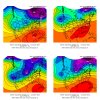
Palm Sunday 1965 had a very unique trough geometry.
For one, it was a positive tilt, which isn’t exactly what you would expect for a borderline super outbreak.
The trough in question had two main parts to it, the back edge was in the process of becoming a cut off low, this was due to anomalously strong ridging that rapidly built in behind the trough, which made it into a high amplitude type.
The leading edge of the trough that was ahead of the ridge progressed onwards, eventually, you have this sprawling, elongated trough that’s in the process of getting split apart, (which it eventually did after the outbreak).
You really only see this during strong La-Niñas and in the winter (where you almost always have a crashing cold front spilling down the central US), not in the spring, which is what really made this day unique. You can also see a very strong ridge over the gulf, another classic La-Niña feature.
The pressure gradient between this southeastern ridge and the Jet stream which was constructively interfering with the subtropical jet, plus the elongated geometry of the tough, resulted in one of the strongest OWS jet streaks on record.
View attachment 54593
The leading short wave trough, predictably bombed out with a central surface pressure in the 980mb range, this combined with the 130+knot jet streak over head, resulted in a expansive LLJ of 50+knots over the entire north end of the OWS.
Thanks to this trough unique orientation, the LLJ, (which usually is always way out ahead of the dry line/cold front and highest instability, was largely behind the front and right in the area of highest instability.
View attachment 54594