Ah okay. I've tried it before and found it a struggle.EarthExplorer. It's not nearly as user-friendly as Sentinel Hub or LandsatLook (which it replaced), but it does the job.
There's a couple of ESRI viewers I find somewhat useful. The current Landsat Explorer is easy to use (especially the date selection) but has practically no customisation and an insane auto-processing on the natural colour which means significant cloud in the image makes the rest nearly black. Most annoyingly, it has no Landsat 1-4 data, so nothing pre-1982. The older 'classic' Explorer has much better contrast controls (in the custom bands option), but though it has some older data much more is missing.
The Copernicus browser has the Earth Observation Browser capabilities (same software) but only for Sentinel. I saw someone write 'Sentinel Hub's capabilities were too good to remain free forever' which I think has some truth to it. I liked that I could fiddle some basic contrast enhancements, for example by using their stretch function. However, I couldn't work out how to do a proper histogram contrast enhancement (like the '2% clip' in the 'classic Explorer') - doesn't help I can't do anything with code for peanuts. Might be possible to do something in QGIS or Multispec, but even if they have the capability my computer would probably explode first.
Someone with knowledge and the right software could do some really cool stuff. This article used NDVI difference to show three of the 3/3/19 tornadoes in great detail. But they don't say exactly how they did it. I tried a couple of scripts in Sentinel Hub and couldn't get them to work, and the change detection function in the Landsat Explorer shows little. It needs very different colour scaling to normal.
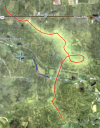
The Harper TX tornado is another good example of the SPC/NCEI data not really being truthful. Officially it had a 3.5 mile, 200 yard wide path. Not only is the visible track on satellite at least 700 yards wide and 5.2 miles as a straight line between the ends, but a plausible interpretation of the path comes to 8.2 miles: