• Welcome to TalkWeather!
    We see you lurking around TalkWeather! Take the extra step and join us today to view attachments, see less ads and maybe even join the discussion.
    CLICK TO JOIN TALKWEATHER

Significant Tornado Events

Everything about it is absurd. Even OFFICIALLY, it had 18 violent tornadoes. And you're right, the proportion of violent tornadoes to tornadoes overall is insane.

The jet streak was BLASTING away and all of these storms were faster than I ever drive, some apparently as fast as 75 MPH.

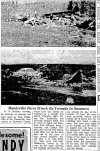
I'm STILL trying to find information and pictures on the Williams Bay-Lake Como, WI tornado that day. I know, I distinctly remember someone in this thread posting extremely impressive damage from an obscure "F1" in southern WI. I found these in a local historical society picture but while this indicates the possibility of something greater than F1, it isn't clear.

View attachment 39661
View attachment 39662
Here you go:

 
Everything about it is absurd. Even OFFICIALLY, it had 18 violent tornadoes. And you're right, the proportion of violent tornadoes to tornadoes overall is insane.

The jet streak was BLASTING away and all of these storms were faster than I ever drive, some apparently as fast as 75 MPH.

I'm STILL trying to find information and pictures on the Williams Bay-Lake Como, WI tornado that day. I know, I distinctly remember someone in this thread posting extremely impressive damage from an obscure "F1" in southern WI. I found these in a local historical society picture but while this indicates the possibility of something greater than F1, it isn't clear.

View attachment 39661
View attachment 39662
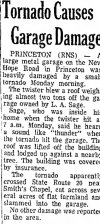
By the way, if the data on Tornado Archive is to be believed, there was an F2 tornado near Princeton, WV at about the same time as the super outbreak. Lo and behold,
A 1965 storm summary from the US Commerce Department says a tornado "lifted a two-ton metal roof from a garage" near Princeton at 6:30 AM on June 12. Interesting. I'd have to really dig to find out if this was connected in any way to the main outbreak.

At a minimum, this outbreak had a geographical extent of about 275 miles South-North from Fairfield County, Ohio (or closer to 450 if we count the tornado in WV) to near Bay City, MI, and about 550 E-W miles from near Cleveland (or 600 if you count an apparent F1 in Cadiz, OH) to NE Iowa.


Princeton_tornado_1965.jpg

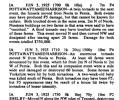
Interestingly, there was another official F2 nearby in Summers County, WV on the preceding Thursday (4/8/65). Pictures are, of course, extremely grainy. Anyway, not that often you get nearly significant tornadoes in WV. The event on 4/8/65 also dropped a couple of F3s further north along the KY/WV border and some other tornadoes in southern Ohio.

Mandeville_Farm_tornado.jpg
 
Last edited:
Here's something cool I found while doing research on some other tornadoes in 1925 (obviously all overshadowed); there were twin F4s in Iowa on June 3 that Grazulis described as "may have been F5" (referring to both, not just one). I don't think these are well-known at all.
 

Attachments

  • Screenshot 2025-04-11 1.56.34 PM.png
    Screenshot 2025-04-11 1.56.34 PM.png
    201.1 KB · Views: 0
Palm Sunday 1965 is just so anomalous to me. Kind of fitting in with that favorable upper Midwest pattern during the mid 19th century. When you look at the annals of tornado history, you see history doesn’t repeat but it does rhyme. You can see super outbreak type events that generally are similar (4/3/74, 4/27/11, 1932, Enigma) and events with more than 10+ violent tornados.

Then there’s Palm Sunday 1965. From the blizzard storm like jet core, geographical location, and extremely high rate of violent tornados (which are probably undercounted judging by research). I’m not saying it’s a one off event, but there’s no real close comparison throughout recorded tornado history due to how new our records are. The amount of violent tornados that day is staggering

In terms of a densely concentrated cluster of violent tornadoes, it was similar over the IN/OH/MI border region as 4/27/11 was in east-central MS northeastward across Alabama, and 4/3/74 over southern IN/OH and northern KY.

However, the geographical distribution of it is what really stands out to me. I mentioned this in one of the recent event threads, but no outbreak since even comes close in terms of producing significant tornadoes all the way from Iowa to western Lake Erie. We've seen big troughs with favorable tilts/wavelengths for high-end outbreaks, we've seen broad warm sectors, but I really wish we knew more about the kind of pattern it took to initiate and maintain tornadic supercells across an area so wide E-W, but relatively restricted N-S.

On top of that, it was one of the few (if not the only) known Midwest regional outbreaks to also affect southern Wisconsin with legit supercell (as opposed to QLCS, like 3/31/23) tornadoes. Someone mentioned earlier that some of those were likely stronger than their official ratings.
 
In terms of a densely concentrated cluster of violent tornadoes, it was similar over the IN/OH/MI border region as 4/27/11 was in east-central MS northeastward across Alabama, and 4/3/74 over southern IN/OH and northern KY.
I know you’re waiting on a Palm Sunday 1965 Redux to chase LOL. I have something similar, I’m waiting on a 4/3/74 redux set up for Central KY. 3/2/2012 attempted it, but LCLs were too high for the 3 or so discrete cells to take advantage of. Plus I had only been driving for a year and was still relatively new in my severe weather hobby.
 
In terms of a densely concentrated cluster of violent tornadoes, it was similar over the IN/OH/MI border region as 4/27/11 was in east-central MS northeastward across Alabama, and 4/3/74 over southern IN/OH and northern KY.

However, the geographical distribution of it is what really stands out to me. I mentioned this in one of the recent event threads, but no outbreak since even comes close in terms of producing significant tornadoes all the way from Iowa to western Lake Erie. We've seen big troughs with favorable tilts/wavelengths for high-end outbreaks, we've seen broad warm sectors, but I really wish we knew more about the kind of pattern it took to initiate and maintain tornadic supercells across an area so wide E-W, but relatively restricted N-S.
You may have your answer in Trey’s new video
 
In terms of a densely concentrated cluster of violent tornadoes, it was similar over the IN/OH/MI border region as 4/27/11 was in east-central MS northeastward across Alabama, and 4/3/74 over southern IN/OH and northern KY.

However, the geographical distribution of it is what really stands out to me. I mentioned this in one of the recent event threads, but no outbreak since even comes close in terms of producing significant tornadoes all the way from Iowa to western Lake Erie. We've seen big troughs with favorable tilts/wavelengths for high-end outbreaks, we've seen broad warm sectors, but I really wish we knew more about the kind of pattern it took to initiate and maintain tornadic supercells across an area so wide E-W, but relatively restricted N-S.

On top of that, it was one of the few (if not the only) known Midwest regional outbreaks to also affect southern Wisconsin with legit supercell (as opposed to QLCS, like 3/31/23) tornadoes. Someone mentioned earlier that some of those were likely stronger than their official ratings.
The Wisconsin tornadoes weren't terribly egregious but the damage pics here indicate Williams Bay was certainly more than an F1 while the Watertown tornado was probably F4.

But that's interesting, I had no idea supercells were so rare in Sconnie


The modern day severe wx outlook had it occurred 6 decades earlier. Oh and Trey's video on Palm Sunday is up.


Teleconnections showed a very +TNI, -PDO and a weak nina transforming to a near super nino.

To be honest, I'd like a more "experienced" certified meteorologist to make a mock SPC outlook, because unless I'm totally wrong, I honestly wouldn't have been surprised if the SPC back in the day would've had a Moderate Risk for this initially on Day 1, unless they would've had a High Risk if the secondary LLJ that formed that day was forecast. Idk maybe they would've issued a High Risk due to the CIN numbers that were in place to keep this setup discrete. But to me, the ingredients in place after doing research, doesn't scream modern day High Risk to me personally.

Of course it's easy to write this up as a High Risk event based off the reports and observations, but thats now how forecasting works obviously.
 
OTD 60 years ago...


And the Anniversary Question: what tornadoes from this outbreak, if any, would receive an EF5 rating today?
 
OTD 60 years ago...


And the Anniversary Question: what tornadoes from this outbreak, if any, would receive an EF5 rating today?

Using today's metrics, still none. Back from like 2011-2013 metrics, probably the Goshen/Dunlap tornado that went through Midway. Literally says on one of the WFO recaps, "May have been an F5." I think the Branch/Hillsdale would be rated an EF5. That one reminds me a lot of the Hackleberg Tornado from 4/27.
 
OTD 60 years ago...


And the Anniversary Question: what tornadoes from this outbreak, if any, would receive an EF5 rating today?


Those twins are one of my fav ever old tornado pics.
 
Tomorrow, 80 years ago...

On April 12th, a deadly tornado outbreak would kill at least 100 people in OK, AR, and MO. The majority of the deaths came from an F5 in Antlers, OK, where the town took a direct hit, killing 70. Despite the significant death toll, the entire outbreak was swept under the rug when President Roosevelt passed away on the same day, making this one of the most forgotten tornado events in American History.

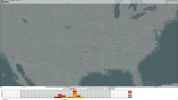
Tornado Archive Data Explorer - Tornado Archive and 55 more pages - Personal - Microsoft​ Edge...png
 
The Wisconsin tornadoes weren't terribly egregious but the damage pics here indicate Williams Bay was certainly more than an F1 while the Watertown tornado was probably F4.

But that's interesting, I had no idea supercells were so rare in Sconnie

When it comes to classic Plains or high-end Dixie Alley day (4/27)-caliber long-track, cyclic tornadic supercells they are pretty rare; the MKX CWA gets one maybe once every 10 years. It could be argued it's coming up on 20, with Stoughton 2005 being the last one (Oakfield in 1996 and Barneveld '84 prior to that, which is where I got the "10 year" return rate from).

Most of our tornadoes come from either QLCS mode or the smallish supercells from MCV-driven summer events.
 
I don't think March 25, 2021 underperformed at all in hindsight. If anything from that month did it was March 17, which also included a 45% hatched tornado probability area (matching 4/27 and 5/24/11, and 5/20/19) but only produced four tornadoes rated above the "weak" category (all EF2).

May 25th of 2024 is a notable one. The second day-2 outlook issued on May 24 contained some of the most ominous wording I'd ever seen outside of 4/27 and 5/20/19, especially for a non-Broyles outlook. ;) However, they held off on the high risk initially due to concerns over lesser storm coverage, but by the time of the first Day-1 outlook it was clear the bigger issue was going to be outflow wrecking the thermodynamics in parts of the warm sector, and potential for destructive storm interactions which did indeed end up significantly limiting the ceiling of the event. As one chaser in the Stormtrack Discord put it: "One left split. I have never before seen a tornado outbreak Atmospheric Anti-Climax by one left split." In keeping with the general theme of last year in the Southern Plains, the most significant tornadoes came after dark.

Edit: Can we stop applying the auto-censor to b**t everywhere in this forum? I understand it when people are calling it prematurely in active event threads, but it's getting old, especially when I'm going back and finding it in my posts where I used it in reference to my own chase, not the event in general.

Can we use it the conventional way? Sure if you look up definitions you might see something like 'no severe weather occurred when it was expected', but that's not how I've seen it used. The senses I've seen are either the one you're using, where the writer didn't see what they wanted, or a generalised sense that expectations weren't met, even if some tornadoes (even destructive ones) did in fact occur.

For writer's experience, looking at storm chasing blogs, articles, forums etc. I've seen more than one person mention a bu$t on 25/5/2008, even though it had the Parkersburg tornado, arguably the most impressive tornado of the decade (or in the top two). From what I gather, most storm chasers had targeted a different area and saw not much.

For expectations, 20/5/2019 is the perfect example. No one would've batted an eye if it was a slight or enhanced. But the forecast meant people were quite legitimately expecting something historic along the lines of the Andover or May 3 outbreaks. Furthermore this came in the context of a drought in Plains events. Expectations were sky-high and weren't met.

Here and certain spots on Twitter I've seen a strong insistence that no tornadoes, or at least no damaging ones, should occur to declare a bu$t. By that standard there's never been a high risk bu$t. The term originated in the storm chaser community and their activities, so there's less consideration of impacts implicit there. The SPC forecasts and verifications are based on objective probabilities as well.

Hence I don't see why the word should be censored so that holders of one opinion aren't offended. Especially as some of those people clearly trawl Twitter for opinions they don't like and post them here to rile people up. Complaints about 'weather weenies' don't cut much ice coming from pseudonymous posters on a forum.

I don't think March 25, 2021 underperformed at all in hindsight. If anything from that month did it was March 17, which also included a 45% hatched tornado probability area (matching 4/27 and 5/24/11, and 5/20/19) but only produced four tornadoes rated above the "weak" category (all EF2).
These events are interesting to compare. March 17 actually saw more tornadoes than March 25 but they were predominantly weak. I remember that the system progressed faster than forecast so the evening event with possible 'long track, intense tornadoes' didn't pan out as expected. Hence ir cuased the usual arguments. Despite having fewer tornadoes, March 25 was the kind of event that is expected in the Southeast, producing long tracked, destructive tornadoes.
 
Last edited:
Back
Top