• Welcome to TalkWeather!
    We see you lurking around TalkWeather! Take the extra step and join us today to view attachments, see less ads and maybe even join the discussion.
    CLICK TO JOIN TALKWEATHER

Enhanced Fujita Ratings Debate Thread

I honestly do not get the Plevna hype at all. The worst damage I saw from it was some average stubbed and partially debarked trees, that people were labeling “EF4 to EF5 type tree damage” for no apparent reason. I don’t recall any truly extreme tree debarking, grass scouring, debarking of shrubs, or any real “extremely violent tornado in a rural area” contextual indicators from Plevna. In terms of tree damage, this pic below was about the worst I saw from Plevna. Debarking can and often does get much more intense than this:
View attachment 54922

Unless there’s some incredible damage I am not aware of, I really think people online saw a loud, scary, Greensburg-like nighttime wedge and extrapolated conclusions about that tornado’s intensity that aren’t actually supported by the damage it left behind. The other issue is people not knowing what they are looking at. The photo below got labeled on social media as “ground scouring” caused by Plevna, when I really don’t think that’s the case. This pic more likely just show some mud puddles or dirt patches in a field that may very well have been there prior to the tornado. Notice how it more follows the tree shelter belt rather than any kind of contoured damage path? The online tornado community has a bad habit of assuming that every little discolored patch of ground in a damage pic is automatically “ground scouring”.
View attachment 54921

Matador on the other hand produced truly extreme grass scouring, which had a very clear contour and path. I think even if Matador only hit trees and grassy fields at peak intensity like Plevna, we would still see that insane high-end vegetation damage that made Matador stand out. These were two completely different calibers of tornado in my opinion.
I remember once the damage photos started rolling in I was borderline puzzled at the lack of any true “violent” looking damage indicators. I think early on in its life, around where this satellite image was taken, there was some higher-end tree/vegetation damage that could’ve hinted at EF4 intensity, but nothing higher than that.
IMG_7207.jpeg

Both the Haviland and Iuka EF3’s seemed to produce more intense tree damage and high-end cycloidal markings than Plevna, despite being less impressive on radar. I’d argue Grinnell and maybe even the Elkader EF2 could’ve reached greater intensities than Plevna based on contextual damage.
 
On a side-note, some Canton 2017 stuff I found in a UAS study:
View attachment 54928
Quite intense; for a bit I'm probably just going to post rarer images as I do some research for my senior project and leave out my own personal estimates.

Ironically it's always seemed like the first Canton tornado was the much stronger one in comparison to the murky wedge that followed. Albeit I am assuming this is Canton 1. Honestly, in kind of a similar way to Capitol MT, it does rub me as an EF5 candidate. Especially what it did to the dealership. (Nevermind, got them mixed up.)

I honestly do not get the Plevna hype at all. The worst damage I saw from it was some average stubbed and partially debarked trees, that people were labeling “EF4 to EF5 type tree damage” for no apparent reason. I don’t recall any truly extreme tree debarking, grass scouring, debarking of shrubs, or any real “extremely violent tornado in a rural area” contextual indicators from Plevna. In terms of tree damage, this pic below was about the worst I saw from Plevna. Debarking can and often does get much more intense than this:
View attachment 54922

Unless there’s some incredible damage I am not aware of, I really think people online saw a loud, scary, Greensburg-like nighttime wedge and extrapolated conclusions about that tornado’s intensity that aren’t actually supported by the damage it left behind. The other issue is people not knowing what they are looking at. The photo below got labeled on social media as “ground scouring” caused by Plevna, when I really don’t think that’s the case. This pic more likely just show some mud puddles or dirt patches in a field that may very well have been there prior to the tornado. Notice how it more follows the tree shelter belt rather than any kind of contoured damage path? The online tornado community has a bad habit of assuming that every little discolored patch of ground in a damage pic is automatically “ground scouring”.
View attachment 54921

Matador on the other hand produced truly extreme grass scouring, which had a very clear contour and path. I think even if Matador only hit trees and grassy fields at peak intensity like Plevna, we would still see that insane high-end vegetation damage that made Matador stand out. These were two completely different calibers of tornado in my opinion.

I think it's safe to say that Plevna was the weakest of the 25 Greensburg family (even if it was one of the larger ones). The other tornadoes however seemed like they could have contained actual EF4+ intensity.
 
Last edited:
Wasn’t it revealed that Canton’s #1s survey was pretty half hearted? I swear it was later revealed that there were multiple large homes that were completely leveled in EF4 candidate fashion, but were never surveyed.
 
Does anyone have that really impressively constructed stone house that survived one of the 25 Greensburg family tornadoes? That one and the Etna 2011 house are quite interesting to me.
 
Wasn’t it revealed that Canton’s #1s survey was pretty half hearted? I swear it was later revealed that there were multiple large homes that were completely leveled in EF4 candidate fashion, but were never surveyed.
Canton #1 was the one actually rated EF4 I thought?

But yeah, the one rated EF3 I do remember seeing a post a while back that showed multiple destroyed structures that were unsurveyed along with some high-end contextual damage suggestive of EF4+ intensity.

There’s also Google Earth imagery from the event that shows that it was likely violent.
 
Canton #1 was the one actually rated EF4 I thought?

But yeah, the one rated EF3 I do remember seeing a post a while back that showed multiple destroyed structures that were unsurveyed along with some high-end contextual damage suggestive of EF4+ intensity.

There’s also Google Earth imagery from the event that shows that it was likely violent.
I think I might be confused about which one is #1 and #2. In any case, I’m referring to the one that was rated EF3 though and hit the dealership.
 
I think I might be confused about which one is #1 and #2. In any case, I’m referring to the one that was rated EF3 though and hit the dealership.
I guess I figured it out. Canton #1 was essentially south west of Canton itself for most of its life and on the ground for 40 minutes or so. Canton #2 was touching down as #1 died....it struck the eastern outskirts of Canton early in its life and was on the ground for over an hour. #1 was rated EF4 and #2 was rated EF3.
 
@buckeye05 Well there you go, officially, published.


Therefore, given the apparent importance of a consistent intense-tornado record in the United States and the probable shock (e.g., Thorne and Vose 2010) to the intense tornado record beginning at around 2014, we recommend that a wholesale reanalysis effort for the United States significant-tornado climatology be undertaken using the revised EF scale. Our recommendation is for a reanalysis of all significant tornadoes, and not only for intense tornadoes, to account for possible cases of EF2 tornadoes needing to be reclassified at EF3 upon implementation of the revised scale (or vice versa). We initially suggest that this reanalysis focus on the 2014–present period to diagnose both how the revised EF scale may change rating practices relative to the current operational U.S. EF scale, as well as whether the revision of the EF scale will lead to more or less consistency in intense-tornado ratings with the F-scale rating era. Admittedly, given the number of significant tornadoes that occur in the United States, this would be a time-intensive task that would likely require the involvement of multiple entities. If such a reanalysis were to lead to further discrepancy between the F-scale and EF-scale rating eras for intense tornadoes, then a reevaluation of the wind speed ranges associated with the EF scale rating categories, as conducted in L25, may be the only option for developing a more consistent long-term intense-tornado record in the United States.

There are some wild findings in this paper btw, essentially (in summary) that there is systematic underrating of tornadoes at all transition points between EF2-3, EF3-4, and EF4-5, and it gets worse as the tornado gets stronger.
 
Last edited:
Claims like this needs hard evidence.
I’ve seen the damage that 1925 Tri-state did, but nothing that one ups what the Kentucky tornado did in Bremen. (Key word is “one up” not saying either one was stronger than the other, which is really up to personal preference)
Of course, the Tri-State tornado caused such feats of damage more consistently and over many more places, which would make it the far more “impressive” out of the two.
I would check out my article because the damage from Tri-State from my opinion is significantly more substantial than even in Bremen. Tornadoes like New Richmond are more comparable to tri-state.

 
The 1925 Tri-State tornado scoured grass down to bare soil in multiple areas, ripped railroad tracks from the ground in multiple areas, and rolled an absolutely massive multi-ton coal tipple Piedmont/El Reno 2011 style. Even structural damage aside, those three things tell you everything you need to know. And on top of that, there absolutely was extremely violent structural damage to very sturdy masonry buildings that could have only occurred as a result of winds well into the EF5 range.

Anyone who doubts the violence of Tri-State 1925 needs to read the damage analysis done by Shawn Schuman and @HAwkmoon.
The tipple was several hundred tons by the way.
 
@buckeye05 Well there you go, officially, published.


There are some wild findings in this paper btw, essentially (in summary) that there is systematic underrating of tornadoes at all transition points between EF2-3, EF3-4, and EF4-5, and it gets worse as the tornado gets stronger.
How have we managed to overcomplicate things this bad for even tornadoes of 120 mph. It's bad enough with the 4s and 5s

Absolutely ridiculous.
 
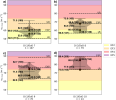
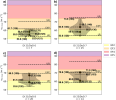
I found these two plots in particular to be notably damning. The different panels correspond to different DoD for each DI (and their LB/EXP/UB), while the violins show the distribution of assigned velocities from DAT. Not only is rating above the expected bound very rare (and in some cases such as DoD 10 for 1-2 FR, non-existent), just meeting the expected bound is quite rare as well.

1789680218195.png

This plot is for 1-2 FR (houses).

1789680255768.png

This plot is for MBS.
 
I found these two plots in particular to be notably damning. The different panels correspond to different DoD for each DI (and their LB/EXP/UB), while the violins show the distribution of assigned velocities from DAT. Not only is rating above the expected bound very rare (and in some cases such as DoD 10 for 1-2 FR, non-existent), just meeting the expected bound is quite rare as well.

View attachment 54997

This plot is for 1-2 FR (houses).

View attachment 54998

This plot is for MBS.

The plot for MBSs is so strange because in terms of structures, they're about as standardized as you can get. There are certified designs and standards that are used universally for companies with thousands of locations. Dollar stores are a great example. I did a pretty deep dive on the topic after Matador and the Dollar General that was destroyed. There's absolutely no excuse for them to go below expected wind speeds to such a significant degree.

@A Guy this is exactly what you've been looking for.
 
Back
Top