• Welcome to TalkWeather!
    We see you lurking around TalkWeather! Take the extra step and join us today to view attachments, see less ads and maybe even join the discussion.
    CLICK TO JOIN TALKWEATHER

Enhanced Fujita Ratings Debate Thread

Linton IN from last year was another horrendous survey that generally gets overlooked.


There precisely zero tornadoes that look like this...

View attachment 51828

...and produce tree damage like this that should ever be rated EF2.

Yeah, this was a intense-violent tornado and the radar presentation/visual presentation revealed it. That tree damage... Now I have to wonder why this was rated EF2.
 
It's hard not to lean towards conspiracy theories when you see multiple offices doing this. "Due to the fact the wind speed was likely stronger here, we're going to give it a lower wind speed rating." Is a conclusion that truly defies all logic or common sense. Who is training surveyors to do this?! Surely two seperate offices aren't coming to this same insane downgrade reasoning on their own... Right??
 
It's hard not to lean towards conspiracy theories when you see multiple offices doing this. "Due to the fact the wind speed was likely stronger here, we're going to give it a lower wind speed rating." Is a conclusion that truly defies all logic or common sense. Who is training surveyors to do this?! Surely two seperate offices aren't coming to this same insane downgrade reasoning on their own... Right??
No, it’s not a “conspiracy”. It’s ok to be frustrated by this kind of thing, but there is no direct evidence to suggest that offices are literally conspiring specifically to bring down ratings. Incompetence and bad mindset/practices getting shared within a relatively small institution is the real answer here, and can look nefarious when it’s just ignorance. Conspiracy and contagious bad practices and ideas are two different things.

For example, if two people within the NWS from different offices are talking shop, and one mentions the theory that geography can influence tree damage intensity, the other could have that concept in their back pocket next time they are surveying tree damage. Then we see that rationale used in multiple locations as the idea spreads, no matter how ridiculous that idea is. It’s really that simple.
 
Last edited:
No, it’s not a “conspiracy”. It’s ok to be frustrated by this kind of thing, but there is no direct evidence to suggest that offices are literally conspiring specifically to bring down ratings. Incompetence and bad mindset/practices getting shared within a relatively small institution is the real answer here, and can look nefarious when it’s just ignorance. Conspiracy and contagious bad practices and ideas are two different things.

For example, if two people within the NWS from different offices are talking shop, and one mentions the theory that geography can influence tree damage intensity, the other could have that concept in their back pocket next time they are surveying tree damage. Then we see that rationale used in multiple locations as the idea spreads, no matter how ridiculous that idea is. It’s really that simple.

Been thinking about it a lot today. Most people are familiar with the concept Hanlon's Razor, which states "Never ascribe malice to that which is adequately explained by incompetence."

However, there's an extension to this philosophy called Grey's law, which says "any sufficiently advanced incompetence is indistinguishable from malice." Basically, if someone is consistently incompetent or refuses to improve, the resulting harm is functionally equivalent to, and often indistinguishable from, malicious intent.

That's where we are at this point. It doesn't matter if it's a conspiracy or stupidity, functionally it's the exact same. The consistent, unwavering, lack of common sense and unshakeable commitment to avoid improvement is malicious, and treating it like a conspiracy is pretty much justified.
 
Been thinking about it a lot today. Most people are familiar with the concept Hanlon's Razor, which states "Never ascribe malice to that which is adequately explained by incompetence."

However, there's an extension to this philosophy called Grey's law, which says "any sufficiently advanced incompetence is indistinguishable from malice." Basically, if someone is consistently incompetent or refuses to improve, the resulting harm is functionally equivalent to, and often indistinguishable from, malicious intent.

That's where we are at this point. It doesn't matter if it's a conspiracy or stupidity, functionally it's the exact same. The consistent, unwavering, lack of common sense and unshakeable commitment to avoid improvement is malicious, and treating it like a conspiracy is pretty much justified.
I mean yeah it’s fair to say that at the end of the day that intent doesn’t matter much when the end result is misuse of a system that was put in place to supposedly prevent misuse. I agree that it’s not a good situation and the end result is the same either way. I just wanted to specifically point out that there’s not a bunch of people in an ominously lit smoke filled NWS conference room concocting new ways to intentionally abuse the EF scale lol.
 
there’s not a bunch of people in an ominously lit smoke filled NWS conference room concocting new ways to intentionally abuse the EF scale lol.
Do you have to "meet" to conspire? :confused:
Maybe it's collusion from offices watching each other. Whatever it is, it is systemic so the only effective solution is to fix the system and not each individual problem.

Systemic problems almost always arise from poor management. If you don't fix that first not only does the problem recur continually, but similar problems emerge in other places until you end up with an essentially unfixable system.

The fish rots from the head down.
 
I just wanted to specifically point out that there’s not a bunch of people in an ominously lit smoke filled NWS conference room concocting new ways to intentionally abuse the EF scale lol.
Maybe they just switched to LED lightbulbs and have an air purifier in there.
 
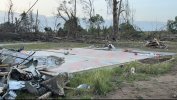
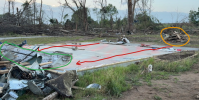
Here are my thoughts on this home:

I'm actually not 100% convinced that the home was swept by the tornado itself, and I'll explain why. First off this doesn't excuse an EF2 rating; this indicator is still probably in the EF3 range and was damaged enough that the foundation needed to be cleared. The red arrows indicate the wind direction if we are to assume the pile at the back is solely caused by the wind - however, if tornadic winds are strong enough to sweep a silled and anchored home, you would also expect them to sweep all the [sheet metal] debris to a point where it is leveled below the foundation, as the area circled in green creates a sort of wall for the wind to push up on and row further. That isn't what we see, though; the area in green is directly in the wind's path but is not rowed or swept, which makes me think it was possibly either dozed or moved by hand off the foundation for reasons I don't really know. Of course it could've momentarily lost intensity but no videos I've seen show that the tornado exhibited an erratic pattern of strength. The area I have circled in orange shows an (almost certainly) manmade pile of woods, which means cleanup had happened in the area at the time of the survey, which was in the May 18-20 timeframe.
1773760890183.png
 
Last edited:
I know its many months post Enderlin EF5 upgrade, but its had me thinking lots about the EF5 debate, especially coming down to a lot of the marginal cases and the whole "What is an EF5" question.

Because for as much as we argue on here about certain tornadoes deserving or not deserving an EF5 rating - in practise there is no actual set definition of what an EF5 is. It is extremely subjective and exists in the context of all ratings that have come before it. That's a bit of a word salad but Ill try explain better, and I'm sure many people have thought the same, too.

The current standard for an EF5 is a tornado estimated (via damage) to have produced winds >200mph. Yet we all know this is simply not put into practise, with the countless times we get DOW measurements or engineering estimates that are ignored when producing a final damage rating.

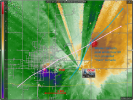
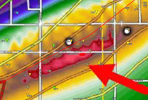
So seemingly, the actually used current standard for an EF5 tornado is a tornado which has produced some sort of exceptional damage, that can be proved with exceptional confidence satisfies the highest DODs on EF scale DIs. I focus on DIs here as more and more there appears to be a mismatch between wind speeds and damage (Greenfield's 300mph winds in the presence of EF3-4 rated damage, Harlan IA's 200mph+ winds in the presence of EF3 damage, El Reno mesonet measurements in presence of EF0-1 damage etc).
1773778006994.png1773778309229.png

The problem is that what is classed as exceptional is completely subjective, and largely depends on previous ratings. I feel the majority of the F scale era had the approach that an averagely built home slabbed, with impressive contextual damage feats satisfies this condition, and such F5 ratings would be given. This then sets the precedent moving forward of what a high-end indicator is, and what should get an F5 rating. This effect is probably part of what led to such strict ratings through the 2010s, when 2011 (+ Moore & Parkersburg) saw pretty much all the EF5s being the absolute peak, most extreme tornadoes (i.e probably something like top 0.5-1% intensity tornadoes).

But then, you can think - maybe that should be what the EF5 rating is, reserved for some to-be-determined set of the most extreme tornadoes?

Thus, I think you can take multiple approaches for what an EF5 should mean:

(A) A tornado with winds over 200mph. (B) A class of high-end tornadoes, which are generally extremely rare, and produce extreme damage consistent with the most violent tornadoes of all time. (C) Some variation or mix of A or B with perhaps slightly different thresholds or delineations.

(A) is not continuous with the F scale, but I don't think this is inherently a problem as clearly the current scale isn't either. And realistically, with this definition you probably see 5-6 'EF5' tornadoes each year (on average). Enderlin falls into this category, and I think engineering based ratings to determine particular wind speeds become more common, as well as DOW ratings.

(B) Is actually a reasonable approach, I think. If we are fully aware the benchmark for EF5 tornadoes is very high, then tornadoes like Rolling Fork, or Rochelle - clearly high-end, awful tragic events, but clearly a notch behind the Moores, Joplins, El Renos, Smithvilles etc - isn't so much of a debate. The issue is then the debate still occurs, just less often and for higher end events - e.g, Vilonia (which I firmly believe is on the same tier as the tornadoes I've just placed in this category but obviously didn't get an EF5 rating anyway)

(C) Is kind of more arbitrary, but I think probably the most continuous with the F scale and the potential to be by far the best option. I don't think every 200mph tornado should be getting EF5, as to be honest I just think its too common to represent what the highest tier of tornadoes is. Truth be told, I think Enderlin was very violent, and objectively deserves the EF5 rating, but I honestly think a lot of our EF4 and even EF3 tornadoes of the past 10-15 years could have done the same to those train cars, ngl. A good baseline would be on average, the kind of tornado you'd get once a year. Now I don't know what kind of threshold would be for windspeeds, or how you'd quantify the damage to be that level. But what is somewhat ironic is if you just followed the current EF scale to a reasonable level and applied context, you'd probably get that - example: Bremen - moderately well built homes completely destroyed, slab thrown and cracked, scouring, extreme wind rowing, granulation --> supports going over EXP and giving an EF5 rating. If your reasonable with this, I think you can kind of start to see one or two tornadoes per year (ignoring anomalies *cough* 2014 or 2011 *cough*) which satisfy this, and generally are above a certain pretty similar intensity.

I know this is a bit of a rant, and probably not the best worded at times - but aside from the actual debates of every DI, missed or lazy surveys, there are still some questions/thoughts I have about EF5 ratings as a concept themselves, that I'm sure have been raised before in this thread.
 
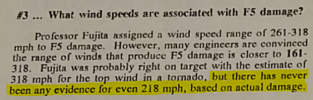
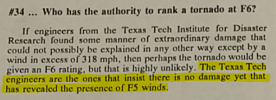
I was reading Tom Grazulis's paper "F5-F6 Tornadoes", and he kept repeating something that surprised me. It turns out engineers from Texas Tech don't believe there has ever been any damage done by any tornado in history that proves windspeeds over 261 mph (F5 threshold). In fact, they don't even believe evidence for 218 mph winds exists. That certainly explains a lot.


1773806451212.png
1773806438673.png
1773806461517.png
 
Last edited:
Keep in mind there have been dozens of studies that conclude certain damage requires 220+ mph winds. From cars, to trees, to trains, parking stops, manhole covers, etc. Even Ethan Moriarty constantly uses basic engineering equations to reach 220 mph+ estimates on several different types of structures.

These excerpts from Grazulis's paper prove one thing. They prove that Texas Tech and anyone associated with them are dirty, rotten liars.
 
Last edited:
This isn’t a conspiracy. It’s very likely (almost certainly, actually) that they meant that with their methodology of calculating wind damage, they cannot conclude windspeeds above 218 mph for any structure, and additionally they were handing out F5 ratings too liberally back then, as 160 mph could slab a poorly built home according to the math. It’s a purely engineering-based approach that, to the dismay of many, does have legitimacy behind it, despite the current issues we can see with it.

When was this paper published? If it was published before any studies concluding 220+ mph winds for thrown objects that came out in 2024, then yeah, this isn’t that outlandish of a statement to make when you’re taking a purely engineering based way of analyzing the damage.

This is unnecessarily vilifying researchers who study tornado damage, and despite how much me or any other person disagrees with it, has a genuine merit to the methodology that has been peer-reviewed.
 
This isn’t a conspiracy. It’s very likely (almost certainly, actually) that they meant that with their methodology of calculating wind damage, they cannot conclude windspeeds above 218 mph for any structure, and additionally they were handing out F5 ratings too liberally back then, as 160 mph could slab a poorly built home according to the math. It’s a purely engineering-based approach that, to the dismay of many, does have legitimacy behind it, despite the current issues we can see with it.

When was this paper published? If it was published before any studies concluding 220+ mph winds for thrown objects that came out in 2024, then yeah, this isn’t that outlandish of a statement to make when you’re taking a purely engineering based way of analyzing the damage.

This is unnecessarily vilifying researchers who study tornado damage, and despite how much me or any other person disagrees with it, has a genuine merit to the methodology that has been peer-reviewed.

As far as I know they have never published any methodology. Especially not anything concluding that all of the worst tornado damage ever recorded can be explained by winds of 218 mph or less. I can't imagine something that preposterous would ever pass peer review. It's a wonder their Jarrell and Joplin studies ever did.

Also, Ethan Moriarty has unintentionally shown mainstream audiences that the math proving higher wind speeds has always been there. Texas Tech never had the math to support their thesis, which is why they always fall back on debris loading and other extenuating circumstances when the math disagrees with them.
 
I guess I don't understand the point he's making, i.e. why civil engineers have to know what the top end tornadic winds are.

I'm talkimg TOP end. I can understand their wanting to grasp tornadoes in general. But engineers can't build around the worst tornadoes. No one can!

I mean, let's be real...if you want to build to withstand F5 winds, then you might as well build houses 1) in Pennsylvania or West Virginia where tornadoes are less common and 2) for good measure, build them inside an old coal mine. Because even the Chickasha or Goldsby "EF4" (lol), I forget which, destroyed an impressive and expensive "storm-proof" house that basically resembled a pillbox. There's no way to build for such power, not unless you want to spend preposterous sums.

So, what was the motivation for the engineers who downgraded Fujita's winds? It couldn't have been done for this.
 
I guess I don't understand the point he's making, i.e. why civil engineers have to know what the top end tornadic winds are.

I'm talkimg TOP end. I can understand their wanting to grasp tornadoes in general. But engineers can't build around the worst tornadoes. No one can!

I mean, let's be real...if you want to build to withstand F5 winds, then you might as well build houses 1) in Pennsylvania or West Virginia where tornadoes are less common and 2) for good measure, build them inside an old coal mine. Because even the Chickasha or Goldsby "EF4" (lol), I forget which, destroyed an impressive and expensive "storm-proof" house that basically resembled a pillbox. There's no way to build for such power, not unless you want to spend preposterous sums.

So, what was the motivation for the engineers who downgraded Fujita's winds? It couldn't have been done for this.

The idea is that engineers are more interested in building codes and costs than the actual science of tornadoes. The top end speed doesn't make much of a difference, but regardless, the top end speed is practically extinct. It also looks like Fujita tried offering revisions to the original scale but was rejected.
 
As far as I know they have never published any methodology. Especially not anything concluding that all of the worst tornado damage ever recorded can be explained by winds of 218 mph or less. I can't imagine something that preposterous would ever pass peer review. It's a wonder their Jarrell and Joplin studies ever did.

Also, Ethan Moriarty has unintentionally shown mainstream audiences that the math proving higher wind speeds has always been there. Texas Tech never had the math to support their thesis, which is why they always fall back on debris loading and other extenuating circumstances when the math disagrees with them.
Link to Texas Tech’s EF scale proposal submitted in 2006. There is a well defined method to how they calculated windspeeds based on a strictly quantitative approach (consulting with experts listed on here and finding the average / standard deviation of each DI to define upper and lower bounds). They strictly state they do not utilize Monte Carlo or other higher end methods to deduce wind speeds because of monetary and computational limitations at the time. And this absolutely went through the ringer to get officially used by the NWS. Your definition of what is and isn’t good science is not the standard, and making blanket statements about how the peer review process must be “preposterous” literally goes against the math based on laws of physics as we understand them saying otherwise.

What specifically are you referring to when you say “the math proving higher windspeeds has always been there?” As far as I can tell, that’s not the case at all. This was submitted in 2006 and every study I know that concludes wind velocities exceeding 220 mph comes from parking stop throws, manhole cover removal, and throwing heavy objects, all of which have studies coming out well after this was submitted. The manhole cover and parking stop stuff was 2011 with Joplin, and throwing heavy objects was the Northern Tornadoes project in 2024. The only thing you can point to, at least to my knowledge, is cycloids calculated by Fujita and others in the 80s or 70s, but that was likely deemed to be inaccurate because the windspeeds from those calculations were honestly ridiculous at first (>400 mph calcs) and were an outlier compared to other ways of calculating windspeeds in tornadoes.

There isn’t some grand conspiracy. This is science. I’m starting to get a little sick of this.
So, what was the motivation for the engineers who downgraded Fujita's winds? It couldn't have been done for this.
They were trying to make the scale more accurate, that’s it. There’s literally nothing else to it. Whether or not they’re more correct than the original F scale is another debate entirely. The original F scale very clearly overestimated weaker tornado’s winds. In my opinion, the EF scale fixes this issue but over corrects for more violent tornadoes and has their windspeeds too low.

Revising this scale is scientific progress, the more we find out about it to change it the better we become. That’s literally what is happening with the newer scale, and what happened with Enderlin. There is positive progress here.
 
Back
Top