I know its many months post Enderlin EF5 upgrade, but its had me thinking lots about the EF5 debate, especially coming down to a lot of the marginal cases and the whole "What is an EF5" question.
Because for as much as we argue on here about certain tornadoes deserving or not deserving an EF5 rating - in practise there is no actual set definition of what an EF5 is. It is extremely subjective and exists in the context of all ratings that have come before it. That's a bit of a word salad but Ill try explain better, and I'm sure many people have thought the same, too.
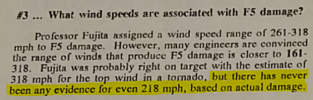
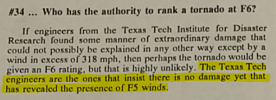
The current standard for an EF5 is a tornado estimated (via damage) to have produced winds >200mph. Yet we all know this is simply not put into practise, with the countless times we get DOW measurements or engineering estimates that are ignored when producing a final damage rating.
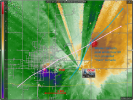
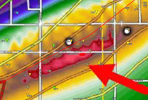
So seemingly, the actually used current standard for an EF5 tornado is a tornado which has produced some sort of exceptional damage, that can be proved with exceptional confidence satisfies the highest DODs on EF scale DIs. I focus on DIs here as more and more there appears to be a mismatch between wind speeds and damage (Greenfield's 300mph winds in the presence of EF3-4 rated damage, Harlan IA's 200mph+ winds in the presence of EF3 damage, El Reno mesonet measurements in presence of EF0-1 damage etc).
The problem is that what is classed as exceptional is completely subjective, and largely depends on previous ratings. I feel the majority of the F scale era had the approach that an averagely built home slabbed, with impressive contextual damage feats satisfies this condition, and such F5 ratings would be given. This then sets the precedent moving forward of what a high-end indicator is, and what should get an F5 rating. This effect is probably part of what led to such strict ratings through the 2010s, when 2011 (+ Moore & Parkersburg) saw pretty much all the EF5s being the absolute peak, most extreme tornadoes (i.e probably something like top 0.5-1% intensity tornadoes).
But then, you can think - maybe that should be what the EF5 rating is, reserved for some to-be-determined set of the most extreme tornadoes?
Thus, I think you can take multiple approaches for what an EF5 should mean:
(A) A tornado with winds over 200mph. (B) A class of high-end tornadoes, which are generally extremely rare, and produce extreme damage consistent with the most violent tornadoes of all time. (C) Some variation or mix of A or B with perhaps slightly different thresholds or delineations.
(A) is not continuous with the F scale, but I don't think this is inherently a problem as clearly the current scale isn't either. And realistically, with this definition you probably see 5-6 'EF5' tornadoes each year (on average). Enderlin falls into this category, and I think engineering based ratings to determine particular wind speeds become more common, as well as DOW ratings.
(B) Is actually a reasonable approach, I think. If we are fully aware the benchmark for EF5 tornadoes is very high, then tornadoes like Rolling Fork, or Rochelle - clearly high-end, awful tragic events, but clearly a notch behind the Moores, Joplins, El Renos, Smithvilles etc - isn't so much of a debate. The issue is then the debate still occurs, just less often and for higher end events - e.g, Vilonia (which I firmly believe is on the same tier as the tornadoes I've just placed in this category but obviously didn't get an EF5 rating anyway)
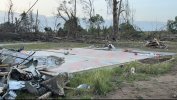
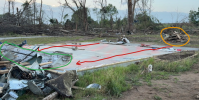
(C) Is kind of more arbitrary, but I think probably the most continuous with the F scale and the potential to be by far the best option. I don't think every 200mph tornado should be getting EF5, as to be honest I just think its too common to represent what the highest tier of tornadoes is. Truth be told, I think Enderlin was very violent, and objectively deserves the EF5 rating, but I honestly think a lot of our EF4 and even EF3 tornadoes of the past 10-15 years could have done the same to those train cars, ngl. A good baseline would be on average, the kind of tornado you'd get once a year. Now I don't know what kind of threshold would be for windspeeds, or how you'd quantify the damage to be that level. But what is somewhat ironic is if you just followed the current EF scale to a reasonable level and applied context, you'd probably get that - example: Bremen - moderately well built homes completely destroyed, slab thrown and cracked, scouring, extreme wind rowing, granulation --> supports going over EXP and giving an EF5 rating. If your reasonable with this, I think you can kind of start to see one or two tornadoes per year (ignoring anomalies *cough* 2014 or 2011 *cough*) which satisfy this, and generally are above a certain pretty similar intensity.
I know this is a bit of a rant, and probably not the best worded at times - but aside from the actual debates of every DI, missed or lazy surveys, there are still some questions/thoughts I have about EF5 ratings as a concept themselves, that I'm sure have been raised before in this thread.