• Welcome to TalkWeather!
    We see you lurking around TalkWeather! Take the extra step and join us today to view attachments, see less ads and maybe even join the discussion.
    CLICK TO JOIN TALKWEATHER

Significant Tornado Events

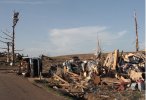
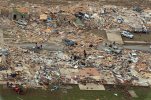
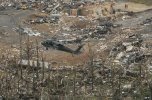
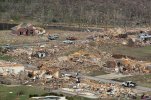
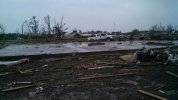
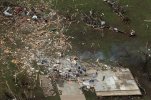
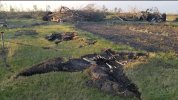
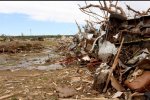
Recently dug up some new pics of Vilonia I had never seen before, and figured I should share a few.

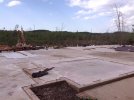
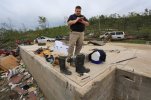
This slabbed home on Deer Dr. near Paron was carried considerable distance, but was only given an EF3 rating because the anchor bolts were missing nuts and washers. Despite this, several bolts were still bent, and a few were even ripped out of the concrete altogether.

1773803632388.jpeg
1773803687515.jpeg

1773803732360.png


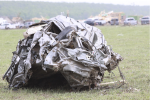
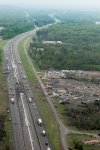
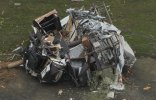
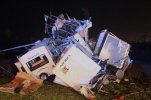
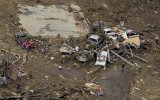
Where the tornado crossed interstate 40. As you can see it demolished the concrete barriers, before plowing into an RV dealership and Fused 3 RVs together into a giant metal ball

1773803905560.jpeg
1773803956031.jpeg
1773803981707.jpeg

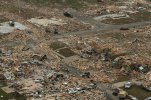
The Parkwood meadow neighborhood

1773804069443.jpeg
1773804102379.jpeg
1773804160480.jpeg
1773804201379.jpeg
 
1773804600658.jpeg

The River Plantation Neighborhood

1773804625878.jpeg

The Hook Restaurant before and after. Only a few blocks from the E Wicker St. EF5 candidate home.

1773804384087.jpeg
1773804420089.jpeg

Another view of the E Wicker St. Home

1773804519525.jpeg

1773804691302.jpeg

An area where mature trees were ripped out by the root ball and tossed considerable distance (Not from Vilonia)

1773804768472.jpeg

A grove of debarked trees acted as a dam where a river of debris piled up

1773804841301.jpeg
 
Last edited:
View attachment 52106

The River Plantation Neighborhood

View attachment 52107

The Hook Restaurant before and after. Only a few blocks from the E Wicker St. EF5 candidate home.

View attachment 52103
View attachment 52104

Another view of the E Wicker St. Home

View attachment 52105

View attachment 52108

An area where mature trees were ripped out by the root ball and tossed considerable distance

View attachment 52109

A grove of debarked trees acted as a dam where a river of debris piled up

View attachment 52110
Vilonia is essentially Arkansas' version of Smithville. It is very high on my list in terms of strength.
 
An area where mature trees were ripped out by the root ball and tossed considerable distance

1773804768472.jpeg
This photo is actually from Enderlin, North Dakota (June 20th, 2025)
 
Stunned that absolutely no discussion on the infamous Tri-State tornado has taken place today. So many towns completely gone from the sheer violence of this tornado. Some of the damage in Murphysboro never ceases to amaze me.

I mentioned it in the anniversaries thread. Probably not much to say that hasn't already been said, and last year was the 100th anniversary.

Remains (and probably always will) quite the meteorological enigma given the nature of tornado observations and damage surveying at the time. I do believe the December 2021 Quad-State Supercell gave us quite likely the closest thing we will ever see to revealing the nature of what actually occurred that day. I could see a rapid cycle between two or more long track violent tornadoes being easily missed, especially with the gap obfuscated in surveys/eyewitness accounts by brief touchdowns and/or RFD damage (both of which occurred in Obion Co., TN). I just don't believe a single tornado track well in excess of 200 miles is physically possible.
 
Last edited:
There was also an unconfirmed tornado, mentioned in a comment in Locomusic's Enigma article, that hit and apparently largely destroyed the town of Norlina, North Carolina. That one actually was potentially violent if it was legit and the implied scale of damage accurate. Not a trace of it on any map I've seen of the outbreak so far.

EDIT: Not my first mention of that one, either!
I reckon if you mentally take off at least one F-category from what the more extreme descriptions imply you'll be closer to the mark more often than not.

I know both people in these tweets; Blue’s research is solid (Newspapers.com) but I’m not convinced that the sources they take from are actually giving the truth. I tried to point out to them that old newspapers have a long history of exaggerating tornado damage descriptions (sometimes outright fabricating information as well) and was iirc brushed off. Not in a bad way though.

I honestly kinda like the rise of amateur research in the field of tornadoes. It opens the door to so many new possible research methods and ideas, and I’m all here for it.

I would expect that more intensive research should uncover more weaker tornadoes, so I'd be sceptical of the claim of 75 significant - that's the same as April 27. That said it's likely that he's documented ones that weren't previously noticed. IMO for these old outbreaks discerning the extent and numbers (by not joining up seperate paths) is probably more useful for the historical record than rating intensities.

I don't think newspapers usually made things up whole cloth, though they'd often report rumours, and it was a lot harder documenting and verifying things back then. That said one of the more commonly cited examples of a severe tornado event in Australia has been, in my opinion, not only exaggerated based on text (rather than pictures, which are available), but I'm sceptical it was actually a tornado at all.
 
Last edited:
Remains (and probably always will) quite the meteorological enigma given the nature of tornado observations and damage surveying at the time.
Not sure I agree with this. It seems to be one of the best documented tornado events of the era (and for many years before and afterwards). We've got sufficient records that people have done detailed damage point documentation.

In comparison, try doing a similar level of analysis for some more recent 100 milers, like Lawrence 1990.
 
I just don't believe a single tornado track well in excess of 200 miles is physically possible.
IMO it is, and Tri-State proved it. The consistent heading of damage (and IIIRC the intensity of the damage) before/after the big MO gap leads me to believe that it kept on truckin' through that whole area. I agree with Locomusic's track length - 222 miles.
 
I reckon if you mentally take off at least one F-category from what the more extreme descriptions imply you'll be closer to the mark more often than not.


I would expect that more intensive research should uncover more weaker tornadoes, so I'd be sceptical of the claim of 75 significant - that's the same as April 27. That said it's likely that he's documented ones that weren't previously noticed. IMO for these old outbreaks discerning the extent and numbers (by not joining up seperate paths) is probably more useful for the historical record than rating intensities.

I don't think newspapers usually made things up whole cloth, though they'd often report rumours, and it was a lot harder documenting and verifying things back then. That said one of the more commonly cited examples of a severe tornado event in Australia has been, in my opinion, not only exaggerated based on text (rather than pictures, which are available), but I'm sceptical it was actually a tornado at all.

In my experience, newspaper quality varied but was regularly quite good in the 19th century. For example, in exhaustively doing my personal genealogy, I've found more often than not that newspapers provided an immense amount of details per every article compared to today. For one thing, 19th century America was very literate.

I think the bigger issue is that there is zero way to really examine described damage feats from a standpoint of building quality etc
 
Someone has posted on Reddit saying this is (or was at least attributed to be) the second Tanner tornado from the Super Outbreak:


The source seems to be Hartsfield, R. J., & Garr, R. (1974). April 3, 1974: The Alabama Tornadoes. I wonder of anyone knows of a copy.


This is perhaps the best view I’ve seen of the Enderlin tornado and its parent barrel mesocyclone and it is incredible.

Like the well known picture of the Stratton tornado. Not much rain obscuring that lovely structure.
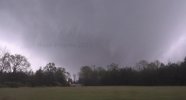
 
Someone has posted on Reddit saying this is (or was at least attributed to be) the second Tanner tornado from the Super Outbreak:


The source seems to be Hartsfield, R. J., & Garr, R. (1974). April 3, 1974: The Alabama Tornadoes. I wonder of anyone knows of a copy.


Like the well known picture of the Stratton tornado. Not much rain obscuring that lovely structure.

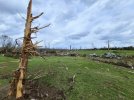
Is it just me, or does this image just scream "4/3/74 KY/IN/OH tornado"? If that's a tornado at all - hard to determine ground contact and it may just be a funnel aloft.

Update: Oh barnacles this may actually be legit :O
 
Last edited:
Time for one of AJS’s write ups! ( Yes it’s me, just on my old account lol )

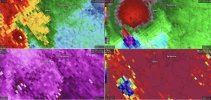
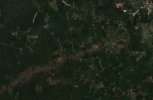
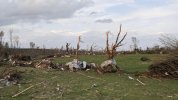
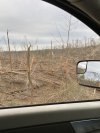
In my opinion, one of the more less talked about significant tornadoes of the 21st century is the long tracked Brent/Centreville EF3 that occurred on March 25, 2021. This beast was on the ground for around 80 miles and 1 hour and 38 minutes as it churned through areas near Brent/Centreville. While officially rated EF3, I have absolutely little doubt in my mind it would have been rated EF4 had it hit one of the towns head on. Brent and Centreville got very lucky that day as the CC/Vrot signature were certainly indicative of a high end event. Was almost certainly more intense than the Newnan, GA “ EF4 “

Below are some damage photos showing some fairly severe tree damage with significant debarking/denuding and a satellite image showing the extensive forestry damage this beast produced. Along with the radar signature and a eerie photo of the monster.IMG_5318.jpegIMG_5317.jpegIMG_5316.jpegIMG_5314.jpegIMG_5313.jpegIMG_5315.jpeg
 
Given it's 3/21 I think it's appropriate to mention this one here today:

That's funny, I always used to hear its peak wind cited as "318 MPH (the theoretical upper bound of the F5 range*) +/- 3," so if officially recorded at 321 MPH wouldn't that make it technically an "inconceivable" F6? Of course, that would open a whole other can of worms with the way the EF-scale and its associated wind speed boundaries have been used for the last ~13 years.

*Although, IIRC the very first time I remember seeing the Fujita scale in a weather book as a kid, it left the upper bound of F5 open, as in "261 MPH+," which IMO made more sense even then since the practical applications for a higher rating were never defined.
 
Back
Top