• Welcome to TalkWeather!
    We see you lurking around TalkWeather! Take the extra step and join us today to view attachments, see less ads and maybe even join the discussion.
    CLICK TO JOIN TALKWEATHER

Significant Tornado Events

I would argue this extends to their office as a whole. While I would consider myself conservative when it comes to forecasting tornado outbreaks, MEG makes me look liberal.

One only needs to find some of the previous severe weather event threads on here where every other NWS office around MEG would be starting to sound the alarm on a possible event coming up, with MEG basically shrugging their shoulders.

Not only that, they played it too conservative in my opinion on 4/27/11. While JAN, BMX, and HUN were correctly handing out tornado emergencies like candy in a generational parameter space, MEG couldn’t even muster a TOR-E for Smithville. I understand there’s a criteria that has to be met, but I think with the radar presentation and environment that day, the correct play was to be more liberal.
Hey, at least MEG wasn't alone in not issuing tornado emergencies on historic tornadoes. Joplin didn't get one. Nor did any of the 5/24 tornadoes in OK.
 
Let's add to the confusion...

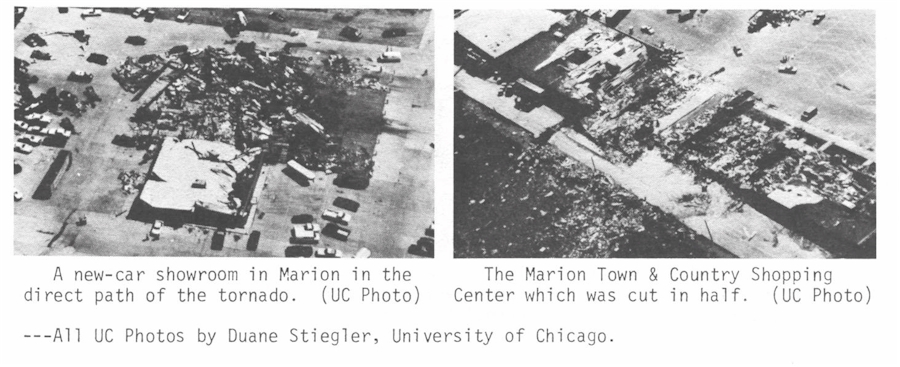
One violent tornado nobody talks about much is the 1982 Marion, IL tornado. The twister cut a 17 mile path through Williamson County tracking through Carterville, Crainville, and eventually into the heart of Marion. Ten people were killed and 181 were injured. A Ford dealership was clobbered, a shopping center was quite literally cut in half, an apartment complex was devastated, and many homes were leveled with a few being swept away, among other damage.

stormdata4.jpg


MarionIL-damage-homes.jpg
MarionIL-damage-homes2.jpg
MarionIL-damage-homes3.jpg
MarionIL-damage-homes4.jpg

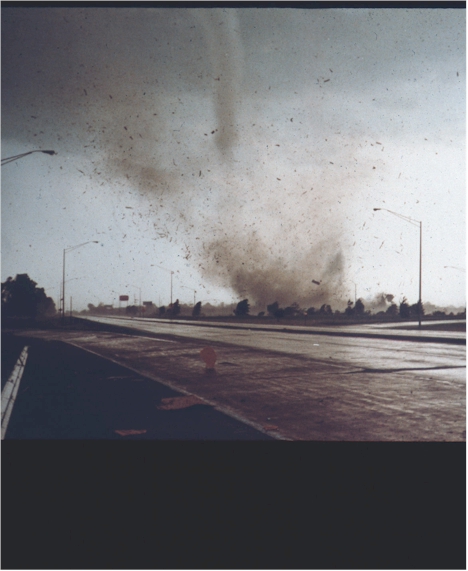
And these photos of the tornado itself taken by Beth Butler are (imo) some of the most incredible tornado photos from the time period, if not in general:

closeup.jpg
 
Yeah that’s my bad. Marion 2004 indeed had some very impressive contextuals that go far beyond rumors about tossed farm machinery, including grass scoured to bare soil with underlying topsoil removed, cars stripped down to their frames and wrapped around debarked trees, and it basically was a predecessor to Rainsville considering what it did that anchored safe. The TornadoTalk article was quite compelling when it was public.

Sorry for the confusion there.
Ok, I have to eat crow. Sorry for being so dismissive.

Still, I can't get over that the TornadoTalk article (apparently one of the most in-depth resources about the tornado) is paywalled. I understand they have to keep the lights on and all, but when their article is the most comprehensive resource about a tornado, yet it's paywalled, it honestly seems kind of greedy to me. And because there isn't a lot of concrete info about Marion '04 floating around outside of their article, it can lead people (including myself) to give the tornado less credit than it actually deserves.

I have a handful of photos from Marion 2004, and while they're impressive, I wish I had more context.
 
Here’s what I’m talking about. Very clear grass scouring and wind rowing. The best EF5 candidate homes are actually in the upper left portion in the first pic. I will admit that in the second pic there is a collateral damage issue (you can see that the neighboring home was removed from its floor and smashed into the other home), but the grass scouring at the bottom of the frame is impressive.
View attachment 49278
View attachment 49279
I hate to break it to you but other tornadoes have scoured grass before and you can see that there's small trees and shrubberies still standing near and around the slabbed homes
 
I hate to break it to you but other tornadoes have scoured grass before and you can see that there's small trees and shrubberies still standing near and around the slabbed homes
Yeah other tornadoes have scoured lawn grass, and it’s almost always ones of exceptional intensity, barring certain scour prone regions that I specifically mentioned already. I’ve been doing this since 2011 and the correlation between lawn grass scouring and extreme intensity isn’t really up for debate. If you’re seriously trying to downplay grass scouring, literally the most contextually significant type of ground scouring that exists, you’re pretty far gone in terms of having a good feel for the relationship between tornado damage and intensity. Also those shrubs are clearly outside of the tornado’s center line, where the most pronounced scouring and wind rowing occurred. The shrubs in the direct path near the railroad tracks were obliterated.

Btw it seems to me you’re just occasionally showing up here and regurgitating dismissive takes you heard from other people, with no actual analysis or takes that are your own.
 
Last edited:
I think he might be using Nick Kras' analysis as a basis. Let's break each house he covered down.

10386 E Kuehl Ct - sill plates attached with anchor bolts, but a few were missing nuts and washers. This phenomenon can just as easily be explained by the tornado itself tearing them out rather than poor construction. He also cited poor contextuals. This was the sidewalk house. He rated it HE EF3.

14874 IL-64 - west side lacked any connections and had unfilled CMU blocks present. East side was bolted, but far apart. He rated it ME EF3.

He did not cover any other DI. This was because of a lack of pictures at the other 200 EF4 DIs.

He rated the tornado 180 EF4, due to violent contextuals overlapping with "poor" construction.
I definitely do not think Rochelle deserves EF5, but I do disagree with Nick on the first home, the one that was bolted but many bolts were missing nuts and washers, I would still consider it above the absolutely of the lowest home. I would still assign it 170+.
 
Yeah the statement that there wasn’t much violent contextual evidence besides the sidewalk is simply not true. Grass scouring occurred in the Deer Creek Subdivision, and homes actually had their lawns scoured. It is especially evident in some of the aerials and local news pics. After years and years of poring over these events, I can confidently say that scouring of lawn grass is one of the most reliable indicators of a very high end event. I’ve never seen it near homes that weren’t completely obliterated, except for in the scour-prone counties of western Oklahoma. In addition, there was wind-rowing of debris in this area as well, especially near the railroad tracks as the tornado exited the neighborhood. Both of these contextuals are clearly visible in that one well-known aerial photo of Deer Creek that has been posted many times.

Regarding the bolts missing washers, I am aware of that, but from what I recall, it was some of the bolts missing their washers, and I don’t recall any home missing washers on every bolt. Think about that for a minute. If a framing crew is out there building the house, does it really make sense that the person responsible for that walked around the foundation perimeter going “Oh let’s put a washer here, let’s skip this one, let’s skip this one too, let’s put another washer here…”?
It’s possible I guess, but given the inconsistency, my gut feeling is that some of these bolts lost their washers during the destruction of the house, rather than a few being absent at random to begin with.

I was genuinely open to seeing if there was legitimate reasoning behind this, but I’m not seeing this as legitimate reasoning. The claim of a lack of impressive contextuals is just simply false, and it’s debatable as to whether the missing washers was a screw up by the framing crew, or a result of the tornado itself.
If the nuts and washers are properly fastened then they will not be lost, the sill plate should shear away from the bolt bending it indicating a full transfer, one common indicator in this home is that a lot of baseplates remained and all anchor bolts remained upright.
 
If the nuts and washers are properly fastened then they will not be lost, the sill plate should shear away from the bolt bending it indicating a full transfer, one common indicator in this home is that a lot of baseplates remained and all anchor bolts remained upright.
With all due respect... assuming it's de facto impossible for a violent tornado to strip a bolt of its nut and washer if they are "properly fastened" just doesn't make sense to me.

If there's one thing tornadoes don't do, it's follow rule books.

Now, if an anchor bolt has a properly fastened nut and washer, does that make it far less likely for them to be torn off? Almost certainly. Does that automatically mean if it does happen, that they wasn't properly installed? No.
 
With all due respect... assuming it's de facto impossible for a violent tornado to strip a bolt of its nut and washer if they are "properly fastened" just doesn't make sense to me.

If there's one thing tornadoes don't do, it's follow rule books.

Now, if an anchor bolt has a properly fastened nut and washer, does that make it far less likely for them to be torn off? Almost certainly. Does that automatically mean if it does happen, that they wasn't properly installed? No.
It is extremely unlikely and the bolt would still be bent, these bolts are upright and it certainly would not happen to several bolts like this. Sadly builders can get away with installing a few bolts with nuts and washers and leave out the rest. Regardless, we can safely rule out this was not the case in the Rochelle tornado.
 
It is extremely unlikely and the bolt would still be bent, these bolts are upright and it certainly would not happen to several bolts like this. Sadly builders can get away with installing a few bolts with nuts and washers and leave out the rest. Regardless, we can safely rule out this was not the case in the Rochelle tornado.
Can you post the photo(s) from Rochelle you're referring to?
 
Btw, my opinions don’t just come from me going “I heard someone say this type of damage is or isn’t significant, so that’s my opinion now too”. While I obviously factor in AMS journals, surveys, presentations, and the word of EF scale field experts, my takes also come from more than a decade of gathering the details of every violent tornado that has occurred in my lifetime, in addition to many others before my time, and taking note of reoccurring patterns and hallmarks that correspond with tornado events of certain intensity levels. I essentially keep a HUGE autism-powered mental database of violent tornadoes, and the damage they caused to a very detailed degree. After many years of doing this, certain high-end event signatures that are incredibly consistent have made themselves apparent, and I know for certain that lawn grass scouring is one of them based on years of observation. That’s why I get frustrated by the flippant “well that doesn’t necessarily mean anything of significance” attitude from people who haven’t put in the same degree of observation I’ve put into this for such a long period of time. And sure, there are certain things I have “thrown out” because they aren’t reliable and vary wildly with no clear correlation to extreme intensity (trenching, asphalt scouring, and vehicle mangling). But lawn scouring is one of the few that I know doesn’t vary wildly, and that’s why having to argue this point is so frustrating.

While I can’t sit here and link an AMS paper proving the correlation between lawn scouring and high-end events, I just know that if someone were to sit down and catalog every single tornado that scoured lawns, I absolutely guarantee you that statistics would show an undeniable correlation between scoured lawns and extremely violent tornadoes, and also ones with controversially low ratings. I can also guarantee you that people like LaDue, and even Marshall know it’s a high-end event hallmark, and they have cited it as such.

So this kind of conversation is just crazy making, because it comes down to something I know to be true but cannot explicitly prove without basically doing a statistics based research paper.
 
Last edited:
Ok, I have to eat crow. Sorry for being so dismissive.

Still, I can't get over that the TornadoTalk article (apparently one of the most in-depth resources about the tornado) is paywalled. I understand they have to keep the lights on and all, but when their article is the most comprehensive resource about a tornado, yet it's paywalled, it honestly seems kind of greedy to me. And because there isn't a lot of concrete info about Marion '04 floating around outside of their article, it can lead people (including myself) to give the tornado less credit than it actually deserves.

I have a handful of photos from Marion 2004, and while they're impressive, I wish I had more context.
It's really greedy considering it WAS free at point, same for the Smithville article. Fortunately I saved lots of the stuff on the article before they paywalled it; I am a TornadoTalk member and I'm considering just saving lots of the stuff in my computer when my membership expires because screw corporate greed.
 
Yeah other tornadoes have scoured lawn grass, and it’s almost always ones of exceptional intensity, barring certain scour prone regions that I specifically mentioned already. I’ve been doing this since 2011 and the correlation between lawn grass scouring and extreme intensity isn’t really up for debate. If you’re seriously trying to downplay grass scouring, literally the most contextually significant type of ground scouring that exists, you’re pretty far gone in terms of having a good feel for the relationship between tornado damage and intensity. Also those shrubs are clearly outside of the tornado’s center line, where the most pronounced scouring and wind rowing occurred. The shrubs in the direct path near the railroad tracks were obliterated.

Btw it seems to me you’re just occasionally showing up here and regurgitating dismissive takes you heard from other people, with no actual analysis or takes that are your own.
It also depends type of tree and soil lmfao. Trees in Illinois are usually hardwood (oaks, hickory, etc), prob the same for shrubs. Plus the grass scoured had alot of sod (grass roots). There is a photo of the shrubs completely defoliated and debarked but Im too lazy to find it rn

Also a list of F4-F5 tornadoes and examples that scoured lawn grass:
Piedmont 2011 (trenched house)
Harper 2004 (above)
Moore 2013 (Orr, PTES, MMC)
BCM 1999 (Bridge Creek)
Jarrell 1997 (DCE)
Tri-State 1925 (De Soto)
Vilonia 2014 (SW Vilonia)
Greensburg 2007 (South Greensburg)
Mayfield 2021 (Bremen)
And more
 
Here’s what I’m talking about. Very clear grass scouring and wind rowing. The best EF5 candidate homes are actually in the upper left portion in the first pic. I will admit that in the second pic there is a collateral damage issue (you can see that the neighboring home was removed from its floor and smashed into the other home), but the grass scouring at the bottom of the frame is impressive.
View attachment 49278
View attachment 49279
One thing that really grabs my attention in the first photo is how the scouring is in that consistent center line path that only appears to occur in particularly high end events.
 
It also depends type of tree and soil lmfao. Trees in Illinois are usually hardwood (oaks, hickory, etc), prob the same for shrubs. Plus the grass scoured had alot of sod (grass roots). There is a photo of the shrubs completely defoliated and debarked but Im too lazy to find it rn

Also a list of F4-F5 tornadoes and examples that scoured lawn grass:
Piedmont 2011 (trenched house)
Harper 2004 (above)
Moore 2013 (Orr, PTES, MMC)
BCM 1999 (Bridge Creek)
Jarrell 1997 (DCE)
Tri-State 1925 (De Soto)
Vilonia 2014 (SW Vilonia)
Greensburg 2007 (South Greensburg)
Mayfield 2021 (Bremen)
And more
About Bremen, something i’ve always wondered is why Ethan (June First) is so impressed with the damage at the 190 MPH DI compared to a lot of the poured concrete anchor bolted homes that were swept away/obliterated in the Deer Creek subdivision in Rochelle. Especially when considering the odd construction of the home in Bremen.
 
View attachment 49290
This home. I would go mid EF4 here, defo not high EF3, but also not an EF5 di in my opinion.
This isn’t one of the Rochelle homes I was thinking of when it comes to actual EF5 potential. Pancaked floor into the basement, vehicle in garage isn’t moved…meh. The other one also had the collateral damage issue I mentioned. I was more highlighting this area to disprove the notion that there was a lack of high end contextual evidence. The real areas of concern are further west away from the railroad tracks.
 
Back
Top