• Welcome to TalkWeather!
    We see you lurking around TalkWeather! Take the extra step and join us today to view attachments, see less ads and maybe even join the discussion.
    CLICK TO JOIN TALKWEATHER

Severe Weather Threat May 17-19, 2025

09z rap is bullish on parameter space and convection for Mississippi and Alabama. Tommrow. 12z HRRR is coming out now
Suprised there is not a 30 percent hatched hail threat be honest , over the center of
The 10 percent t hatched tornado threat , steep
Lapse rates . Nearly off chart
 
Ah, the perils of being in a different time zone to everyone else and not having the time to reply until the usefulness of said reply is long past. I wonder if we could use a 'general tornadoes discussion thread' for things that aren't directly about current events or don't fit our existing threads.

I thought several of those were nighttime tornadoes, though?
Most large events have at least some tornadoes at night, something I suspect is understated for older ones. May 3 1999 is 'the' plains outbreak for many people and had quite a lot at night.

The problem is: what is a classic, high(er) end plains outbreak? I think most people's expectations are set by 90, 91 and 99, of which the first two had most of their notable tornadoes in daylight. But there's been some night outbreaks, like 25/5/55. I've my pet idea that plains outbreaks tend not to have quite the same combination of geographical spread and intensity as those elsewhere, but that's based on... not much. I find the more you think about this the less clear the answer is. Especially when you look at older outbreaks and wonder whether the 'fewer days, larger outbreaks' paper has something to it. Or you start thinking about whether the diurnal predominant climatology is due to smaller events. It becomes hair tearing.

I look for something with more spread that, say, Greensburg 07 even if the numbers of sigtors are similar. That was a genuine 'storm of the day' event. 9/5/16 wouldn't quite meet my idea of a major event in terms with its small cluster of notable tornadoes in S OK and everything else off in NE, it fit the enhanced it was forecast as. 16/11/15 fits better as a contiguous outbreak (but no-one makes long-term plans for a storm chasing trip in November).

It'll be interesting to see the numbers that eventually shake out of this outbreak, IMO the somewhat circumspect forecast was reasonable, and it was towards but not at the ceiling. One thing's for sure though, the main event by intensity, if not by numbers, was at night.
 
Last edited:
2025 has incredibly violent so far... What has been happening and why?
 

Damage from Plevna. Hard to make out exactly what’s being shown, but without a doubt shows some significant damage.

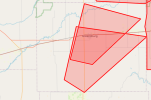
The first minute is the same home everyone has been showing, allegedly on the outskirts of Plevna, then at 1 minute switches to the middle of town, W. 3rd Ave at Main St. The trailer home on the north side was destroyed, but it looks like the structure homes visible are still standing. The church and the wood home on the north side of W. 3rd a block to the west have been seen on Twitter as still intact.
 
Screenshot 2025-05-19 9.35.42 AM.png
Took nearly the exact same path too. These are the two TOR-Es for Greensburg, one for the 2007 EF5 and one for last night's EFU. Guess which one is which.
 
Just woke up to my Wikipedia talk page blowing up about a tornado hitting near Greensburg. Is this true? Also, did that DFW tornado last night drop in the metro?

Read through the thread and see what you missed. I am in the process of doing that myself. When you click the link to read a forum thread, it will take you to the last post you saw previously, which makes reading through everything you missed super easy.
 
So the run just previous to the ones you are referencing now, I believe, quite literally had it swapped. NAM was going for an outbreak and the HRRR was calling for little to no convection even occurring in North TX. So I wouldn’t rely on the models for a telltale picture on today.
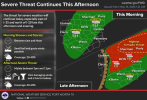
As of right now it looks like FWD is more concerned with the NE TX location later on this evening. In regards to the tornado threat.


By mid-afternoon, the surface dryline boundary will be pulled
eastward, advancing into western North Texas during peak heating.
Strong to severe thunderstorms are expected to develop near/east
of this boundary with aid from strong synoptic ascent from a deep
upper trough pivoting into the Central Plains. With significant
instability characterized by SBCAPE exceeding 4000 J/kg and strong
deep-layer shear exceeding 50 kts, a supercellular storm mode
should dominate initially, before perhaps eventual upscale growth
into clusters heading into the evening. This will support all
severe hazards, including large hail and a few tornadoes,
especially as 0-1 km shear/helicity increase heading towards
sunset with the onset of a strengthening low-level jet over parts
of Northeast Texas
. Another concern is the anticipated fast storm
motions later today, even for established supercells with deviant
motion. Mean steering flow will be in excess of 55 mph, left
splitting supercells could race northeast in excess of 60 mph, and
even right-movers could see ENE motions as high as 40-50 mph.
This will be of even greater concern if convection is still
ongoing after nightfall which is possible in parts of Northeast
Texas.


1747662889985.png
 
2025 has incredibly violent so far... What has been happening and why?
2024 has been similar in activity between march and May.

Tornado outbreak sequences are caused by PNA patterns, which is based on geopotential height and sea level pressure anomalies in the general area between the north west pacific and west coast of North America.

-PNA patterns are identified when there are height falls (measured in decameters, and is caused by troughing), which promotes sea level pressure to drop over a large area. This eventually leads to the development of surface lows which then move east and are responsible for severe weather outbreaks.

PNA patterns can be influenced by ENSO state, but for the most part the teleconnection is highly variable, and usually doesn’t stay in a specific phase for more than a week.

However, how often the PNA does go negative is more effected by ENSO state, and during neutral or La Niña, (particularly during the spring) North Pacific jet extensions tend to occur more often. (The key phrase is “more often” as these can happen regardless of ENSO state) These jet extensions cause Rosby wave breaking (which is just the breakdown of the jetstream into troughs/ridges) which are then westerly injected into North America.

Depending on the amplitude of the wave guide, which can go from low, neutral, or high amplitude, are responsible for most of our weather.

The trough present right now is a high amplitude longwave which is the trough type that produces the most substantial tornado outbreaks.

This year, including last year, we have had prevalent plains and Dixie tornado outbreaks, 2024 was during a La Niña and this year is a cold neutral, recall that 2011 was during a La Niña.

I wouldn’t be surprised if we have a more active summer than usual, 2004 was a neutral-Modoki ENSO state, and a -PNA pattern was present throughout the summer, which helped 2004 become the most tornado active season on record, with the help of the active hurricane season as well.

Obviously, this is a “VERY GENERAL” explanation and skips a laughable amount of critical details, but I don’t feel like writing a bible.
 
Back
Top