• Welcome to TalkWeather!
    We see you lurking around TalkWeather! Take the extra step and join us today to view attachments, see less ads and maybe even join the discussion.
    CLICK TO JOIN TALKWEATHER

Severe WX Severe Weather Threat June 6-14

I'm so curious what has caused every event this year to underperform so significantly. My gut is telling me it has something to do with the low pressure systems not being deep or isolated enough. Seems like every trough that ejects from the rockies is being handicapped in some way by a neighboring low pressure system or ridge.

Height falls are meager and I don't think we've seen any sub 990 mb lows verify. The ones that come close do seem to produce pretty significant and active weather.
 
I'm so curious what has caused every event this year to underperform so significantly. My gut is telling me it has something to do with the low pressure systems not being deep or isolated enough. Seems like every trough that ejects from the rockies is being handicapped in some way by a neighboring low pressure system or ridge.

Height falls are meager and I don't think we've seen any sub 990 mb lows verify. The ones that come close do seem to produce pretty significant and active weather.
That and the cuts. That doesn't belong here but the lack of soundings is also preventing us from recognising when a setup is cooked.
 
One thing of note is the subtle 700 mb inversion on your sounding. I'm not convinced totally that we see many, many initiation attempts tomorrow. I feel like this inversion could play a part in limiting crapvection plenty tomorrow. We will see.
This set up needs an inversion, the 3km NAM, which is notorious for its inversion layer bias, is the only cam that shows one, all other cams show a overly saturated profile which is actually the main failure mode here.

If your vertical profile is too moist, that lowers the LFC so much that air parcels don’t have time to actually ingest that moisture to grow larger and more buoyant before doing a free ascent. This can lead to anemic updrafts and in the face of such a high shear environment, can be a deal breaker for tornadoes.

The ventilation in the upper 400mb is also an issue, these storms will be moving over 40knots, when the upper level winds are moving around that speed or even slower, you’re going to get squashed, ratchet shaped blobs instead of the classic VDR arc sculpted supercells one would expect in a parameter space like this one.

If we could get a drier vertical profile and a more stout inversion layer, that should negate the ventilation issues a bit, considering it’s mid June, I would bet this does occur, as the latest runs show a drying trend.
 
This set up needs an inversion, the 3km NAM, which is notorious for its inversion layer bias, is the only cam that shows one, all other cams show a overly saturated profile which is actually the main failure mode here.

If your vertical profile is too moist, that lowers the LFC so much that air parcels don’t have time to actually ingest that moisture to grow larger and more buoyant before doing a free ascent. This can lead to anemic updrafts and in the face of such a high shear environment, can be a deal breaker for tornadoes.

The ventilation in the upper 400mb is also an issue, these storms will be moving over 40knots, when the upper level winds are moving around that speed or even slower, you’re going to get squashed, ratchet shaped blobs instead of the classic VDR arc sculpted supercells one would expect in a parameter space like this one.

If we could get a drier vertical profile and a more stout inversion layer, that should negate the ventilation issues a bit, considering it’s mid June, I would bet this does occur, as the latest runs show a drying trend.
I completely agree with you. The point I was trying to make is that I see the inversion as a positive to limit saturation issues, my wording mightve not been clear enough. Plus drier slot can aid ventilation issues like you said
 
This set up needs an inversion, the 3km NAM, which is notorious for its inversion layer bias, is the only cam that shows one, all other cams show a overly saturated profile which is actually the main failure mode here.

If your vertical profile is too moist, that lowers the LFC so much that air parcels don’t have time to actually ingest that moisture to grow larger and more buoyant before doing a free ascent. This can lead to anemic updrafts and in the face of such a high shear environment, can be a deal breaker for tornadoes.

The ventilation in the upper 400mb is also an issue, these storms will be moving over 40knots, when the upper level winds are moving around that speed or even slower, you’re going to get squashed, ratchet shaped blobs instead of the classic VDR arc sculpted supercells one would expect in a parameter space like this one.

If we could get a drier vertical profile and a more stout inversion layer, that should negate the ventilation issues a bit, considering it’s mid June, I would bet this does occur, as the latest runs show a drying trend.
 
A lot calling that a uncapped environment means tmrw will blow up into a MCS.

I think a lot are ignoring the inversion at 700-850mb. This could either hurt convection unless we have enough of a saturated layer so that there's a balance at mix so that storms develop but aren't choked off and we get relatively discrete convection.

Don't want to annoy, but would appreciate insight from people like @andyhb if possible
 
There is strong forcing tomorrow, getting convection will not be a problem. The bigger question is whether too much convection will form to take advantage of the parameter space near/south of the warm front. I do see the hints of an inversion/remnant EML in some soundings, but the high degree of moisture would probably act to lessen that.
 
There is strong forcing tomorrow, getting convection will not be a problem. The bigger question is whether too much convection will form to take advantage of the parameter space near/south of the warm front. I do see the hints of an inversion/remnant EML in some soundings, but the high degree of moisture would probably act to lessen that.
Well appreciated. I fully agree, it's about how much convection develops. The 12z HRRR has many "beans" if you will developing, but it is a bit of a more cramped in warm sector that way. Will have to see how the 18z HRRR trends
 
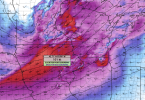
The magnitude of the wind fields being suggested by guidance tomorrow is upper echelon, especially for June. Very rare to see 90-100+ kt 500 mb maxes this late in the year (this from the 3 km NAM at 22z tomorrow).

Screenshot 2026-06-10 at 12.51.10 PM.png
 
The 18z could either be the same or we uptrend pretty decently. The latest outlook by Kerr is his usual conservative. Except I don't really blame him given lack of robust storms from CAM output. That could change though very easily.
Kerr gets too much hate. I don't blame him, especially this time, due to how much this season has underperformed more times than not.
 
Back
Top