• Welcome to TalkWeather!
    We see you lurking around TalkWeather! Take the extra step and join us today to view attachments, see less ads and maybe even join the discussion.
    CLICK TO JOIN TALKWEATHER

Severe Weather 3/15 - 3/16

I don’t think it’s overly important at the now-cast ish portion now to focus on risk levels, at least today. This is a high impact potential system. We’ve got a lot of people that deal with storm anxiety - know your area, the impacts, and take action if nothing happens.

Debating whether an event should’ve been (insert risk level here) can be done post-event.

SPC pros know what they’re doing and have good reason(s) for what level we’re at.
 
It remains possible, but, unclear if discrete per-frontal convection
can develop. Should this occur, supercells with a possible higher
tornado risk in addition to hail and damaging gusts would be
possible. This appears most likely where low-level moisture can
maintain dewpoints near 60 F. Given expected increase in severe
risk, the threat continues across the entirety of WW53 this
afternoon into this evening.

 
I don’t think it’s overly important at the now-cast ish portion now to focus on risk levels, at least today. This is a high impact potential system. We’ve got a lot of people that deal with storm anxiety - know your area, the impacts, and take action if nothing happens.

Debating whether an event should’ve been (insert risk level here) can be done post-event.

SPC pros know what they’re doing and have good reason(s) for what level we’re at.
Not trying to feed any fires, etc. just my two cents.

Game on. Let’s get through this!
 
Definitely an interesting event over the next two days. In my opinion, goes to show how important synoptics are that, despite pretty terrible moisture return, we've still ended up with a widespread severe weather risk due to how high-end the trough is.

For today, I'm of the opinion that the highest-end tornado event would actually come with a linear mode, more in line with the older RRFS, and some of the NSSL runs. On days like today where instability is on the lower end and lapse rates are meagre, you really want to rely on some sort of organised forcing - like the frontal trough - for tornado potential. Especially since the shear is strong, you would likely see plentiful QLCS circulations - and likely embedded supercells too.

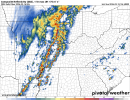
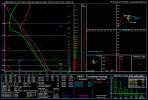
I've seen many people on twitter talking about how the HRRR appears concerning given how it shows broken storms/pre frontal convection. However even just by looking at the simulated reflectivity, the model is not actually resolving robust, dominant supercells, but pretty nebulous showers and storms, some of which may acquire brief rotation. Given that CAPE is pretty marginal (hovering around 1000j/kg) and lapse rates are quite low - you would expect any showers or storms to struggle somewhat and I think that's been directed fairly accurately here.

1773603389278.png1773603645069.png

The RRFS output is more concerning in that it depicts actual supercells ahead of the line - and RRFS has certainly had some good calls over the years - but it is also probably the most 'trigger happy' in terms of firing supercells and giving them UH streaks. But clearly it is a scenario worth being aware of, and the 500mb flow is quite favourable. I've seen some on twitter mention March 14th 2025 - in which storms were riding a nose of ~2000j/kg CAPE right under the 300mb jet core - this is just not the same calibre of setup (fortunately). I think even if we get pre-frontals, we will probably be looking at a more CIG1 tier event than CIG2 or higher.

However, regardless of what happens with any discrete supercells, there certainly exists potential for several tornadoes - including strong ones - if we do get a QLCS, from which embedded mesocyclones may be able to develop. Additionally we've seen tornadogensis occur just in prefrontal cells just ahead of the line as they become better forced. Potential for this is probably highest from NE AR/SE MO into W TN/KY (and maybe far N MS). And of course, widespread strong winds are likely. I think the SPC as usual have made a good call with the 10% CIG1: we've seen many more favourable setups for a QLCS outbreak in the past, but its worth never underestimating a high end synoptic.
 
Definitely an interesting event over the next two days. In my opinion, goes to show how important synoptics are that, despite pretty terrible moisture return, we've still ended up with a widespread severe weather risk due to how high-end the trough is.

For today, I'm of the opinion that the highest-end tornado event would actually come with a linear mode, more in line with the older RRFS, and some of the NSSL runs. On days like today where instability is on the lower end and lapse rates are meagre, you really want to rely on some sort of organised forcing - like the frontal trough - for tornado potential. Especially since the shear is strong, you would likely see plentiful QLCS circulations - and likely embedded supercells too.

I've seen many people on twitter talking about how the HRRR appears concerning given how it shows broken storms/pre frontal convection. However even just by looking at the simulated reflectivity, the model is not actually resolving robust, dominant supercells, but pretty nebulous showers and storms, some of which may acquire brief rotation. Given that CAPE is pretty marginal (hovering around 1000j/kg) and lapse rates are quite low - you would expect any showers or storms to struggle somewhat and I think that's been directed fairly accurately here.

View attachment 51885View attachment 51886

The RRFS output is more concerning in that it depicts actual supercells ahead of the line - and RRFS has certainly had some good calls over the years - but it is also probably the most 'trigger happy' in terms of firing supercells and giving them UH streaks. But clearly it is a scenario worth being aware of, and the 500mb flow is quite favourable. I've seen some on twitter mention March 14th 2025 - in which storms were riding a nose of ~2000j/kg CAPE right under the 300mb jet core - this is just not the same calibre of setup (fortunately). I think even if we get pre-frontals, we will probably be looking at a more CIG1 tier event than CIG2 or higher.

However, regardless of what happens with any discrete supercells, there certainly exists potential for several tornadoes - including strong ones - if we do get a QLCS, from which embedded mesocyclones may be able to develop. Additionally we've seen tornadogensis occur just in prefrontal cells just ahead of the line as they become better forced. Potential for this is probably highest from NE AR/SE MO into W TN/KY (and maybe far N MS). And of course, widespread strong winds are likely. I think the SPC as usual have made a good call with the 10% CIG2: we've seen many more favourable setups for a QLCS outbreak in the past, but its worth never underestimating a high end synoptic.
Indeed, I think it was @WeathermanLeprechaun who was mentioning lesser confidence in prefrontal activity. I agree in that with strongly-forced environments, especially here, where you will have a fast-moving QLCS, the main area to worry about is the line itself. You may even have convection out ahead, but in many cases they don't get properly-rooted, though they can result it constructive mergers with the QLCS which can create its own set of problems. That said, I still think the risk for strong tornadoes exists in any embedded mesocyclone that can become robust, and especially in any boundary-riders, which have a long history of being trouble for the Deep South in these kinds of setups. At this point though, I think it becomes a bit of hair-splitting - a tornado threat will exist either way, and a nearly-solid swath of 70+ MPH winds from Kentucky to the Gulf Coast is more than plenty to worry about.
 
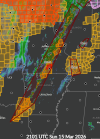
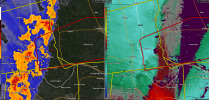
Most of these cells in western AR are showing evidence of rotation, leading to one being TOR-warned. Of course, a bunch of them are in the dreaded Texarkana Hole™, so that stinks.
1773608974754.png
 
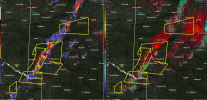
Strong indications of rotation in this TOR-warned storm north of St. Louis, including a developing inflow notch. Looking at it from TSTL because KLSX is RF city right now.
1773609076466.png
 
Indeed, I think it was @WeathermanLeprechaun who was mentioning lesser confidence in prefrontal activity. I agree in that with strongly-forced environments, especially here, where you will have a fast-moving QLCS, the main area to worry about is the line itself. You may even have convection out ahead, but in many cases they don't get properly-rooted, though they can result it constructive mergers with the QLCS which can create its own set of problems. That said, I still think the risk for strong tornadoes exists in any embedded mesocyclone that can become robust, and especially in any boundary-riders, which have a long history of being trouble for the Deep South in these kinds of setups. At this point though, I think it becomes a bit of hair-splitting - a tornado threat will exist either way, and a nearly-solid swath of 70+ MPH winds from Kentucky to the Gulf Coast is more than plenty to worry about.
Well said, agree with both of you.

Seen some on twitter calling for Moderate for this one but I think the current outlook adequately communicates the risk very well.
 
Well said, agree with both of you.

Seen some on twitter calling for Moderate for this one but I think the current outlook adequately communicates the risk very well.
I wouldn't be upset if they pulled out a 15%, but doesn't really feel like a situation where confidence is high enough for it; setups with some degree of uncertainty are more or less what 10% is made for (as far as its application over the years), so I'm happy with it. Wouldn't be surprised to see it pulled east if confidence continues to increase in overnight activity for the 01Z EOD update.
 
Back
Top