Definitely an interesting event over the next two days. In my opinion, goes to show how important synoptics are that, despite pretty terrible moisture return, we've still ended up with a widespread severe weather risk due to how high-end the trough is.
For today, I'm of the opinion that the highest-end tornado event would actually come with a linear mode, more in line with the older RRFS, and some of the NSSL runs. On days like today where instability is on the lower end and lapse rates are meagre, you really want to rely on some sort of organised forcing - like the frontal trough - for tornado potential. Especially since the shear is strong, you would likely see plentiful QLCS circulations - and likely embedded supercells too.
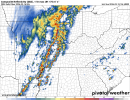
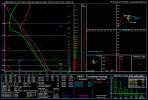
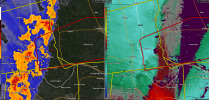
I've seen many people on twitter talking about how the HRRR appears concerning given how it shows broken storms/pre frontal convection. However even just by looking at the simulated reflectivity, the model is not actually resolving robust, dominant supercells, but pretty nebulous showers and storms, some of which may acquire brief rotation. Given that CAPE is pretty marginal (hovering around 1000j/kg) and lapse rates are quite low - you would expect any showers or storms to struggle somewhat and I think that's been directed fairly accurately here.
View attachment 51885View attachment 51886
The RRFS output is more concerning in that it depicts actual supercells ahead of the line - and RRFS has certainly had some good calls over the years - but it is also probably the most 'trigger happy' in terms of firing supercells and giving them UH streaks. But clearly it is a scenario worth being aware of, and the 500mb flow is quite favourable. I've seen some on twitter mention March 14th 2025 - in which storms were riding a nose of ~2000j/kg CAPE right under the 300mb jet core - this is just not the same calibre of setup (fortunately). I think even if we get pre-frontals, we will probably be looking at a more CIG1 tier event than CIG2 or higher.
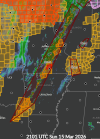
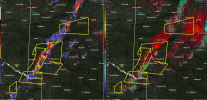
However, regardless of what happens with any discrete supercells, there certainly exists potential for several tornadoes - including strong ones - if we do get a QLCS, from which embedded mesocyclones may be able to develop. Additionally we've seen tornadogensis occur just in prefrontal cells just ahead of the line as they become better forced. Potential for this is probably highest from NE AR/SE MO into W TN/KY (and maybe far N MS). And of course, widespread strong winds are likely. I think the SPC as usual have made a good call with the 10% CIG2: we've seen many more favourable setups for a QLCS outbreak in the past, but its worth never underestimating a high end synoptic.