• Welcome to TalkWeather!
    We see you lurking around TalkWeather! Take the extra step and join us today to view attachments, see less ads and maybe even join the discussion.
    CLICK TO JOIN TALKWEATHER

Severe Weather 2026

The f#ck?
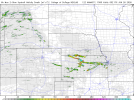
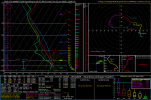
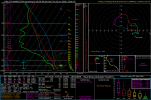
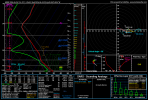
Helicity values of 700+ with 6000+SB cape? I can’t recall/remember ever seeing that on a modeled sounding.
View attachment 53883
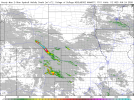
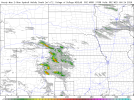
I'm skeptical based purely on how small the area is. It seems quite conditional based on that alone. However, I definitely don't think i've ever seen UD helicity swaths quite like these. Looks like ground scraping mesos with 10-mile-wide embedded wedges lmao. Sounding 1 is from directly in front of the N KS blue, 2 is in front of the central KS blue. interestingly, Stormnet has the tornado risk much further SE than these tracks (more into Oklahoma). Also worth mentioning the track screenshot is from the last frame of the most recent NAM run so who knows how it progresses in the hours after that. These shear vectors are wild.

1782230084373.png

1782229942352.png1782229983861.png
 
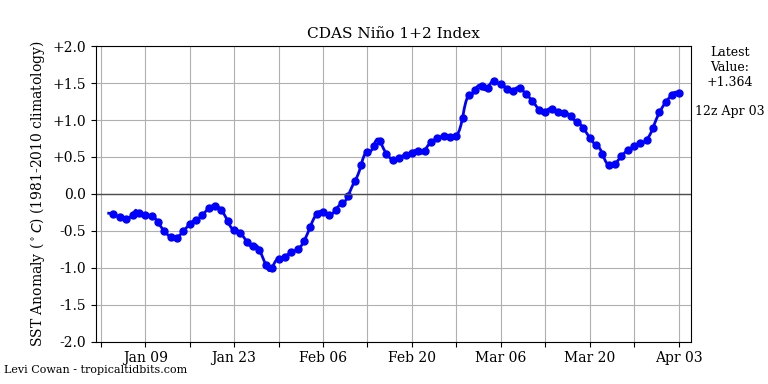
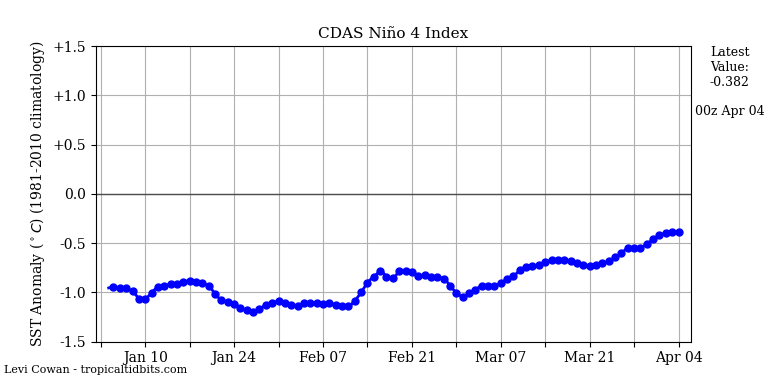
TNI values (Nino 1+2 minus Nino 4) have also gone up by .7 to 1.67, which is very high. Remember, that anything over 1 is positively correlated to tornado outbreaks. Looking at the GFS for the Northern hemisphere reveals a ridiculously chaotic pattern above the polar vortex, and all sorts of Rossby wave mayhem. I'm a firm believer in the Kara Sea Ridge theories now. Basically, it looks like rapidly melting arctic ice is going to keep things extremely active for the foreseeable future.

nino12.png
nino4.png


1782231304884.png
 
RRFS A, FV3, and MPAS are all not showing anything even remotely similar to what the NAM 3km is. Not even the regular NAM agrees with it, but it does show a decent environment further East. I'm chalking this up as a fluke run until there's more supporting evidence.
 
RRFS A, FV3, and MPAS are all not showing anything even remotely similar to what the NAM 3km is. Not even the regular NAM agrees with it, but it does show a decent environment further East. I'm chalking this up as a fluke run until there's more supporting evidence.
Erm, not exactly.
There’s substantial disagreement because the trough responsible is extremely low amplitude, diffuse, and honestly barely a trough at all.
1782234505798.png
This leads to massive uncertainty on where the surface low will be from the height falls caused by this trough.
A rule of thumb (and is why I put more stock in the 3kmNam for this specific instance) is that surface lows tend to develop at the triple point junction of their boundaries.
The warm front will be in northern central Ks, so where that front connects to the dryline is where the surface low likely will develop. This will put the bulk of the activity in central KS/northern OK; “coincidentally” where storm net has the highest probs.
 
Back
Top