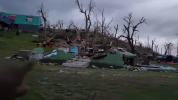
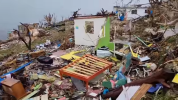
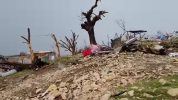
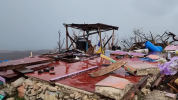
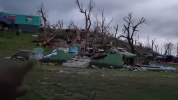
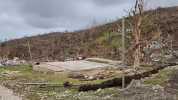
Obviously, the damage is extremely impressive for a TC, likely the strongest TC wind damage we've ever seen in history. But I believe a more detailed analysis is necessary.
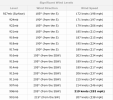
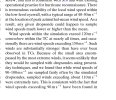
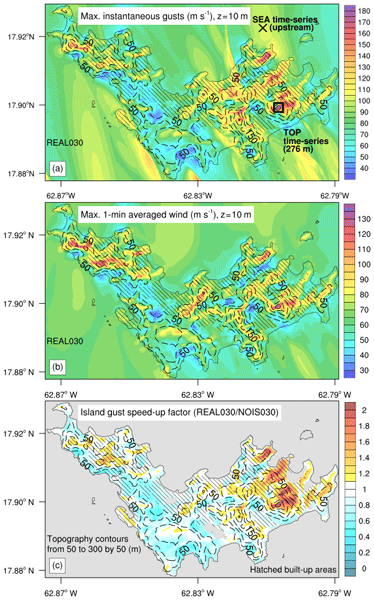
Beeston Springs and the nearby towns and villages are situated on mountain slopes at elevations between 200-500 meters. These areas lie well within the hurricane's boundary layer and are also on windward slopes. The wind speed conversion ratio from the hurricane's mean surface to 300-500 meters is approximately 0.7. Due to topographic effects, the gust factor is relatively high. Here, I take it as 1.3. Assuming the hurricane's intensity at the time was around 150 knots (within half an hour of landfall), the maximum gusts in this region could conservatively reach 300 mph with sustained wind speed well into 200mph. (sustained winds might have been slightly weaker due to the influence of friction.)Multiple studies on Category 5 hurricane boundary-layer wind speeds support that such winds are entirely possible.
View attachment 48786
Abstract. In view of the high vulnerability of the small islands of the Lesser Antilles to cyclonic hazards, realistic very fine scale numerical simulation of hurricane-induced winds is essential to prevent and manage risks. The present innovative modeling aims at combining the most...

nhess.copernicus.org
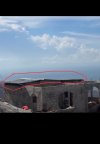
Then we can look into damage: the destruction across the area clearly reflects how buildings of varying quality perform differently under extreme wind speeds. First, in terms of this house below
View attachment 48785
a concrete block house reinforced with rebar, with a sheet metal roof. Its original appearance can be inferred from nearby houses that were not completely destroyed.
View attachment 48781
Not far away, same type of house but built with a concrete roof remains intact.
View attachment 48783
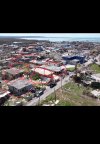
This disparity in damage is observable throughout Jamaica. Almost all these types of building covered with concrete roof remains intact and those built with wooden roof would been more or less damaged.
View attachment 48787
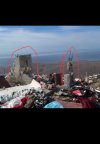
A closer look at this destruction reveals that the sections reinforced with rebar remain standing, while the collapsed portions include the sheet metal roof and unreinforced concrete block walls.
View attachment 48784
The houses got damaged from 2015 Ciudad Acuña tornado is almost identical to this which can take a reference here.
View attachment 48780
Also concrete block houses reinforced by rebar, but all covered with concrete roofs. Many of those houses suffered extensive wall collapses, with at least one being completely leveled.
View attachment 48782
There seems to be some debate regarding the rating and intensity of the Ciudad Acuña tornado. However, if the house above in Ciudad Acuña can be rated EF5, then Melissa’s concrete block house could only be rated EF3. If the house in Ciudad Acuña can be rated EF4, then Melissa’s house would only qualify for EF2, given the significant differences in both construction quality and damage severity.
Then, this house below was a CMU house not reinforced with rebar get leveled. Similar houses in US would typically get high end EF3 to low end EF4 rating. I would tend to give high end EF3 to this one given lack of rebar
View attachment 48788
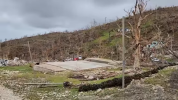
Then this one slabbed is just a barn, more like SBO building in EF scale.
View attachment 48789
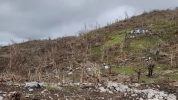
Trees around the area were completed destroyed. I'm not an expert on this. But not exactly looks like "debarking" in my eye.However, this isn't all that matters. Under such prolonged extreme wind speeds from a Cat5 hurricane of this magnitude, these trees ought to have been destroyed.