• Welcome to TalkWeather!
    We see you lurking around TalkWeather! Take the extra step and join us today to view attachments, see less ads and maybe even join the discussion.
    CLICK TO JOIN TALKWEATHER

Enhanced Fujita Ratings Debate Thread

I’ve thought about this. Generally it’s thought that EF4+ wind speeds have to occur for this to happen but the current transmission tower DI tops out at 165 MPH, hence the EF3 rating in Kouts this year.

One issue though in terms of calculating it though may stem from the fact that it’s not a “solid” object (not the best description but you know what I’m getting at). Instead, it’s a latticework of interconnected metal bars with lots of space in between for the wind to pass through. I could be wrong, but it might be tough to calculate due to the wind passing through much of the tower during a tornado impact. Another problem is a transmission tower isn’t going to maintain the same shape and weight distribution when being hit by a tornado. It’s going to twist and crumple into different unpredictable shapes while being lofted.

The bridge support that was thrown up the canyon embankment at Hurricane Creek outside of Tuscaloosa also had a similar truss-type structural makeup. I think that one might also be tougher to calculate for that reason too, among others.
Wasn't Bowdle (at least partially) rated EF4 based on damage to transmission towers?

FWIW, Spann wrote in his 4/27 book that he believes the destruction of the railroad bridge over Hurricane Creek was indicative of EF5 intensity. I know he's not a damage survey expert, but he is a well-respected meteorologist in the field, and honestly, that (combined with the AMETSOC paper that rates the tornado EF5 based on treefall patterns near the bridge) is good enough for me.
 
Wasn't Bowdle (at least partially) rated EF4 based on damage to transmission towers?

FWIW, Spann wrote in his 4/27 book that he believes the destruction of the railroad bridge over Hurricane Creek was indicative of EF5 intensity. I know he's not a damage survey expert, but he is a well-respected meteorologist in the field, and honestly, that (combined with the AMETSOC paper that rates the tornado EF5 based on treefall patterns near the bridge) is good enough for me.
Oh yeah Bowdle absolutely was. But they had to “break the rules” and go beyond the assigned upper bound for transmission towers, which is something most WFOs are not going to. Hopefully the new upper bound for transmission towers will be extended into the EF4 range once the updated scale is rolled out.

Also I’m not at all doubting that EF5 winds were required to do that to the Hurricane Creek railroad bridge support. In fact, I’m highly confident that EF5 winds had to have occurred there, and the treefall data from that location backs it up even more. I’m just saying getting a precise calculation might be tough there due to the shape/design of the support, along with the fact that the calculation wouldn’t just be as simple as “what windspeed is needed to loft this bridge support?”. The calculation would be, “What windspeed is needed to roll this bridge support up an embankment with a slope of this specific degree, tumbling it uphill but without fully lofting it?” That’s very specific and tricky. But is it impossible? Probably not, but it would definitely take a lot more work and involve far more variables than a lofted fertilizer tank or train car.

The railroad bridge is one of the top two things I want to see calculated, but I’ve been really thinking about it lately, and it’s going to be a lot more complicated than I first thought it would be.
 
Last edited:
Oh yeah Bowdle absolutely was. But they had to “break the rules” and go beyond the assigned upper bound for transmission towers, which is something most WFOs are not going to. Hopefully the new upper bound for transmission towers will be extended into the EF4 range once the updated scale is rolled out.

Also I’m not at all doubting that EF5 winds were required to do that to the Hurricane Creek railroad bridge support. In fact, I’m highly confident that EF5 winds had to have occurred there, and the treefall data from that location backs it up even more. I’m just saying getting a precise calculation might be tough there due to the shape/design of the support, along with the fact that the calculation wouldn’t just be as simple as “what windspeed is needed to loft this bridge support?”. The calculation would be, “What windspeed is needed to roll this bridge support up an embankment with a slope of this specific degree, tumbling it uphill but without fully lofting it?” That’s very specific and tricky. But is it impossible? Probably not, but it would definitely take a lot more work and involve far more variables than a lofted fertilizer tank or train car.

The railroad bridge is one of the top two things I want to see calculated, but I’ve been really thinking about it lately, and it’s going to be a lot more complicated than I first thought it would be.

I'm currently at the realization that it's completely unreasonable to try and attach an exact wind speed to tornado damage. We really need to go back to more broad wind speed ranges for these classifications.

I'm sure the question "Is it probable sub-200 mph winds could cause this damage?" Is much easier to answer mathematically than "what exact wind speed caused this damage?"
 
I'm currently at the realization that it's completely unreasonable to try and attach an exact wind speed to tornado damage. We really need to go back to more broad wind speed ranges for these classifications.

I'm sure the question "Is it probable sub-200 mph winds could cause this damage?" Is much easier to answer mathematically than "what exact wind speed caused this damage?"
Yeah I’ve often thought about that. Maybe keeping things more broad and maybe assigning a range of possible wind speeds could solve some of the issues? It’s an interesting idea.
 

Seconding the Floyd research by Anton here. This has always been my TOTY of 2025 (yes, i hold the hot seat for this one), and this definitely proves the theory some have that maybe we underestimate how truly easy it is for a tornado to breach EF4-EF5 intensity.

Honestly quite extraordinary research, and i know that Anton Seimon worked with Pecos Hank, i believe in 2019 scanning one of the tornadoes on 5/28 that year. Note these findings are VERY preliminary but this proves to me you don't need 400 SRH at all to produce a violent tornado too.
 
It's definitely from Greenfield, from a CAP overflight of the damage path per andyhb's original post: https://talkweather.com/threads/severe-weather-threat-5-19-5-22-2024.2275/page-53#post-121789

Honestly, that would be textbook EF5 damage if the home was well-anchored. I don't think it was, but have never been able to definitively confirm which damage point on the DAT corresponds to that house.
Huge thanks for this!

Yeah I’ve often thought about that. Maybe keeping things more broad and maybe assigning a range of possible wind speeds could solve some of the issues? It’s an interesting idea.

I think a silver lining to the NWS's stubbornness to upgrade tornadoes has been all the good science that has been published in the meantime. If so much of these findings didn't contradict official ratings, they might not have gotten the same recognition and widespread discussion. While we might not get upgrades anytime soon, it's still important to gather the data that will need to be used to determine corrected wind speed ranges.

There's certainly enough methodology now to peg down some pretty accurate wind speeds.

We have solid understandings of:
Lofting of large objects
Tree fall
Cycloidal marks
Strong doppler radar correlations like debris height
Engineering

None of these methods are individually perfect, but together, much more realistic probabilistic analysis can be done. A realistic curve would probably have the maximum EF rating on the lower tail, radar data on the upper tail, then a combination of the rest in the middle. Based on the confidence values associated with the middle analysis you could come up with a pretty realistic most likely wind speed.
 
The slides are funny because they keep reiterating the same thing

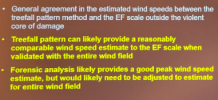
General agreement in the estimated wind speeds between treefall pattern method and the EF scale outside the violent core of damage.

Basically, they're in agreement everywhere but the most important region of the tornado lmao. The following bullet point says,

Treefall pattern can likely provide a reasonably comparable wind speed estimate to the EF scale when validated with the entire wind field.

It's so weird how experts constantly tip-toe around the EF Scale like it's a person with feelings or something. The scale was never devised to evaluate "general wind speeds" across an entire tornado. The goal has always been to find the maximum damage and maximum wind speeds. This approach is revisionist to the entire history and purpose of both Fujita scales.

I understand Lyza is playing the long game here, and trying not to ruffle any feathers, but it begs the question, whose feathers are getting ruffled over this? Why is there this weird controlling shadow over tornado science holding it back at every turn, when there's seemingly no actual public figures leading this field?

1786029135756.png
 

Seconding the Floyd research by Anton here. This has always been my TOTY of 2025 (yes, i hold the hot seat for this one), and this definitely proves the theory some have that maybe we underestimate how truly easy it is for a tornado to breach EF4-EF5 intensity.

Honestly quite extraordinary research, and i know that Anton Seimon worked with Pecos Hank, i believe in 2019 scanning one of the tornadoes on 5/28 that year. Note these findings are VERY preliminary but this proves to me you don't need 400 SRH at all to produce a violent tornado too.

In case anyone was wondering, the only "F4" in New Mexico history was in October (!) of 1908

 
The slides are funny because they keep reiterating the same thing

Basically, they're in agreement everywhere but the most important region of the tornado lmao. The following bullet point says -img
Essentially, my biggest takeaway becomes that the EF scale vastly improved the F-scale's ability to rate weaker/borderline strong tornadoes, but vastly set us back for the upper end of EF3 and beyond. The F-scale becomes better suited for characterizing more violent outbreaks, AKA the ones that matter the most. If I absolutely had to pick between the two, I really don't know which one I would pick. In a vacuum, I'd pick the EF scale, since it is objectively better when it is applied and used correctly and when effort is put into it.* But there's no denying that surveyors are extremely inconsistent across WFOs and that leads to horrendous misuses of it that we see today across a lot of the surveyors in the country. At least we have Grand Forks, Norman, and Jackson to show how the EF scale can be better when used correctly, unlike the Memphis and Springfield offices.
It's so weird how experts constantly tip-toe around the EF Scale like it's a person with feelings or something. The scale was never devised to evaluate "general wind speeds" across an entire tornado. The goal has always been to find the maximum damage and maximum wind speeds. This approach is revisionist to the entire history and purpose of both Fujita scales.

I understand Lyza is playing the long game here, and trying not to ruffle any feathers, but it begs the question, whose feathers are getting ruffled over this? Why is there this weird controlling shadow over tornado science holding it back at every turn, when there's seemingly no actual public figures leading this field?
This is how professional science is conducted, and they word it like this to be as objective and unbiased as possible in their assessment/interpretation of the data. Individual studies like this will serve as compounding evidence against the current EF scale's use. I don't think anyone's feathers are getting ruffled here, he's saying it like it is in a professional way. Personally, I wouldn't look at it this way at all, and I would imagine that this presentation was received well by the leading experts in tornado science that were present at this conference.

* By "objectively better" I'm not talking about the windspeed estimates attached to the scale, I'm talking about the ratings themselves. EF scale windspeed estimates are very poor, as we all know.
 
In case anyone was wondering, the only "F4" in New Mexico history was in October (!) of 1908

As someone who has periodically lived there, I am like 90% sure the reason is kinda similar to a lot of northern plains outbreaks where there are like, 0 damage indicators (not even trees!) out there, especially far outside of Albuquerque, Roswell, and Santa Fe. I'd wager some of the other NM tornado events are similarly comically underrated.
 
Interesting aside, the only other time I (and probably many other severe weather history buffs) have heard of Tucumcari is in reference to the (now defunct) NOAA wind profiler site located there, which is what allowed the SPC to catch the incoming jet streak in time to upgrade the 1630Z outlook to a moderate risk on May 3, 1999.
 

Seconding the Floyd research by Anton here. This has always been my TOTY of 2025 (yes, i hold the hot seat for this one), and this definitely proves the theory some have that maybe we underestimate how truly easy it is for a tornado to breach EF4-EF5 intensity.

Is it that the tornadoes are reaching EF-4+ intensity, or that the probability of EF-whatever damage being observed at speeds given by engineering analysis is not actually that high? Especially when there is a strong bias towards assigning the lower bound.

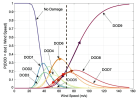
That goes back to that paper on fragility curves calculated from tree windfall derived speeds in Joplin. The calculated median windspeed for DoD 9 was 192 MPH, which is close to the upper bound. While engineering analyses might say that given damage could occur at a given windspeed, it's not a discrete thing and there might only be x% chance of it actually happening, so we should actually expect a range of probabilities.

If we follow that paper, engineering based EF-scale analyses are biased towards estimating low windspeeds for an observed DoD (i.e. saying that a given DoD occured at a windspeed where the probability of it actually occuring is not that high). This means we could expect alternative measurement methods to yield higher windspeeds than EF-scale estimates, without any so estimated tornado necessarily being capable of proportionately more intense damage if you went by EF-scale ranges.
 
Last edited:


Interesting to note in comparison to Enid - pretty much the entire probability distribution is above the EF5 threshold. With a result like that, essentially saying "it is impossible <200mph winds caused this damage feat", it is easier to see how an EF5 rating was allowed even through all the layers of bureaucracy.
 
Is it that the tornadoes are reaching EF-4+ intensity, or that the probability of EF-whatever damage being observed at speeds given by engineering analysis is not actually that high? Especially when there is a strong bias towards assigning the lower bound.

That goes back to that paper on fragility curves calculated from tree windfall derived speeds in Joplin. The calculated median windspeed for DoD 9 was 192 MPH, which is close to the upper bound. While engineering analyses might say that given damage could occur at a given windspeed, it's not a discrete thing and there might only be x% chance of it actually happening, so we should actually expect a range of probabilities.

If we follow that paper, engineering based EF-scale analyses are biased towards estimating low windspeeds for an observed DoD (i.e. saying that a given DoD occured at a windspeed where the probability of it actually occuring is not that high). This means we could expect alternative measurement methods to yield higher windspeeds than EF-scale estimates, without any so estimated tornado necessarily being capable of proportionately more intense damage if you went by EF-scale ranges.
I’ve read this paper over a few times now and finally it’s clearer to me. It was a bit hard for me to decipher, but basically it seems like scientific evidence of something I have been saying for a long time, which is:

“The windspeed at which something COULD potentially begin to happen, is very different from the windspeed at which something TENDS TO happen”

For example, tree damage. The EF scale currently has total stubbing and debarking occurring largely in the EF2 to EF3 range. In real life though, actual case studies that compare tree damage to nearby structural damage, computer based physics modeling, and general statistical correlation from my personal observations over the years all suggest that total stubbing and debarking has a much stronger correlation with the EF4+ range. Now can really severe stubbing and debarking happen in the EF2 to EF3 range? Yes, but it’s quite rare and the only examples are cherry picked outliers. Thankfully the concept of severe debarking/stubbing as an EF4 indicator is slowly catching on, but you get my point, and I’m sure the same sentiment can be applied to other DIs as well. The scale and its application operates on a “windspeed at which this degree of damage could begin to happen” basis rather than a “windspeed at which this usually happens” basis. If the objective is finding the most likely actual max windspeed of the tornado based on damage, this approach isn’t favorable.

But with this said, at this stage I don’t really care about the wind speed estimates handed out in actual surveys themselves, because I’m not at all confident that they are genuinely accurate. They are simply a safe, conservative estimate rather than an accurate reading of the tornado’s actual intensity. Instead, I more prefer to rate and discuss tornadoes via a spectrum of EF-scale rankings rather than trying to assign an accurate windspeed estimate. For example, I prefer to simply say “low-end EF4 tornado” rather than “170 MPH tornado” because I’m not so sure that 170 MPH tends to be the most likely maximum real life windspeed for any given tornado that produces that kind of damage. When I do use numbers and wind speeds, I’m actually more just using them as placeholders to convey where the tornado was within the spectrum of an EF scale ranking (high-end, low-end, etc) rather than actually believing that this was the actual maximum windspeed.

But yeah overall, the paper seems to back up my thinking on this topic: EF scale windspeed estimates that get handed out are the lowest conceivable failure point of the DIs, but are conveyed to the public as the tornado’s maximum windspeed, when in reality these can be and often are two very different things.
 
Back
Top