Is it that the tornadoes are reaching EF-4+ intensity, or that the probability of EF-whatever damage being observed at speeds given by engineering analysis is not actually that high? Especially when there is a strong bias towards assigning the lower bound.
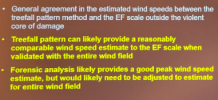
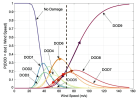
That goes back to that paper on fragility curves calculated from tree windfall derived speeds in Joplin. The calculated median windspeed for DoD 9 was 192 MPH, which is close to the upper bound. While engineering analyses might say that given damage could occur at a given windspeed, it's not a discrete thing and there might only be x% chance of it actually happening, so we should actually expect a range of probabilities.
If we follow that paper, engineering based EF-scale analyses are biased towards estimating low windspeeds for an observed DoD (i.e. saying that a given DoD occured at a windspeed where the probability of it actually occuring is not that high). This means we could expect alternative measurement methods to yield higher windspeeds than EF-scale estimates, without any so estimated tornado necessarily being capable of proportionately more intense damage if you went by EF-scale ranges.
I’ve read this paper over a few times now and finally it’s clearer to me. It was a bit hard for me to decipher, but basically it seems like scientific evidence of something I have been saying for a long time, which is:
“The windspeed at which something COULD potentially begin to happen, is very different from the windspeed at which something TENDS TO happen”
For example, tree damage. The EF scale currently has total stubbing and debarking occurring largely in the EF2 to EF3 range. In real life though, actual case studies that compare tree damage to nearby structural damage, computer based physics modeling, and general statistical correlation from my personal observations over the years all suggest that total stubbing and debarking has a much stronger correlation with the EF4+ range. Now can really severe stubbing and debarking happen in the EF2 to EF3 range? Yes, but it’s quite rare and the only examples are cherry picked outliers. Thankfully the concept of severe debarking/stubbing as an EF4 indicator is slowly catching on, but you get my point, and I’m sure the same sentiment can be applied to other DIs as well. The scale and its application operates on a “windspeed at which this degree of damage could begin to happen” basis rather than a “windspeed at which this usually happens” basis. If the objective is finding the most likely actual max windspeed of the tornado based on damage, this approach isn’t favorable.
But with this said, at this stage I don’t really care about the wind speed estimates handed out in actual surveys themselves, because I’m not at all confident that they are genuinely accurate. They are simply a safe, conservative estimate rather than an accurate reading of the tornado’s actual intensity. Instead, I more prefer to rate and discuss tornadoes via a spectrum of EF-scale rankings rather than trying to assign an accurate windspeed estimate. For example, I prefer to simply say “low-end EF4 tornado” rather than “170 MPH tornado” because I’m not so sure that 170 MPH tends to be the most likely maximum real life windspeed for any given tornado that produces that kind of damage. When I do use numbers and wind speeds, I’m actually more just using them as placeholders to convey where the tornado was within the spectrum of an EF scale ranking (high-end, low-end, etc) rather than actually believing that this was the actual maximum windspeed.
But yeah overall, the paper seems to back up my thinking on this topic: EF scale windspeed estimates that get handed out are the lowest conceivable failure point of the DIs, but are conveyed to the public as the tornado’s maximum windspeed, when in reality these can be and often are two very different things.