• Welcome to TalkWeather!
    We see you lurking around TalkWeather! Take the extra step and join us today to view attachments, see less ads and maybe even join the discussion.
    CLICK TO JOIN TALKWEATHER

Enhanced Fujita Ratings Debate Thread

The other issue with Bakersfield is it should’ve broken our record drought of 4 or more violent tornados in 3 days that is outlined on the SPC Violent tornado webpage. The last occurrence of that was the Pilger day in 2014. You have to go back to the decade of 1930 to find another similar length drought.

However, with the way ratings currently are, it’s not surprising we are in a record drought of that specific metric.

The 4 that would’ve broken the record from 3/14 and 3/15:
1. Fifty-Six, AR
2. Diaz, AR
3. Bakersfield, MO
4. Tylertown, MS

I think it's also safe to say that the december 2021 outbreak should've also broken that drought with Saloma and Bowling Green.
 
I realize I’m a little late to the party here, but going back to Enid, and specifically Enderlin: was it ever expanded on why rating a tornado an EF5 requires a deluge of meetings? Is it just the natural path of bureaucracy? I distinctly remember the MIC of Grand Forks on WeatherBrains saying they had meet with the SPC when they were going to rate Enderlin a 5. Why the SPC?


Edit: didn’t a past user on here claim that Paducah wanted to rate Mayfield a 5 but that the regional parent office squashed it? He claimed to have heard that straight from the surveyors, although I questioned that when I read it on here originally. With Grand Forks expanding on the process in WeatherBrains, I don’t think those claims are far-fetched. The person’s username escapes me, but he was adamant on that claim.
 
Last edited:
The other issue with Bakersfield is it should’ve broken our record drought of 4 or more violent tornados in 3 days that is outlined on the SPC Violent tornado webpage. The last occurrence of that was the Pilger day in 2014. You have to go back to the decade of 1930 to find another similar length drought.

However, with the way ratings currently are, it’s not surprising we are in a record drought of that specific metric.

The 4 that would’ve broken the record from 3/14 and 3/15:
1. Fifty-Six, AR
2. Diaz, AR
3. Bakersfield, MO
4. Tylertown, MS
I really wouldn’t count tornado intensity records beyond 2013 reliable enough to compare to past records if we’re trying to do consistent tornado climate data analysis.
Obviously theres plenty of inconsistencies with tornado ratings back then, but the thing is though it usually was in the opposite direction of overestimating them, which was a way better thing to do then consistently going for the lower bound like we do now.
To speak nothing of the disastrous way of how we handle EF5s now with the whole systematic processing through multiple government agencies of non conventional DIs as being the only possible means to get tornadoes of that rating.
 
In the context of this current conversation I just want to reshare some Greenfield photos. Over 30 homes were completely destroyed and swept off their foundations. The tornado cut right through the middle of town. This is a normal, average, American small town. Isn't it odd the tornado was given a max rating of 180 mph? Swiping through a town so devastatingly the scar can be seen from space, is still only good for a lower-bound wind speed rating, despite the fact the expected wind speed rating of 200 mph was derived from the average American home.

screenshot-2024-09-09-020128-png.29979

gonrw05acaa6skz-jpg.29976

save_20240606_233147-jpg.29978

aerial_imagery_of_ef4_damage_to_homes_in_greenfield-_iowa-jpg.29961

1716477657898-png.27541

gomcmjyxaaab-9q-jpg.29975
 
In the context of this current conversation I just want to reshare some Greenfield photos. Over 30 homes were completely destroyed and swept off their foundations. The tornado cut right through the middle of town. This is a normal, average, American small town. Isn't it odd the tornado was given a max rating of 180 mph? Swiping through a town so devastatingly the scar can be seen from space, is still only good for a lower-bound wind speed rating, despite the fact the expected wind speed rating of 200 mph was derived from the average American home.

screenshot-2024-09-09-020128-png.29979

gonrw05acaa6skz-jpg.29976

save_20240606_233147-jpg.29978

aerial_imagery_of_ef4_damage_to_homes_in_greenfield-_iowa-jpg.29961

1716477657898-png.27541

gomcmjyxaaab-9q-jpg.29975
Honestly while I get the sentiment I've never been offended by Greenfield's rating, I guess it would also work as an upper end EF4 but even then where it is now is fine. Which makes the DOW readings even stranger tbh.
 
Honestly while I get the sentiment I've never been offended by Greenfield's rating, I guess it would also work as an upper end EF4 but even then where it is now is fine. Which makes the DOW readings even stranger tbh.

I'm choosing to respond to this comment because it represents the standard clueless Twitter and Reddit mindset. Nothing against you, because your comment is a very average and normal stance to have. It's just misguided.

The 180 mph rating has nothing to do with the actual wind speeds of the tornado, and is 100% disconnected from the DOW recorded wind speeds. Even the surveyors who gave it the rating would likely say as much. Greenfield was given the 180 mph rating because it's the minimum wind speeds Engineers decided were required to cause the damage sustained by those homes, due to their construction quality. This rating was given despite the fact engineers and scientists already agreeing that 200 mph winds are required to sweep the average American home. Surely, the surveyors didn't decide there wasn't a single average home in the whole town, right? There were over 35 DOD 10 homes to choose from, after all. The rating is purely the result of compounding precedent over time, which has lead to Lower Bound wind speeds becoming the standard. It's the same precedent that has lead to Enid's final rating, and all the other underrated tornadoes.

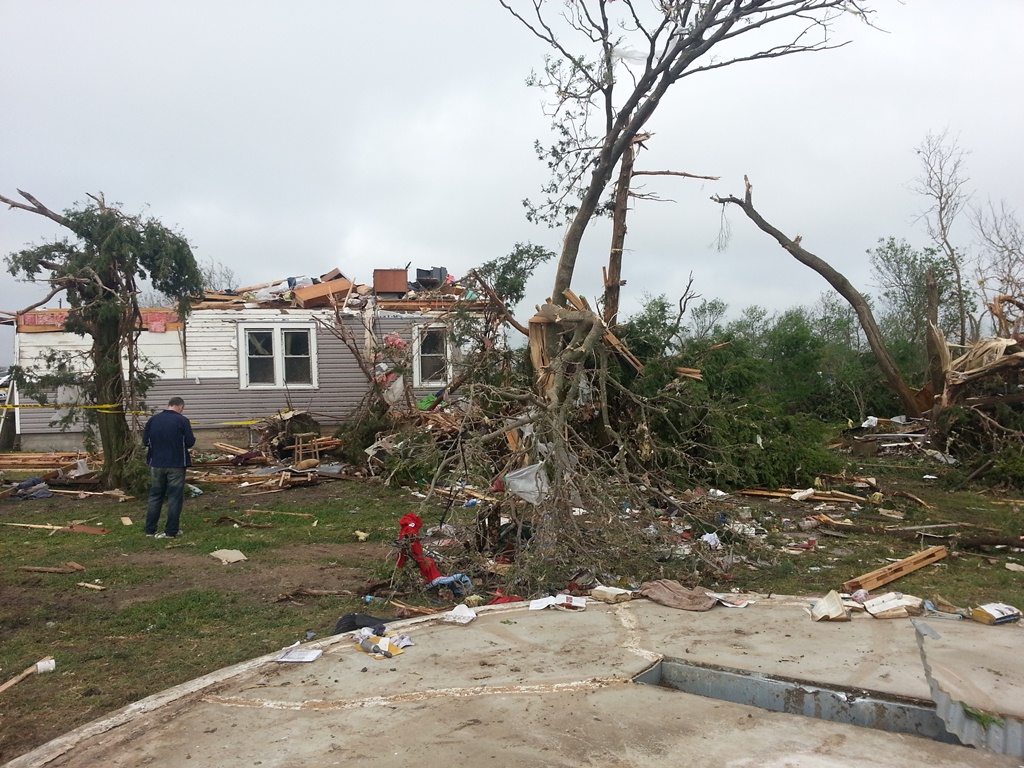
Here is what the damage looked like where a direct OTG measurement of 175 mph winds were recorded by the TIV2. As you can see, there's no defoliation or debarking to speak of. And in the immediate vicinity a home only sustained low-end EF3 damage. It's not at all difficult to see how a 1-5 second wind gust of 320 mph would cause the damage seen in Greenfield, which was several orders of magnitude more intense. The tornado was 100 meters wide and moving at 60 mph. The actual wind speed of the tornado is not in question (at least not by anyone with half a brain cell). It's the damage classification that is the problem, and by extension, the wind speeds assigned to that classification. Being "fine" with Greenfield's rating is being fine with all tornado ratings since 2013. I don't think enough people in this thread realize that. ALL tornadoes are underrated by about 40 mph on average. Not just the more textbook EF5s.

save_20240119_090737-jpg.23531
house1a.jpg
 
The fact wind speeds are so clearly disconnected from tornado ratings makes the actual damage classification discussion, so much more difficult to have. There's way more tornadoes with 205+ mph winds than there are that match the top 1% upper-echelon intensity we've come to associate with F5 and EF5 ratings.
 
Back
Top