• Welcome to TalkWeather!
    We see you lurking around TalkWeather! Take the extra step and join us today to view attachments, see less ads and maybe even join the discussion.
    CLICK TO JOIN TALKWEATHER

Enhanced Fujita Ratings Debate Thread

The other issue with Bakersfield is it should’ve broken our record drought of 4 or more violent tornados in 3 days that is outlined on the SPC Violent tornado webpage. The last occurrence of that was the Pilger day in 2014. You have to go back to the decade of 1930 to find another similar length drought.

However, with the way ratings currently are, it’s not surprising we are in a record drought of that specific metric.

The 4 that would’ve broken the record from 3/14 and 3/15:
1. Fifty-Six, AR
2. Diaz, AR
3. Bakersfield, MO
4. Tylertown, MS

I think it's also safe to say that the december 2021 outbreak should've also broken that drought with Saloma and Bowling Green.
 
I realize I’m a little late to the party here, but going back to Enid, and specifically Enderlin: was it ever expanded on why rating a tornado an EF5 requires a deluge of meetings? Is it just the natural path of bureaucracy? I distinctly remember the MIC of Grand Forks on WeatherBrains saying they had meet with the SPC when they were going to rate Enderlin a 5. Why the SPC?


Edit: didn’t a past user on here claim that Paducah wanted to rate Mayfield a 5 but that the regional parent office squashed it? He claimed to have heard that straight from the surveyors, although I questioned that when I read it on here originally. With Grand Forks expanding on the process in WeatherBrains, I don’t think those claims are far-fetched. The person’s username escapes me, but he was adamant on that claim.
 
Last edited:
The other issue with Bakersfield is it should’ve broken our record drought of 4 or more violent tornados in 3 days that is outlined on the SPC Violent tornado webpage. The last occurrence of that was the Pilger day in 2014. You have to go back to the decade of 1930 to find another similar length drought.

However, with the way ratings currently are, it’s not surprising we are in a record drought of that specific metric.

The 4 that would’ve broken the record from 3/14 and 3/15:
1. Fifty-Six, AR
2. Diaz, AR
3. Bakersfield, MO
4. Tylertown, MS
I really wouldn’t count tornado intensity records beyond 2013 reliable enough to compare to past records if we’re trying to do consistent tornado climate data analysis.
Obviously theres plenty of inconsistencies with tornado ratings back then, but the thing is though it usually was in the opposite direction of overestimating them, which was a way better thing to do then consistently going for the lower bound like we do now.
To speak nothing of the disastrous way of how we handle EF5s now with the whole systematic processing through multiple government agencies of non conventional DIs as being the only possible means to get tornadoes of that rating.
 
In the context of this current conversation I just want to reshare some Greenfield photos. Over 30 homes were completely destroyed and swept off their foundations. The tornado cut right through the middle of town. This is a normal, average, American small town. Isn't it odd the tornado was given a max rating of 180 mph? Swiping through a town so devastatingly the scar can be seen from space, is still only good for a lower-bound wind speed rating, despite the fact the expected wind speed rating of 200 mph was derived from the average American home.

screenshot-2024-09-09-020128-png.29979

gonrw05acaa6skz-jpg.29976

save_20240606_233147-jpg.29978

aerial_imagery_of_ef4_damage_to_homes_in_greenfield-_iowa-jpg.29961

1716477657898-png.27541

gomcmjyxaaab-9q-jpg.29975
 
In the context of this current conversation I just want to reshare some Greenfield photos. Over 30 homes were completely destroyed and swept off their foundations. The tornado cut right through the middle of town. This is a normal, average, American small town. Isn't it odd the tornado was given a max rating of 180 mph? Swiping through a town so devastatingly the scar can be seen from space, is still only good for a lower-bound wind speed rating, despite the fact the expected wind speed rating of 200 mph was derived from the average American home.

screenshot-2024-09-09-020128-png.29979

gonrw05acaa6skz-jpg.29976

save_20240606_233147-jpg.29978

aerial_imagery_of_ef4_damage_to_homes_in_greenfield-_iowa-jpg.29961

1716477657898-png.27541

gomcmjyxaaab-9q-jpg.29975
Honestly while I get the sentiment I've never been offended by Greenfield's rating, I guess it would also work as an upper end EF4 but even then where it is now is fine. Which makes the DOW readings even stranger tbh.
 
Honestly while I get the sentiment I've never been offended by Greenfield's rating, I guess it would also work as an upper end EF4 but even then where it is now is fine. Which makes the DOW readings even stranger tbh.

I'm responding to this comment because it represents the standard clueless Twitter and Reddit mindset. Nothing against you, because your comment is a very average and normal stance to have. It's just misguided.

The 180 mph rating has nothing to do with the actual wind speeds of the tornado, and is 100% disconnected from the DOW recorded wind speeds. Even the surveyors who gave it the rating would likely say as much. Greenfield was given the 180 mph rating because it's the minimum wind speeds Engineers decided were required to cause the damage sustained by those homes, due to their construction quality. This rating was given despite the fact engineers and scientists already agreeing that 200 mph winds are required to sweep the average American home. Surely, the surveyors didn't decide there wasn't a single average home in the whole town, right? There were over 35 DOD 10 homes to choose from, after all. The rating is purely the result of compounding precedent over time, which has lead to Lower Bound wind speeds becoming the standard. It's the same precedent that has lead to Enid's final rating, and all the other underrated tornadoes.

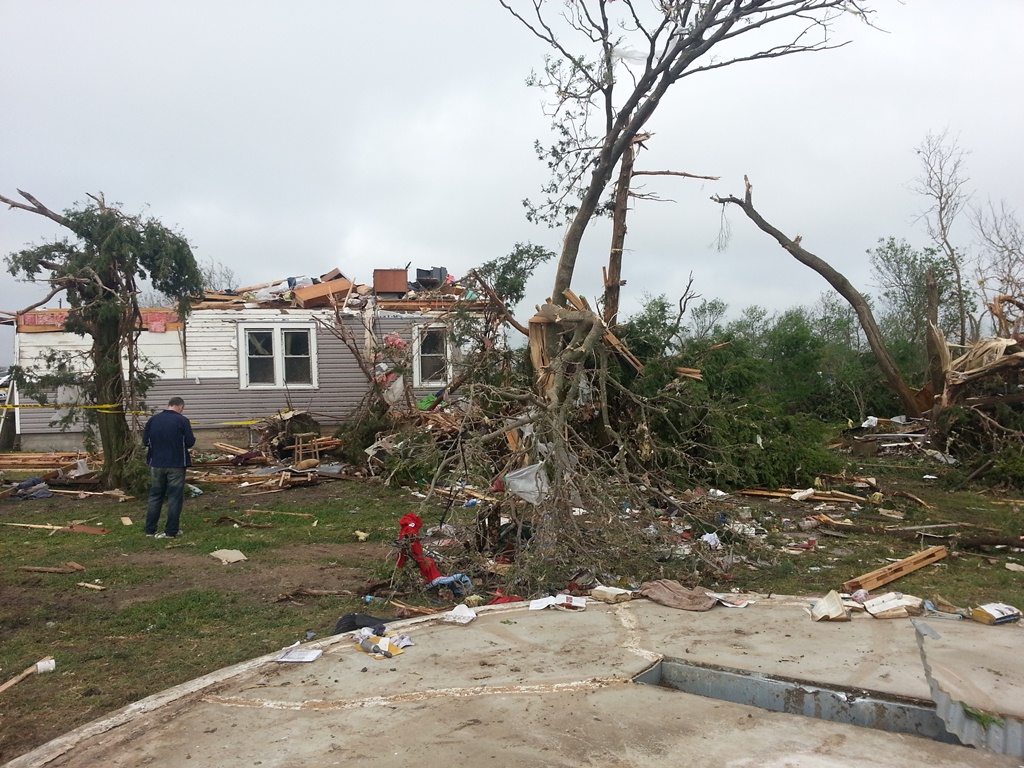
Here is what the damage looked like where a direct OTG measurement of 175 mph winds were recorded by the TIV2. As you can see, there's no defoliation or debarking to speak of. And in the immediate vicinity a home only sustained low-end EF3 damage. It's not at all difficult to see how a 1-5 second wind gust of 320 mph would cause the damage seen in Greenfield, which was several orders of magnitude more intense. The tornado was 100 meters wide and moving at 60 mph. The actual wind speed of the tornado is not in question (at least not by anyone with half a brain cell). It's the damage classification that is the problem, and by extension, the wind speeds assigned to that classification. Being "fine" with Greenfield's rating is being fine with all tornado ratings since 2013. I don't think enough people in this thread realize that. ALL tornadoes are underrated by about 40 mph on average. Not just the more textbook EF5s.

save_20240119_090737-jpg.23531
house1a.jpg
 
Last edited:
The fact wind speeds are so clearly disconnected from tornado ratings makes the actual damage classification discussion, so much more difficult to have. There's way more tornadoes with 205+ mph winds than there are that match the top 1% upper-echelon intensity we've come to associate with F5 and EF5 ratings.
 
Oh I do agree, I kinda think that either we have MPH way too low or don't know the full story on tor damage (admittedly I lean toward the latter). Which is why I clarified the DOW readings at the end.

I mean on the topic, there are tornadoes that do not a whole lot like Sulphur which don't do a whole lot with >200 mph winds, and then there are tornadoes like Mangum which have EF4 windspeeds based on DOW and tear pipes out of the ground. There's clearly more than just wind speed to tornado damage.
 
Last edited:
I mean on the topic, there are tornadoes that do not a whole lot like Sulphur which don't do a whole lot with >200 mph winds, and then there are tornadoes like Magnum which have EF4 windspeeds based on DOW and tear pipes out of the ground. There's clearly more than just wind speed to tornado damage.
Freudian slip there Eep? ;)
 
I think I've finally found a way to fix the way we rate tornadoes.

There is currently a severe asymmetry in the way tornadoes are rated
Evidence supporting a higher rating must be nearly perfect.
Evidence supporting a lower rating may consist merely of unresolved doubt.

A well-built home can be swept away, display extraordinary contextual damage, and still fail to achieve the best-supported rating because every uncertainty is treated as a ceiling

Ratings should be wind speed ranges on a probability curve and follow these principles:

1. A documented weaknesses shifts the distribution downward
2. A documented strength or extreme effect moves it upward.
3. Unresolved construction or mechanism questions broaden the curve
4. Several independent, spatially coherent indicators can shift the center of the distribution substantially even when none is individually perfect
5. the rating should follow the likely middle of the distribution, not its conservative lower tail.
6. Widen the distribution (final rated wind speed range) when uncertainty exists. Not move the estimates towards the lower bound.
 
Last edited:
@buckeye05 I'd be interested in your opinion in particular on this paper: Empirical Approach to Evaluating the Tornado Fragility of Residential Structures

This is on the Joplin tornado, and appears to consist of overlaying a treefall windspeed model (a conservative one that estimates only 175 mph, whereas Karstens' estimates 230) over the damage and then calculating fragility curves by matching the observed damage to the modelled windspeed. However, I'm not sure I grasp the paper well enough to support the implications that I'm thinking of when it comes to how the EF scale treats damage.

These are that we should expect we should see given damage across a range of speeds for a given structure, whereas the EF scale assigns one value otherwise dependent on estimated structural strength and subjective modifiers. Secondly, the conservative approach of assigning speeds at or near lower bound for a given DoD is similar to treating the curves as if they are much steeper than in this example. So while a survey might, say, assign 155 mph to a DoD 9 house there would actually only be a 20ish% chance of that DoD being observed if that's what the wind speed actually was. This implies a high likelihood of underestimating the true windspeed, especially for tornadoes with sparse DIs (low samples size). It may also show some merit in the IF scale's overlapping windspeed ranges.

However, it is possible that my understanding of the paper and how I've applied that is completely wrong, so I'd be interested in your opinion as you seem to have better understanding of these things than me.
Unfortunately, I don’t lol. My expertise is more centered on tree damage, typical American construction, context related stuff, statistical correlation, and general traditional EF scale application. I usually try to only speak on things that I have a strong grasp on. But with that said, I do think I get the gist of it and your takeaway from it is generally what I got from it as well. Sorry I can’t be more helpful. Things like treefall pattern analysis and computer based physics modeling are areas I need to brush up on.
 
Also, can someone explain to me why I keep seeing discussions about “if Enid gets upgraded”? I mean it’s already in NCEI. Doesn’t that mean the door is already closed? Is there actually a chance, or is it just a mixture of false hope combined with people not understanding how the data finalization process works? I really think it’s the latter.
 
Also, can someone explain to me why I keep seeing discussions about “if Enid gets upgraded”? I mean it’s already in NCEI. Doesn’t that mean the door is already closed? Is there actually a chance, or is it just a mixture of false hope combined with people not understanding how the data finalization process works? I really think it’s the latter.
Genuinely curious, was Enderlin in the NCEI before it got upgraded? It took a long time to see that get finalized.
 
I realize I’m a little late to the party here, but going back to Enid, and specifically Enderlin: was it ever expanded on why rating a tornado an EF5 requires a deluge of meetings? Is it just the natural path of bureaucracy? I distinctly remember the MIC of Grand Forks on WeatherBrains saying they had meet with the SPC when they were going to rate Enderlin a 5. Why the SPC?


Edit: didn’t a past user on here claim that Paducah wanted to rate Mayfield a 5 but that the regional parent office squashed it? He claimed to have heard that straight from the surveyors, although I questioned that when I read it on here originally. With Grand Forks expanding on the process in WeatherBrains, I don’t think those claims are far-fetched. The person’s username escapes me, but he was adamant on that claim.
LeDue's supposed to be on Weatherbrains talking about the EF scale on the 17th, I think. That might be a good question to email in.
 
I'm responding to this comment because it represents the standard clueless Twitter and Reddit mindset. Nothing against you, because your comment is a very average and normal stance to have. It's just misguided.

The 180 mph rating has nothing to do with the actual wind speeds of the tornado, and is 100% disconnected from the DOW recorded wind speeds. Even the surveyors who gave it the rating would likely say as much. Greenfield was given the 180 mph rating because it's the minimum wind speeds Engineers decided were required to cause the damage sustained by those homes, due to their construction quality. This rating was given despite the fact engineers and scientists already agreeing that 200 mph winds are required to sweep the average American home. Surely, the surveyors didn't decide there wasn't a single average home in the whole town, right? There were over 35 DOD 10 homes to choose from, after all. The rating is purely the result of compounding precedent over time, which has lead to Lower Bound wind speeds becoming the standard. It's the same precedent that has lead to Enid's final rating, and all the other underrated tornadoes.

Here is what the damage looked like where a direct OTG measurement of 175 mph winds were recorded by the TIV2. As you can see, there's no defoliation or debarking to speak of. And in the immediate vicinity a home only sustained low-end EF3 damage. It's not at all difficult to see how a 1-5 second wind gust of 320 mph would cause the damage seen in Greenfield, which was several orders of magnitude more intense. The tornado was 100 meters wide and moving at 60 mph. The actual wind speed of the tornado is not in question (at least not by anyone with half a brain cell). It's the damage classification that is the problem, and by extension, the wind speeds assigned to that classification. Being "fine" with Greenfield's rating is being fine with all tornado ratings since 2013. I don't think enough people in this thread realize that. ALL tornadoes are underrated by about 40 mph on average. Not just the more textbook EF5s.

save_20240119_090737-jpg.23531
house1a.jpg
Greenfield is fine. It's a overrated EF5 candidate. Your comment makes perfect sense but Greenfield is not a tornado that despite likely having EF5 intensity, the damage just doesn't meet that criteria. I've never seen it as a candidate honestly.
 
Also, can someone explain to me why I keep seeing discussions about “if Enid gets upgraded”? I mean it’s already in NCEI. Doesn’t that mean the door is already closed? Is there actually a chance, or is it just a mixture of false hope combined with people not understanding how the data finalization process works? I really think it’s the latter.
It's false hope. It's a odd situation all things considered but it won't be changed anytime soon
 
Greenfield is fine. It's an overrated EF5 candidate. Your comment makes perfect sense but Greenfield is not a tornado that despite likely having EF5 intensity, the damage just doesn't meet that criteria. I've never seen it as a candidate honestly.
The homes were (almost 100%) built below-quality in town as an individual damage assessment shows, so I’m completely fine with 180-185. The parking stops Ethan has already said shouldn’t be used and other than that there isn’t much going for it besides DOW readings over obviously-not-EF5 damage.
 
I think the only valid path for Greenfield to receive an EF5 would be the parking stops, due to Joplin’s precedent and windspeed calculations being well in excess of 200 mph for them. Debris granulation and debarking in Greenfield were evident, but didn’t really have the EF5 look to me. There is one tree in town that was 100% debarked, but there’s a significant caveat to said tree; its branches are relatively intact, which is a very strange observation. I really don’t know what to make of that, the tree was likely dead, or it could’ve been something else entirely. Either way, strange presentation of damage in town.

Also, I’ve heard that a manhole cover was removed in town too, but I haven’t seen any pictures of that DI, so I’m assuming someone just lied or something. At the end of the day, though, if Greenfield received the rating, it’d easily be the weakest EF5 damage-wise, and it’s not even close IMO. Honestly, that’s part of the reason why I don’t think it’s that big of an issue.
 
I think the only valid path for Greenfield to receive an EF5 would be the parking stops, due to Joplin’s precedent and windspeed calculations being well in excess of 200 mph for them. Debris granulation and debarking in Greenfield were evident, but didn’t really have the EF5 look to me. There is one tree in town that was 100% debarked, but there’s a significant caveat to said tree; its branches are relatively intact, which is a very strange observation. I really don’t know what to make of that, the tree was likely dead, or it could’ve been something else entirely. Either way, strange presentation of damage in town.

Also, I’ve heard that a manhole cover was removed in town too, but I haven’t seen any pictures of that DI, so I’m assuming someone just lied or something. At the end of the day, though, if Greenfield received the rating, it’d easily be the weakest EF5 damage-wise, and it’s not even close IMO. Honestly, that’s part of the reason why I don’t think it’s that big of an issue.
Pretty sure there's too much assumptions to consider the parking stops a EF5 candidate, and Ethan has said that before I believe. I agree. There are far better tornadoes to use than Greenfield for that argument
 
Back
Top