• Welcome to TalkWeather!
    We see you lurking around TalkWeather! Take the extra step and join us today to view attachments, see less ads and maybe even join the discussion.
    CLICK TO JOIN TALKWEATHER

Enhanced Fujita Ratings Debate Thread

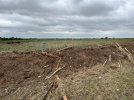
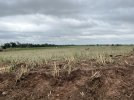
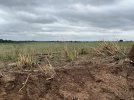
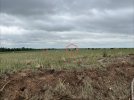
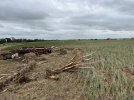
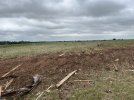
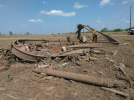
Great photos @Western_KS_Wx! See this is why I got so heated over the “Enid didn’t have EF5 contextuals” comment. I mean come on, those photos were the first thing that came to mind. Did that person just somehow never see them? They were all over social media. As you said, anyone with any kind of knowledge recognizes this as EF5 contextual damage.

Also beating a dead horse, but take note of where most of the bare soil grass scouring took place. Southgate Road, precisely where the EF5 intensity winds were suspected to have occurred in the NCEI entry. The correlation between bare soil grass scouring and extreme intensity is undeniable by this point, and you really have to have your head in the sand to not see that.
 
Great photos @Western_KS_Wx! See this is why I got so heated over the “Enid didn’t have EF5 contextuals” comment. I mean come on, those photos were the first thing that came to mind. Did that person just somehow never see them? They were all over social media. As you said, anyone with any kind of knowledge recognizes this as EF5 contextual damage.

Also beating a dead horse, but take note of where most of the bare soil grass scouring took place. Southgate Road, precisely where the EF5 intensity winds were suspected to have occurred in the NCEI entry. The correlation between bare soil grass scouring and extreme intensity is undeniable by this point, and you really have to have your head in the sand to not see that.

Thank you! I definitely was grateful that the people on that property allowed me to document the damage, it was truly unreal seeing damage that upper-echelon right in the centerline.

But yeah, there were multiple contextual feats done by this tornado that were synonymous with an EF5-strength tornado, and it wasn’t one that barely crossed that threshold either. The debarked tree limbs (some large) that were strewn into the field east of South 16th Street well away from any nearby trees was also quite impressive to me and reminded me a lot of the Harper, KS shoulda-been F5.

I feel like if contextual damage can be used to downgrade a rating, it should be used the same way to upgrade it as well, especially in an example like this where it’s very obvious.

Then of course throw in the fact that researchers found DI’s that indicated it was indeed an EF5 tornado, I just don’t understand why we wouldn’t side with the evidence there to support such a rating.

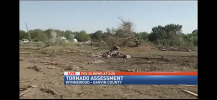
Another area of damage that I think gets overlooked was along South 30th Street. While not quite as intense as previously hit areas, it was still quite impressive. This was actually the location of the highest rated DI from this tornado, where a poorly built home was swept away with winds estimated at 180mph. The ground was scoured to bare soil along the embankment near the road, and shrubs were stripped bare. On top of that, a few large tanks were thrown hundreds of yards downwind into a field.
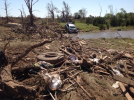
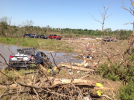
IMG_4950.jpegIMG_4954.jpegIMG_4957.jpegIMG_4959.jpegIMG_4971.jpegIMG_4951.jpeg
 
I have a big favor to ask. I currently am looking for some scientific literature that would be really helpful in relation to some personal research I’m doing. Does anyone have the full set of tables associated with proposed EF Scale update, particularly within the context of their original source? I’m also looking for any literature that covers the phenomenon of proposed EF5 tree damage, and particularly scientific literature pertaining to how en mass root ball displacements came to be proposed as EF5 tree damage? Having both of these things handy would be a huge help.

Edit: Still having trouble sourcing the tables but I did watch a video presentation. Sounds like the concept of EF5 tree damage is the result of computer generated physics models. This may be similar to what was done in Enid.
 
Last edited:
This was by far the strongest Oklahoma tornado since Moore 2013.
To be fair, I wouldn't discount Katie. I think it is a tornado that fairly similarly, did not produce any 'proper' EF5 damage based on traditional DIs, but contextual damage clearly supports a very violent, likely EF5 intensity tornado.

1785402992276.png1785403002978.png
1785403022864.png1785403037237.png

Personally, I actually find some of these contextuals the same level or potentially a tick above Enid, especially when you consider it was a very narrow vortex core and moved faster than Enid. I reckon, had this happened today, perhaps you would have seen similar studies and we'd be having conversations like the ones above, about Katie!

As much as it is frustrating that clear calculations that show EF5 winds are not considered in rating, at least we are seeing research into this stuff at all. Even 5 years ago the rating probably would have been left as 180mph without a second thought to potential analysis on trees, debris thrown, the vortex etc.
 
To be fair, I wouldn't discount Katie. I think it is a tornado that fairly similarly, did not produce any 'proper' EF5 damage based on traditional DIs, but contextual damage clearly supports a very violent, likely EF5 intensity tornado.

View attachment 54386View attachment 54387
View attachment 54388View attachment 54389

Personally, I actually find some of these contextuals the same level or potentially a tick above Enid, especially when you consider it was a very narrow vortex core and moved faster than Enid. I reckon, had this happened today, perhaps you would have seen similar studies and we'd be having conversations like the ones above, about Katie!

As much as it is frustrating that clear calculations that show EF5 winds are not considered in rating, at least we are seeing research into this stuff at all. Even 5 years ago the rating probably would have been left as 180mph without a second thought to potential analysis on trees, debris thrown, the vortex etc.
Ah yes i forgot about Katie. Strongest since then I'd say but this is very impressive too and probably did reach EF5 intensity during its life.
 
I have a big favor to ask. I currently am looking for some scientific literature that would be really helpful in relation to some personal research I’m doing. Does anyone have the full set of tables associated with proposed EF Scale update, particularly within the context of their original source? I’m also looking for any literature that covers the phenomenon of proposed EF5 tree damage, and particularly scientific literature pertaining to how en mass root ball displacements came to be proposed as EF5 tree damage? Having both of these things handy would be a huge help.

Edit: Still having trouble sourcing the tables but I did watch a video presentation. Sounds like the concept of EF5 tree damage is the result of computer generated physics models. This may be similar to what was done in Enid.
I somehow do; I’ll send it on the 8th as it’s on a folder on my home PC.
 
A new paper by Lyza has recently been published: How Have the Intrinsic Characteristics and Application of the Enhanced Fujita Scale Contributed to a Decreased Frequency of Intense Tornadoes in the United States?

Unfortunately it's been paywalled, but I think a hint is given by his AMS conference prsentation from January: 3 - Why Is the Observed Frequency of Intense Tornadoes in the United States Decreasing? One sentence I fond especially noteworthy:
Meanwhile, DI 2/DoD 9 (“all walls collapsed”), the EF-Scale DI/DoD that corresponds to F4 damage to homes on the F-Scale, is assigned an EF3 rating 75% of the time when it is used as the peak DI/DoD for a tornado in the dataset, despite featuring an EXP windspeed in the EF4 range.
Seems to confirm my own observation that current surveying practice is effectively treating the lower bound as the default, which is tantamount to saying that only a small number of houses are built to the 'expected' level, which asks how it became 'expected' in the first place.
 
I count this one as the 2nd (unofficial) EF5 that I watched happen live honestly. That footage Amanda Benton got WHILE the tornado was over Southgate Road was extraordinarily similar to any infamous KFOR coverage from the 1990s/2010s, and this thing was almost identical to Moore '13 in evolution too. It started off as a strong tornado, rapidly developed a debris cloud so high it enveloped the whole tornado and unleashed absolute violence on whatever it hit in its core.


1:44:36. I don't think people realize just how violent this thing actually got during its life.

I know visuals don’t always tell the full story, but when you’ve seen enough high-end, violent tornado videos you can get a pretty good idea. This is absolutely up there among the most violent tornadoes I’ve seen.
 
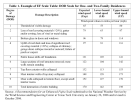
Also came across this original version of the DOD table for the Family Home DI, from the first proposed version of the EF scale (Jan 2006, Revised in Oct 2006 and submitted to be put in effect 2007, as we know). This particular screenshot is from the FEMA report on Greensburg though I'm sure there are other versions elsewhere.

1785424491938.png
 
A new paper by Lyza has recently been published: How Have the Intrinsic Characteristics and Application of the Enhanced Fujita Scale Contributed to a Decreased Frequency of Intense Tornadoes in the United States?

Unfortunately it's been paywalled, but I think a hint is given by his AMS conference prsentation from January: 3 - Why Is the Observed Frequency of Intense Tornadoes in the United States Decreasing? One sentence I fond especially noteworthy:

Seems to confirm my own observation that current surveying practice is effectively treating the lower bound as the default, which is tantamount to saying that only a small number of houses are built to the 'expected' level, which asks how it became 'expected' in the first place.

I've been emphasizing this point endlessly for years now. It's especially ridiculous because the whole reason the winds were adjusted down was so damage could be rated consistently across both scales. The argument is always "most houses can be blown down by winds far below EF4 level", which is completely false. The entire reason the expected value for DOD 9 is 170 mph, is because those are the winds required to blow down most houses. It's not some arbitrary threshold. It's the threshold that was deliberated on for years, agreed upon by both scientist and engineers, and implemented specifically to assign to houses that were blown down.

This is why the "it's a damage scale" argument to justify low ratings is so bogus. It IS a damage scale, which is why a destroyed house is EF4. The only way damage can get more intense than complete destruction (4/5), is when all the debris is carried away and leaves a bare slab or subfloor (5/5).
 
I've been emphasizing this point endlessly for years now. It's especially ridiculous because the whole reason the winds were adjusted down was so damage could be rated consistently across both scales. The argument is always "most houses can be blown down by winds far below EF4 level", which is completely false. The entire reason the expected value for DOD 9 is 170 mph, is because those are the winds required to blow down most houses. It's not some arbitrary threshold. It's the threshold that was deliberated on for years, agreed upon by both scientist and engineers, and implemented specifically to assign to houses that were blown down.

This is why the "it's a damage scale" argument to justify low ratings is so bogus. It IS a damage scale, which is why a destroyed house is EF4. The only way damage can get more intense than complete destruction (4/5), is when all the debris is carried away and leaves a bare slab or subfloor (5/5).

There's a reason why even in those fairly rare cases when a hurricane/typhoon makes landfall at Category 5 intensity (unless it happens to hit an area with nothing but mobile homes or very subpar-constructed frame homes, like Andrew) AND at least some of the area affected by the strongest winds is not also obliterated by surge; relatively few frame homes are "blown down."

I realize hurricane and tornado winds behave differently so it's not an apples-to-apples comparison (the SSHWS refers to one-minute sustained winds, are those even a thing that exists in tornadoes?), but the way the EF-scale has been applied since 2013 (really since 2011) makes no sense if you're trying to capture an accurate record of tornado intensity. What exactly are we trying to measure, here?
 
I've been emphasizing this point endlessly for years now. It's especially ridiculous because the whole reason the winds were adjusted down was so damage could be rated consistently across both scales. The argument is always "most houses can be blown down by winds far below EF4 level", which is completely false. The entire reason the expected value for DOD 9 is 170 mph, is because those are the winds required to blow down most houses. It's not some arbitrary threshold. It's the threshold that was deliberated on for years, agreed upon by both scientist and engineers, and implemented specifically to assign to houses that were blown down.

This is why the "it's a damage scale" argument to justify low ratings is so bogus. It IS a damage scale, which is why a destroyed house is EF4. The only way damage can get more intense than complete destruction (4/5), is when all the debris is carried away and leaves a bare slab or subfloor (5/5).
Basically a lot of surveyors have a “how low can you go” mindset which isn’t what the creators of the scale intended. It seems the common approach is to start with the lower bound and go from there, when in reality they should be starting from the expected damage.

Going lower bound is fine if there truly is a major contextual discrepancy, or the house is very poorly anchored. It’s also valid if there are fatal weak points that clearly and obviously exacerbated the damage compared to surrounding homes, such as a CMU foundation coming apart underneath the bolts, wood rot, or a non-concrete basement walkout wall being blown in. For example, the recent Menasha, WI leveled a home but that EF3 rating is fine because it was old and poorly anchored, and it was clear that the tornado itself was not an EF4 tier event given the context and surrounding damage. But generally I think the high end of the EF3 range is the most “abused” range of the EF scale. EF3 was never intended to encompass anchor-bolted houses being slabbed with severe contextual damage, but we have seen it in cases like Lake City, AR and Bakersfield, MO. Just huge, huge misses with zero explanation or justification even given (not saying that there even are any valid explanations that could be given for those two to begin with).

Thankfully this year we haven’t seen anything quite to that level of absurdity.
 
Last edited:
Back
Top