• Welcome to TalkWeather!
    We see you lurking around TalkWeather! Take the extra step and join us today to view attachments, see less ads and maybe even join the discussion.
    CLICK TO JOIN TALKWEATHER

Enhanced Fujita Ratings Debate Thread

Almost certainly the most severe Appalachian forest damage since Moshannon back in '85.

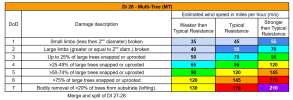
Hypothetically, there's got to be a scientific way to pull EF5 wind estimates from extreme tree damage, hasn't there? I'm not saying this IS EF5 (200+) but it could be. Of course most posters here believe some Texas tornadoes (Loyal Valley, Matador) may have produced comparably severe damage.

Edit: I see the linked Tweet estimates 191 MPH

I imagine, though, that it would be a lot of work (in examination alone).

Don't take this as an argument, I'm more curious if anyone has thoughts.
1774207357610.png
the new ef scale can get EF5 rated multi trees if they are strong types.
 
oh i forgot to say that ... a 1957 tornado got upgraded to IF5
View attachment 52178

they are really giving away the 5 rating to a lot of tornadoes lately , however most high end EF4 seem to likely warrant a 5 rating then some of the new IF5
@Tokai.Ryu Here's the ESWD confirmation you wanted. Happy now?

On a side note - did they combine this with the Robecca Pavese tornado, since all evidence suggests they were the same tornado?
 
WIND SPEEDS REQUIRED TO UPSET VEHICLES (2003)

At F2 wind speeds of about 56 m/s (125mi/hr), “Cars, vans, and pickups may be moved but fewer than 10% are tipped over.”
At F3 wind speeds of about 70 m/s (155mi/hr), “Cars, vans, and pickups are moved and 10% to 50% are tipped over. Vehicles that are tipped over may be rolled or lifted and thrown.”
At F4 wind speeds of about 90 m/s (200mi/hr), “More than 50% of cars, vans, and pickups are tipped over. Vehicles that are tipped over may be rolled or lifted and thrown.”

I found another study exactly like this one conducted in 2017. The methodology was almost the exact same:
1. Tornado-induced motion of vehicles was simulated.•
2. Model vehicles tested in a tornado simulator and wind tunnel.
3. Results were compared to field observations.

Critical wind speeds for tornado-induced vehicle movements (2017)

Laboratory data predicted sliding at EF-1 velocities while the field observations of Paulikas et al. (2016) show only 24% of vehicles slide in EF-1 tornadoes. Results also predicted lofting at EF-4 velocities but field observations show only 15% of vehicles are flipped or lofted in this range.

The 2003 study showed 10-50% of cars are flipped and/or lofted between 155-200 mph. The 2017 study shows 15% of vehicles are flipped and/or lofted in the 166-200 mph range.

These results are identical and verifiable because they both used actual wind tunnel observations. I'm amazed the revised EF scale doesn't include these results seeing as they appear to be quite conclusive. It also verifies Vilonia was well into the EF5 range.

Does anyone feel like emailing anyone at the NWS and inquiring about this?
 
The 150-mph estimate of the Lake Village EF3 is slowly being upped (currently 160); be prepared for an EF4 upgrade very soon. What I think is happening is that they're going through a panel to determine a maximum contextual rating, as the survey noted that a "consensus" was used for multiple of the EF3 structures.

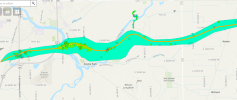
Also, what a beautiful survey:
1774375739352.png
Regardless of how you feel about the rating you've gotta admit this is an amazing survey visually.
 
The 150-mph estimate of the Lake Village EF3 is slowly being upped (currently 160); be prepared for an EF4 upgrade very soon. What I think is happening is that they're going through a panel to determine a maximum contextual rating, as the survey noted that a "consensus" was used for multiple of the EF3 structures.

Also, what a beautiful survey:
View attachment 52228
Regardless of how you feel about the rating you've gotta admit this is an amazing survey visually.
Are they really considering an upgrade?
 
Are they really considering an upgrade?
No idea, I'm just assuming they might be based off them upping the windspeed a significant amount (especially since no EF3 DIs have an attached 160-mph windspeed estimate, which makes me think it's contextual).
 
No idea, I'm just assuming they might be based off them upping the windspeed a significant amount (especially since no EF3 DIs have an attached 160-mph windspeed estimate, which makes me think it's contextual).
The 160 di is on the survey and it’s just a house that was well built having most of its exterior walls collapsed.
However they did just add like hundreds of new di’s to the survey.
 
Appears to me as VERY in depth so far. Like, NWS Jackson with Somerset-London levels of in depth.
That's why I'm confident it might be upgraded - most of the bad surveys are usually ones that miss a lot (New Wren, Vilonia, Matador, etc.). The in-depth ones are usually good surveys.
 
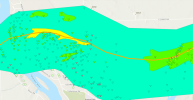
View attachment 52236
They also added like 4 Satellite tornadoes which is rather impressive in its own right, for both the tornado and the NWS office for actually caring enough to add them, so props to NWS Chicago for that.

Impressive, since that office (like most here in the upper Midwest) doesn't have a whole lot of experience with surveying high-end tornadoes. IIRC Rochelle 2015 was the last proper one, which I don't think was a bad survey overall but they opened a can of worms by giving it the absolute possible upper bound of EF4 without going to EF5. BTW there are still damaged, abandoned buildings in Fairdale; I've passed through there on chases in subsequent years.
 
I've got good news and bad news.

The good news is a brand new study on cycloidal debris swaths just dropped! Was published one week ago today. They observed Mayfield 2021, Clarkesville 2023, Washington 2013, Rochelle-Fairdale 2015, and Dodge City 2016.

The study is behind a paywall, but I signed up for a 30 day free trial of deepdyve.com to get access.

The Viability of Cycloidal Debris Swaths as a Tornado Wind Speed Estimation Method


The bad news is the results of the study aligned almost perfectly with the assigned EF ratings and maximum wind speeds of those tornadoes.

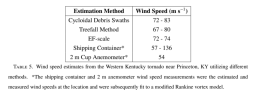
Mayfield
1774387366017.png

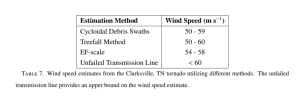
Clarkesville
1774387455091.png

Washington, Rochelle-Fairdale, Dodge City
1774387539048.png


After a streak of recent studies have found the EF scale underestimates wind speeds, we now have at least one on the board that supports those wind speeds. Using Fujita's own methods, no less!
 
Last edited:
I've got good news and bad news.

The good news is a brand new study on cycloidal debris swaths just dropped! Was published one week ago today. They observed Mayfield 2021, Clarkesville 2023, Washington 2013, Rochelle-Fairdale 2015, and Dodge City 2016.

The study is behind a paywall, but I signed up for a 30 day free trial of deepdyve.com to get access.

The Viability of Cycloidal Debris Swaths as a Tornado Wind Speed Estimation Method


The bad news is the results of the study aligned almost perfectly with the assigned EF ratings and maximum wind speeds of those tornadoes.

Mayfield
View attachment 52238

Clarkesville
View attachment 52239

Washington, Rochelle-Fairdale, Dodge City
View attachment 52240


After a streak of recent studies have found the EF scale underestimates wind speeds, we now have at least one on the board that supports those wind speeds. Using Fujita's own methods, no less!
Is the equation or methodology laid out in the study?
 
Is the equation or methodology laid out in the study?

Here you go! It's a doozy.

Methods

a. Cycloidal Debris Swath Method

To estimate tornado wind speeds, the cycloidal debris swath method developed by Fujita (1967)
and Fujita et al. (1970) is applied. The process to obtain tornado wind speed estimates involves
analyzing, tracing, and measuring cycloidal debris swaths from aerial imagery. The wind speed
estimates obtained represent a wind speed for an unknown averaging time and an unknown height
near the surface. Wind speed estimates from the cycloidal debris swath use the width (w), and
height (2R) and subsequently relate them to the variable n, the ratio of the tornado tangential wind
speed (V) to the tornado translational wind speed (U).

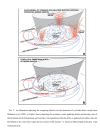
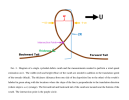
Figure 3 shows the variables needed for the wind speed estimate, where w is the x-distance across
the cycloidal debris swath, parallel to the translation vector, and 2R is the y-distance (perpendicular
to translation vector) from the top of the cycloidal debris swath to the location at which the tails

1774390836645.png

of the swath have a slope of 0 (see Section 2.a.2). As shown in Fig. 4, the x-axis is defined as the
tornado translation direction, determined by examining other cycloidal debris swaths and nearby
foliage/structural damage. It is hypothesized that the height is twice the radius of maximum winds
(RMW) (Prosser 1964), allowing for the RMW to be estimated as half the height of the cycloidal
debris swath. The forward (backward) tail extends in the same (opposite) direction of tornado
translation.

The derivation of the wind speed estimation method from Fujita (1967) and Fujita et al. (1970)
is outlined in Section 2.a.1 to include more detail and correct an omitted x symbol in Eq. 9 that
appears in the original publications. The final solution of the derivation remains unchanged. In
the original derivation, Fujita assumed the vortex was a suction vortex, but the derivation is valid
for any vortex or object rotating about a translating point.


1774390911658.png

1774390963639.png

1774390985318.png

2) MEASURING CYCLOIDAL DEBRIS SWATHS

Dimensions of full cycloidal debris swaths are determined by utilizing high-resolution aerial
imagery, in which the full extent of the swaths is seen, allowing for a detailed analysis. The visible
imagery is imported into Esri ArcGIS Pro version 3.2.2, and histogram stretching is applied using
minimum and maximum values along with adjustments to the brightness, contrast, and gamma
values to better discern cycloidal debris swaths. Using the annotation feature, the cycloidal debris
swaths are manually traced such that the resulting line is smooth, similar to the appearance of
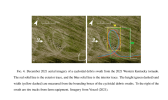
the trace completed in Fig. 4. The trace follows the boundary between debris deposition and the
absence of debris, thus yielding an interior and exterior trace for each swath. In cases where a
cycloidal debris swath is not complete, the curved line between points is interpreted across short
distances. In addition, caution must be used in the interpretation of the imagery to not confuse
other ground markings, such as the tire marks seen in Fig. 4, with the cycloidal debris swath.

The distance w of the cycloidal debris swath is then measured as the x-distance between the two
locations where the slope of the cycloidal debris swath trace is ±co (perpendicular to the translation
vector of the tornado). The distance 2R of the cycloidal debris swath is measured as the y-distance
between the highest and lowest points of the trace (where the slope of the curved path is 0) in the
rotated reference frame. In cases where a tail of a cycloidal debris swath is incomplete, a line
extending from the bottom of the existing tail to a tail of an adjacent swath is used to estimate the
bottom of the current swath. Using bounding boxes for both the width and height measurements
of a single trace, like Fig. 4, allows for more accurate and reproducible measurements needed for
the cycloidal debris swath wind speed estimate where 2R is the height of a box and w is the width
of a box. After n is determined by solving for Eq. 12 numerically, a wind speed estimate for the
swath is calculated from n and U (Eq. 13).


3) ERROR BOUNDS AND OUTLIER CYCLOIDAL DEBRIS SWATHS

Within a single cycloidal debris swath, there are variations in its thickness (Fig. 3). The thickness
is estimated by measuring the distance from one side of the curved path to the other side in one
area. A mean edge thickness is calculated by measuring the thickness of the swath at the locations
where the slope is +oo or -oo and dividing by 2. A similar process estimates the average top and

1774391082210.png


bottom thickness using 3 (or 2 if a tail is incomplete) measurement points; the top of the cycloidal
swath and a point on each tail where the slope is 0.

By tracing the cycloidal debris swaths along the inner and outer parts of the curved path (blue
and red line in Fig. 4), different wind speed estimates are obtained for each trace. The equations
presented in Section 2.a.1 define an idealized, infinitely thin trace and path. The true path of the
vortex, inflow rolls, or debris responsible for the cycloidal debris swath is unknown. Therefore, the
interior and exterior traces serve as an upper and lower bound to estimate the potential path. This
also reduces the subjectivity and human error that can arise from manually tracing the features.
By providing a range of wind speed estimates, a more robust and realistic wind speed estimate for
the tornado is obtained.

Further reduction in measurement errors is achieved by assuming a steady-state vortex across
multiple cycloidal debris swaths in a general area. The wind speed estimates for all the interior
and exterior traces for all cycloidal debris swaths are compared. Outlier values, those falling more
than 1.5 times outside the interquartile range, are discarded. These estimates are discarded along
with estimates where the debris boundaries are not accurately determined during tracing. The
remaining wind speed estimates from all the cycloidal debris swaths provide an estimated wind
speed for the tornado.

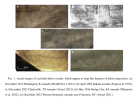
And here's the swaths they used

1774391195025.png
 
Who wants to show Nick some instances of obvious EF5 at Vilonia? Be nice. I like him. Respond on Twitter if you can


Tom Hanks Running GIF

Me getting out of here before this bomb goes off again
 
Back
Top