Methods
a. Cycloidal Debris Swath Method
To estimate tornado wind speeds, the cycloidal debris swath method developed by Fujita (1967)
and Fujita et al. (1970) is applied. The process to obtain tornado wind speed estimates involves
analyzing, tracing, and measuring cycloidal debris swaths from aerial imagery. The wind speed
estimates obtained represent a wind speed for an unknown averaging time and an unknown height
near the surface. Wind speed estimates from the cycloidal debris swath use the width (w), and
height (2R) and subsequently relate them to the variable n, the ratio of the tornado tangential wind
speed (V) to the tornado translational wind speed (U).
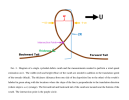
Figure 3 shows the variables needed for the wind speed estimate, where w is the x-distance across
the cycloidal debris swath, parallel to the translation vector, and 2R is the y-distance (perpendicular
to translation vector) from the top of the cycloidal debris swath to the location at which the tails
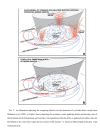
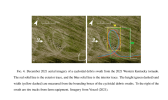
of the swath have a slope of 0 (see Section 2.a.2). As shown in Fig. 4, the x-axis is defined as the
tornado translation direction, determined by examining other cycloidal debris swaths and nearby
foliage/structural damage. It is hypothesized that the height is twice the radius of maximum winds
(RMW) (Prosser 1964), allowing for the RMW to be estimated as half the height of the cycloidal
debris swath. The forward (backward) tail extends in the same (opposite) direction of tornado
translation.
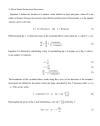
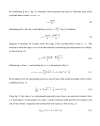
The derivation of the wind speed estimation method from Fujita (1967) and Fujita et al. (1970)
is outlined in Section 2.a.1 to include more detail and correct an omitted x symbol in Eq. 9 that
appears in the original publications. The final solution of the derivation remains unchanged. In
the original derivation, Fujita assumed the vortex was a suction vortex, but the derivation is valid
for any vortex or object rotating about a translating point.
2) MEASURING CYCLOIDAL DEBRIS SWATHS
Dimensions of full cycloidal debris swaths are determined by utilizing high-resolution aerial
imagery, in which the full extent of the swaths is seen, allowing for a detailed analysis. The visible
imagery is imported into Esri ArcGIS Pro version 3.2.2, and histogram stretching is applied using
minimum and maximum values along with adjustments to the brightness, contrast, and gamma
values to better discern cycloidal debris swaths. Using the annotation feature, the cycloidal debris
swaths are manually traced such that the resulting line is smooth, similar to the appearance of
the trace completed in Fig. 4. The trace follows the boundary between debris deposition and the
absence of debris, thus yielding an interior and exterior trace for each swath. In cases where a
cycloidal debris swath is not complete, the curved line between points is interpreted across short
distances. In addition, caution must be used in the interpretation of the imagery to not confuse
other ground markings, such as the tire marks seen in Fig. 4, with the cycloidal debris swath.
The distance w of the cycloidal debris swath is then measured as the x-distance between the two
locations where the slope of the cycloidal debris swath trace is ±co (perpendicular to the translation
vector of the tornado). The distance 2R of the cycloidal debris swath is measured as the y-distance
between the highest and lowest points of the trace (where the slope of the curved path is 0) in the
rotated reference frame. In cases where a tail of a cycloidal debris swath is incomplete, a line
extending from the bottom of the existing tail to a tail of an adjacent swath is used to estimate the
bottom of the current swath. Using bounding boxes for both the width and height measurements
of a single trace, like Fig. 4, allows for more accurate and reproducible measurements needed for
the cycloidal debris swath wind speed estimate where 2R is the height of a box and w is the width
of a box. After n is determined by solving for Eq. 12 numerically, a wind speed estimate for the
swath is calculated from n and U (Eq. 13).
3) ERROR BOUNDS AND OUTLIER CYCLOIDAL DEBRIS SWATHS
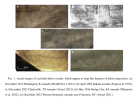
Within a single cycloidal debris swath, there are variations in its thickness (Fig. 3). The thickness
is estimated by measuring the distance from one side of the curved path to the other side in one
area. A mean edge thickness is calculated by measuring the thickness of the swath at the locations
where the slope is +oo or -oo and dividing by 2. A similar process estimates the average top and
bottom thickness using 3 (or 2 if a tail is incomplete) measurement points; the top of the cycloidal
swath and a point on each tail where the slope is 0.
By tracing the cycloidal debris swaths along the inner and outer parts of the curved path (blue
and red line in Fig. 4), different wind speed estimates are obtained for each trace. The equations
presented in Section 2.a.1 define an idealized, infinitely thin trace and path. The true path of the
vortex, inflow rolls, or debris responsible for the cycloidal debris swath is unknown. Therefore, the
interior and exterior traces serve as an upper and lower bound to estimate the potential path. This
also reduces the subjectivity and human error that can arise from manually tracing the features.
By providing a range of wind speed estimates, a more robust and realistic wind speed estimate for
the tornado is obtained.
Further reduction in measurement errors is achieved by assuming a steady-state vortex across
multiple cycloidal debris swaths in a general area. The wind speed estimates for all the interior
and exterior traces for all cycloidal debris swaths are compared. Outlier values, those falling more
than 1.5 times outside the interquartile range, are discarded. These estimates are discarded along
with estimates where the debris boundaries are not accurately determined during tracing. The
remaining wind speed estimates from all the cycloidal debris swaths provide an estimated wind
speed for the tornado.