• Welcome to TalkWeather!
    We see you lurking around TalkWeather! Take the extra step and join us today to view attachments, see less ads and maybe even join the discussion.
    CLICK TO JOIN TALKWEATHER

Enhanced Fujita Ratings Debate Thread

I'm moreso referring to the "it slammed into the water tower so hard that it caused a dent" argument I see often, especially on Reddit and YouTube documentaries. There's always a focus-in on the "dent" part. I don't have any comments on the Explorer itself as I haven't seen any photos of it, but do know it traveled 0.9-1.2 miles (can't remember the exact number) from southwest to northeast of the water tower.
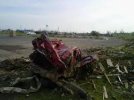
I have seen photos of the explorer. I don't have the photos, but the damage was EXTREME. The trunk and back row were squashed into nonexistence, the frame is gone, and the engine compartment area has been pushed up and deformed. Also, the main funeral home argument i see does not care about the building being swept away, but that the bricks were literally ground into a powder and mixed with water to form a slush.
 
View attachment 49726This is the ford explorer. Not much of a car left, it looks like it was turned into one of those scrapyard metal cubes.
One of the most iconic 4/27 damage pics ever. Also another great candidate for mathematical analysis. I have always wondered what minimum wind speed would have been required to loft the truck into the top of the water tower?

Also crazy to think that Lynn Davis’s truck was thrown even farther by the New Wren tornado.
 
Exactly, and if you aren't amazed when you consider that feat it's a you problem. Not only this, but some of the most experienced and seasoned weather scientists were "impressed" by it, so what does it matter if some edgy kids in a Discord server aren't? It's a completely meaningless argument, and a level of self importance that is laughable.

I'll take it a step further and say my unpopular opinion is that I don't really care how seasoned of a professional it is, if they say something a tornado did was "not impressive" they immediately lose credibility to me. Why would you openly advertise such a lack of objectivity?

How many people were impressed by the grain cars in Enderlin? Almost none. Yet that feat required 260 mph winds. How many people have discounted the safe that was thrown in Rainsville for years, yet a recently released compact objects study proved winds FAR exceeding 200 mph were required to do that. It's so wild to me that surveying tornado damage has basically become a vibe check, and it's such a commonly accepted practice. At least TRY to be scientific!

Anyways, sorry for the sassiness. Thanks for coming to my Ted Talk. Rant over.
100%. A big issue right now is people being too focused on hypotheticals, and not being focused enough on what does or does not tend to happen at certain intensity levels in real life. Sure one can say something is not necessarily impressive, and provide a hypothetical scenario in which that particular instance of damage is minimized in some reasonable way. But the problem with that approach is that it doesn’t factor in real world tornado damage history. When it comes to grasping tornado damage and intensity, it’s so important to have that “mental contextual damage database” I always mention. This is because studying what actually DOES tend to happen at certain intensity levels, is so much more important than what hypothetically COULD happen at certain intensity levels. At least that is, if the goal is accuracy.

Deep grass scouring is a perfect example. In my 14 years of doing this, I have only seen lawn grass scoured to bare soil in tornadoes that were either very violent, or at least suspected to have been very violent. Outside of Oklahoma’s “scour prone zone”, I have never seen lawn grass scoured to bare soil within the immediate vicinity of buildings that were not violently obliterated in a high-end manner. One can say, “well, that can also happen at lower intensities depending on soil composition”. To that I say, “Ok great, but in reality, it never does”. When people challenge my opinion on grass scouring, I always challenge them to find me a house outside of W Central Oklahoma surrounded by deep, soil exposing grass scouring that is either partially intact still, or left weakly collapsed in an unscattered heap. They can never find me an example, because it simply doesn’t happen. The best the last guy who challenged me on this could come up with was a pixilated aerial photo of some obscure brown smudge in the distance and some bizarre anecdote about cows eating grass. You can’t make this stuff up.

In a nutshell: Study real tornado events, and actually pay attention to what kind of contextual hallmarks you tend to see in high-end tornadoes. I promise you that undeniable consistencies will become apparent. Ambiguously dismissing everything as “unimpressive” based on your gut feelings and hypotheticals without real life tornado event basis will do nothing but lure you away from having a good grasp on what contextual damage is, and isn’t impressive.
 
To add some more context to my previous post, I'm 99% sure both of those Reddit posts were made by people on the younger side. If I had to guess, the "smithville ef6" post was made by someone in their adolescent years or early teens, and the "nope, Smithville was Overrated and a high end EF4" post was probably made by someone in their mid to late teens.

Both are examples of the Dunning-Kruger effect. "omg it was ef6" is at the peak of Mount Stupid, while "nope, EF4" is on the descent into the Valley of Despair.

Like @buckeye05 said, those growing older and out of the first phase of tornado damage enthusiasm (but still young and not particularly knowledgeable) are now "correcting" en masse to go from "i see a sept slab it was F5" to "No it wasnt THAt well constructed so EF4"

And still, don't snort Pixy Stix.
 
100%. A big issue right now is people being too focused on hypotheticals, and not being focused enough on what does or does not tend to happen at certain intensity levels in real life. Sure one can say something is not necessarily impressive, and provide a hypothetical scenario in which that particular instance of damage is minimized in some reasonable way. But the problem with that approach is that it doesn’t factor in real world tornado damage history. When it comes to grasping tornado damage and intensity, it’s so important to have that “mental contextual damage database” I always mention. This is because studying what actually DOES tend to happen at certain intensity levels, is so much more important than hypothetically COULD happen at certain intensity levels.

Deep grass scouring is a perfect example. In my 14 years of doing this, I have only seen lawn grass scoured to bare soil in tornadoes that were either very violent, or at least suspected to have been very violent. Outside of Oklahoma’s “scour prone zone”, I have never seen lawn grass scoured to bare soil within the immediate vicinity of buildings that were not violently obliterated in a high-end manner. One can say, “well, that can also happen at lower intensities depending on soil composition”. To that I say, “Ok great, but in reality, it never does”. When people challenge my opinion on grass scouring, I always challenge them to find me a house outside of W Central Oklahoma surrounded by deep, soil exposing grass scouring that is either partially intact still, or left weakly collapsed in an unscattered heap. They can never find me an example, because it simply doesn’t happen. The best the last guy who challenged me on this could come up with was a pixilated aerial photo of some obscure brown smudge in the distance and some bizarre anecdote about cows eating grass. You can’t make this stuff up.

In a nutshell: Study real tornado events, and actually pay attention to what kind of contextual hallmarks you tend to see in high-end tornadoes. I promise you that undeniable consistencies will become apparent. Ambiguously dismissing everything as “unimpressive” based on your gut feelings and hypotheticals without real life tornado event basis will do nothing but lure you away from having a good grasp on what contextual damage is, and isn’t impressive.
Imma sound like such an idiot, but what exactly makes the soil around that area in Oklahoma so scour prone? Because if it really is that difficult to scour the soil out in that part of the state, then it truly just strengthens the reasoning on how grass/ground scouring is such a reliable indicator of a violent/high end event. Some of the most extreme examples of ground/grass scouring have actually came from very extreme Oklahoma tornadoes such as Both Moores, 2011 El Reno, and Washington/Chickasha. So I am very on board with you and agree very much so that scouring is truly one of the most reliable indicators of a very high end event!
 
Imma sound like such an idiot, but what exactly makes the soil around that area in Oklahoma so scour prone? Because if it really is that difficult to scour the soil out in that part of the state, then it truly just strengthens the reasoning on how grass/ground scouring is such a reliable indicator of a violent/high end event. Some of the most extreme examples of ground/grass scouring have actually came from very extreme Oklahoma tornadoes such as Both Moores, 2011 El Reno, and Washington/Chickasha. So I am very on board with you and agree very much so that scouring is truly one of the most reliable indicators of a very high end event!
Scour prone, not scour resistant. As in it’s easier for tornadoes to scour the ground in Oklahoma, not harder. You have it backwards.

But basically, Oklahoma soil tends to be “powdery”. Tornadoes there can kick up lots of that powdery soil and “smear” it across the grass. This creates streaks of discoloration that look very impressive from afar, but when you get up close, you will sometimes see that the grass is simply stained by the kicked up soil, but with minimal surface vegetation removal. This is why a lot of Oklahoma events have very visible ground scouring paths. In addition, the soil composition in Oklahoma likely allows for grass to pull out of the ground a little easier. This is particularly true in western Oklahoma.

BUT, with that said, when you see totally bare soil exposed in Oklahoma with pretty much no grass left, it’s still usually associated with a high-end EF4 or EF5 candidate event. Basically when it comes to grass scouring, the most important thing is the actual degree of grass removal. An aerial pic showing a discolored path across the ground tells you pretty much nothing. You need close up, quality photos showing how much of the surface vegetation has actually been removed.
 
Scour prone, not scour resistant. As in it’s easier for tornadoes to scour the ground in Oklahoma, not harder. You have it backwards.

But basically, Oklahoma soil tends to be “powdery”. Tornadoes there can kick up lots of that powdery soil and “smear” it across the grass. This creates streaks of discoloration that look very impressive from afar, but when you get up close, you will sometimes see that the grass is simply stained by the kicked up soil, but with minimal surface vegetation removal. This is why a lot of Oklahoma events have very visible ground scouring paths. In addition, the soil composition in Oklahoma likely allows for grass to pull out of the ground a little easier. This is particularly true in western Oklahoma.

BUT, with that said, when you see totally bare soil exposed in Oklahoma with pretty much no grass left, it’s still usually associated with a high-end EF4 or EF5 candidate event. Basically when it comes to grass scouring, the most important thing is the actual degree of grass removal. An aerial pic showing a discolored path across the ground tells you pretty much nothing. You need close up, quality photos showing how much of the surface vegetation has actually been removed.
Ahh okay. I had a feeling I had them backwards. That’s my bad!

Good info as well. Learned something new that i’ll keep in mind!
 
Looking back, that’s what makes the scouring from the 1974 Guin, AL tornado so impressive. I do remember now learning about scour resistant Alabama soil is and based on the damage photos we have from Guin, it appears to have caused ground scouring to bare soil and the fact it was making remarkably fast and caused that amount of scouring definitely gives credence to the fact it was a very high end event.
 
Looking back, that’s what makes the scouring from the 1974 Guin, AL tornado so impressive. I do remember now learning about scour resistant Alabama soil is and based on the damage photos we have from Guin, it appears to have caused ground scouring to bare soil and the fact it was making remarkably fast and caused that amount of scouring definitely gives credence to the fact it was a very high end event.
Absolutely, you got it. That one Guin photo is my go-to example for what legitimately high-end grass scouring looks like.
 
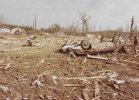
IMG_3358.jpeg
Truly a classic example of what high end grass scouring looks like and what you only see in very high end events. Like @buckeye05 said, truly one of the benchmark examples.


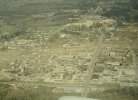
IMG_3359.jpeg
While on the topic of Guin now, this aerial of the damage path through town has always impressed me. The fact the core was quite narrow and within that corridor was complete devastation in such a short amount of time is very impressive! I would say this photo is probably a feeding contributor to what led to the rumors of the foundations being “ dislodged and swept away. “
 
100%. A big issue right now is people being too focused on hypotheticals, and not being focused enough on what does or does not tend to happen at certain intensity levels in real life. Sure one can say something is not necessarily impressive, and provide a hypothetical scenario in which that particular instance of damage is minimized in some reasonable way. But the problem with that approach is that it doesn’t factor in real world tornado damage history. When it comes to grasping tornado damage and intensity, it’s so important to have that “mental contextual damage database” I always mention. This is because studying what actually DOES tend to happen at certain intensity levels, is so much more important than what hypothetically COULD happen at certain intensity levels. At least that is, if the goal is accuracy.

Deep grass scouring is a perfect example. In my 14 years of doing this, I have only seen lawn grass scoured to bare soil in tornadoes that were either very violent, or at least suspected to have been very violent. Outside of Oklahoma’s “scour prone zone”, I have never seen lawn grass scoured to bare soil within the immediate vicinity of buildings that were not violently obliterated in a high-end manner. One can say, “well, that can also happen at lower intensities depending on soil composition”. To that I say, “Ok great, but in reality, it never does”. When people challenge my opinion on grass scouring, I always challenge them to find me a house outside of W Central Oklahoma surrounded by deep, soil exposing grass scouring that is either partially intact still, or left weakly collapsed in an unscattered heap. They can never find me an example, because it simply doesn’t happen. The best the last guy who challenged me on this could come up with was a pixilated aerial photo of some obscure brown smudge in the distance and some bizarre anecdote about cows eating grass. You can’t make this stuff up.

In a nutshell: Study real tornado events, and actually pay attention to what kind of contextual hallmarks you tend to see in high-end tornadoes. I promise you that undeniable consistencies will become apparent. Ambiguously dismissing everything as “unimpressive” based on your gut feelings and hypotheticals without real life tornado event basis will do nothing but lure you away from having a good grasp on what contextual damage is, and isn’t impressive.

I agree with you completely, but I still hate the word "impressive" when it comes to evaluating tornado intensity. By pouring over the worst tornado damage in every context, situation, and location, you're essentially, by the very nature of the your experience, making yourself harder to impress. You desensitize yourself in a way that can inherently add subjectivity to damage evaluation. I think it's very possible to have an EF5 that's not overly impressive in any one metric. You have to find a way to use your experience to set a bar that is objective, scientific, and doesn't rely on extremes.

I know you understand all this, but it's important to really emphasize the point, because this is exactly why tornadoes are being underrated.
 
I agree with you completely, but I still hate the word "impressive" when it comes to evaluating tornado intensity. By pouring over the worst tornado damage in every context, situation, and location, you're essentially, by the very nature of the your experience, making yourself harder to impress. You desensitize yourself in a way that can inherently add subjectivity to damage evaluation. I think it's very possible to have an EF5 that's not overly impressive in any one metric. You have to find a way to use your experience to set a bar that is objective, scientific, and doesn't rely on extremes.

I know you understand all this, but it's important to really emphasize the point, because this is exactly why tornadoes are being underrated.
I’d honestly argue that poring over tornado damage in every context, situation, and location is a good thing. That’s how you notice patterns, and start to see what kinds of contextual hallmarks are, or are not associated with certain tornado intensity levels. That’s how I built my mental “contextual damage catalog” over the years, which has allowed me to see what is or isn’t a significant high-end indicator. You have to have a solid database of real life examples and reference points to build a good understanding of contextual damage.

I take issue with the opposite. When people aren’t “impressed” with pretty much anything based on hypothetical scenarios, but don’t have any actual reference points for basis, and have no real life examples that demonstrate why the contextual damage in question “isn’t impressive”. For example, when you talk about a bunch of grass being ripped out of the ground, it isn’t physically impressive because you can do that with your hands. Somebody who doesn’t really know what they’re talking and is dismissive of grass scouring will probably base their argument on that type of basis. But that stance has zero basis in real life tornado damage, and the physical aspect isn’t why it’s impressive. What makes it impressive is the correlation and consistency with certain types of structural damage: how we only really see this phenomenon within the immediate vicinity of buildings that have been totally obliterated. A naive person will say “Well I’m sure total grass scouring to bare soil happens all the time in EF3s and marginal EF4 damage too”, without a single real life example to support that claim, assured that they don’t have to provide one because they think there are plenty out there. But what they don’t realize, is that there are pretty much no real life examples to support that opinion. Sure, I bet there are a few outliers if you dig hard enough, but that’s all they would be: outliers, not a representation of what typically happens.

You have to pore over decades of real tornado damage to tell what is or what isn’t impressive. The problem we have is a bunch of young people who haven’t done that, and instead are just deeming things “unimpressive” based on gut feelings, regurgitated statements, and hypotheticals, despite real life tornado damage history showing otherwise. They only say these things because they don’t actually know as much as they think they do. It’s a classic Dunning-Kruger scenario.
 
Last edited:
I’d honestly argue that poring over tornado damage in every context, situation, and location is a good thing. That’s how you notice patterns, and start to see what kinds of contextual hallmarks are, or are not associated with certain tornado intensity levels. That’s how I built my mental “contextual damage catalog” over the years, which has allowed me to see what is or isn’t a significant high-end indicator. You have to have a solid database of real life examples and reference points to build a good understanding of contextual damage.

I take issue with the opposite. When people aren’t “impressed” with pretty much anything based on hypothetical scenarios, but don’t have any actual reference points for basis, and have no real life examples that demonstrate why the contextual damage in question “isn’t impressive”. For example, when you talk about a bunch of grass being ripped out of the ground, it isn’t physically impressive because you can do that with your hands. Somebody who doesn’t really know what they’re talking and is dismissive of grass scouring will probably base their argument on that type of basis. But that stance has zero basis in real life tornado damage, and the physical aspect isn’t why it’s impressive. What makes it impressive is the correlation and consistency with certain types of structural damage: how we only really see this phenomenon within the immediate vicinity of buildings that have been totally obliterated. A naive person will say “Well I’m sure total grass scouring to bare soil happens all the time in EF3s and marginal EF4 damage too”, without a single real life example to support that claim, assured that they don’t have to provide one because they think there are plenty out there. But what they don’t realize, is that there are pretty much no real life examples to support that opinion. Sure, I bet there are a few outliers if you dig hard enough, but that’s all they would be: outliers, not a representation of what typically happens.

You have to pore over decades of real tornado damage to tell what is or what isn’t impressive. The problem we have is a bunch of young people who haven’t done that, and instead are just deeming things “unimpressive” based on gut feelings, regurgitated statements, and hypotheticals, despite real life tornado damage history showing otherwise. They only say these things because they don’t actually know as much as they think they do. It’s a classic Dunning-Kruger scenario.

In regards to your bolded point, I think the ultimate blood boiling moments are when people are clearly referencing underrated tornadoes for the basis of these claims. Like EF3s that obviously should've been EF4s and so on. I could argue EF3s can completely debark trees and scour grass "because Barnesville did it". Obviously that's disengenous, but it's almost where we're at now. I'm pretty sure this is how MEG operates. I'm still extremely salty about Lake City getting that EF3 rating. In the context of the experience you're referring to, it was so clearly mid to high end EF4 at the very least. It's legitimately insane to have the official record say it wasn't a violent tornado.

Like I said, I fully agree with your entire point. I just see issues with the concept of "impressiveness" as a tornado rating metric. I understand your meaning when you use the word in this context, but it still doesn't sit right. Maybe I'm just getting caught up on semantics.
 
This may be ignorance here on my part, but I was always under the impression that the water tower dent wasn’t notable due to the actual dent. It was notable because the vehicle itself traveled half a mile, hit the water tower, then was picked up again and later completely mangled.

I’m not saying it is or isn’t impressive, but that was my assumption on why it’s mentioned so much.
Water towers are made of fairly thick material by necessity so denting is notable as that takes considerable force. One thing I've always wondered about here was the water level inside. A panel backed by air would far more easily dented than one backed by the mass and pressure of water being behind it. Given how high up the dent is I'm inclined to believe that the water level wasn't up high enough to affect the denting but that possibility is there since these tanks usually fill automatically before you get much below the full mark.

Also to consider is that the impact would have taken away some of the momentum of the thrown Explorer, yet it still traveled about a quarter mile further post-impact. That Explorer had to have been flying along at an insane speed to do this since we know it was out off the core by this time and thus slowing down when it hit the water tower. Being out of the core also means that the car was descending at the time too, so it had to have been lofted well above the 300ft height of the water tower, something seen only in the strongest of tornadoes. Even the Pampa F5 pictures of 2 pickups lofted at the same time wasn't above 200ft up.

Add this to the other damages and to me it's clear that this was the strongest tornado of that outbreak as well as one of the strongest tornadoes ever.
 
In regards to your bolded point, I think the ultimate blood boiling moments are when people are clearly referencing underrated tornadoes for the basis of these claims. Like EF3s that obviously should've been EF4s and so on. I could argue EF3s can completely debark trees and scour grass "because Barnesville did it". Obviously that's disengenous, but it's almost where we're at now. I'm pretty sure this is how MEG operates. I'm still extremely salty about Lake City getting that EF3 rating. In the context of the experience you're referring to, it was so clearly mid to high end EF4 at the very least. It's legitimately insane to have the official record say it wasn't a violent tornado.

Like I said, I fully agree with your entire point. I just see issues with the concept of "impressiveness" as a tornado rating metric. I understand your meaning when you use the word in this context, but it still doesn't sit right. Maybe I'm just getting caught up on semantics.
Nah I get what you’re saying and we’re on the same page here. Basically, it’s the trend of the words “impressive” and “unimpressive” being thrown around in a purely subjective manner without any further explanation besides “it’s my opinion”. Or like you said, based on defaulted ratings where the actual intensity was clearly higher. That’s a huge problem too.

To many here reading my posts, that’s how mine may come off at first too, but I promise you there is valid basis and real life examples to back up everything I say. For example, I’m not going to be dismissive of something like asphalt scouring just “because I don’t think it means much”. I’m dismissive of it because there are real life examples proving that it’s not a high-end indicator (New Boston, TX/Wantonga, OK/Waupauca County, WI). I used to consider it a high-end indicator, but real life examples proved otherwise. Grass scouring is the opposite. For many years, I’ve been waiting for a series of counter examples that blow my grass scouring theory out of the water, but those counter examples have never surfaced. That’s how I know my opinion has basis: many years of real life evidence. So if people want to be dismissive of certain contextual hallmarks, they need to provide real life examples that support a basis for that dismissiveness. Problem is, these kids never do provide any real life basis, yet still think their points are valid even though they have no actual evidence.

Essentially, I’ve spent over a decade doing a rough, long-term statistical analysis on contextual damage without writing anything down. So there are certain things about contextual damage that I just know are true, but since I’ve never published a study or anything, I cannot prove, which is frustrating.
 
Nah I get what you’re saying and we’re on the same page here. Basically, it’s the trend of the words “impressive” and “unimpressive” being thrown around in a purely subjective manner without any further explanation besides “it’s my opinion”. Or like you said, based on defaulted ratings where the actual intensity was clearly higher. That’s a huge problem too.

To many here reading my posts, that’s how mine may come off at first too, but I promise you there is valid basis and real life examples to back up everything I say. For example, I’m not going to be dismissive of something like asphalt scouring just “because I don’t think it means much”. I’m dismissive of it because there are real life examples proving that it’s not a high-end indicator (New Boston, TX/Wantonga, OK/Waupauca County, WI). I used to consider it a high-end indicator, but real life examples proved otherwise. Grass scouring is the opposite. For many years, I’ve been waiting for a series of counter examples that blow my grass scouring theory out of the water, but those counter examples have never surfaced. That’s how I know my opinion has basis: many years of real life evidence. So if people want to be dismissive of certain contextual hallmarks, they need to provide real life examples that support a basis for that dismissiveness. Problem is, these kids never do provide any real life basis, yet still think their points are valid even though they have no actual evidence.

Essentially, I’ve spent over a decade doing a rough, long-term statistical analysis on contextual damage without writing anything down. So there are certain things about contextual damage that I just know are true, but since I’ve never published a study or anything, I cannot prove, which is frustrating.
Totally agree about grass scouring btw. I'm going to list other high end indicators and you tell me if you agree or disagree.

1. Engine block removal/total seperation from vehicle.
2. Concrete slab displacement
3. Debarking paired with nubbing of trees
4. Shrub debarking (one of the strongest indicators)
5. Home debris granulation into pieces no longer than 1-3 feet... "Mulching"
6. Cycoidal marking
7. Rebar shearing
8. Anchor bolt shearing, extrusion from concrete
9. Heavy vehicle, farm equipment, and tractor lofting greater than 100 meters

These, off the top of my head, are what I believe only the top 0.1% of tornadoes are capable of. .
 
Totally agree about grass scouring btw. I'm going to list other high end indicators and you tell me if you agree or disagree.

1. Engine block removal/total seperation from vehicle.
2. Concrete slab displacement
3. Debarking paired with nubbing of trees
4. Shrub debarking (one of the strongest indicators)
5. Home debris granulation into pieces no longer than 1-3 feet... "Mulching"
6. Cycoidal marking
7. Rebar shearing
8. Anchor bolt shearing, extrusion from concrete
9. Heavy vehicle, farm equipment, and tractor lofting greater than 100 meters

These, off the top of my head, are what I believe only the top 0.1% of tornadoes are capable of. .
My takes on these over the years:

1.) I call this vehicle disassembly. When the vehicle is either stripped down to its chassis or literally torn apart into multiple pieces. Usually only seen in very high-end EF4 or EF5 candidate events, or in suspected extremely violent tornadoes that didn’t hit much (Spiritwood, ND for example)

2.) If we’re talking about buckling or partial dislodging of thick reinforced house or business foundations, then yes absolutely a good indicator of extreme intensity, and incredibly rare. The restaurant in Mount Hope is a great example, and honestly the only definite one I can think of right now. But…this is not the case if we’re talking about a small surface concrete foundation for a shed, or outbuilding, or grain bin or something. Those are usually poured thin and without reinforcements, so they can crack and buckle surprisingly easy. I’ve seen a thin pole barn slab buckle in an EF2. So in a nutshell, yes but only if it’s a thick slab.

3.) Extreme debarking and tree damage can indeed be a high-end indicator, especially if it takes place in rural areas without much debris loading. What you really want to look for is numerous very large trees that are completely stubbed and have literally zero bark remaining; as in genuine 100% debarking. Think Louisville, Bassfield, Buckeye, Chickasha, El Reno/Piedmont, Vilonia, Bridge Creek, Moore, Greensburg, and Hackleburg/Phil Campbell. You also want to see consistent widespread stubbing and debarking, not just a few here and there. Another good indicator of extreme intensity is when trees are both root balled and totally debarked (Harper 2004, Philadelphia 2011, and Enderlin 2025).

4.) Shrub shredding and debarking is another good high-end EF4 to EF5 indicator, but it has to be genuinely severe, not just partial. A good indicator of extreme low level winds, and provides great contextual support if the shrubs are around the perimeter of a well-anchored slabbed home.

5.) Good high-end indicator, but one to three feet is not genuine granulation or mulching, as plenty of tornadoes do that. Genuine granulated debris is fine enough to literally pour out of the palm of your hand, can fill up a glass mason jar, and is literally coin/wood-chip sized (think Parkersburg). This is very rare, and therefore one of the more reliable high-end indicators. Debris granulation is one of the most misunderstood contextual indicators, because people frequently see regular scattered debris and call it granulation when it’s not actually granulated. It truly has to be finely ground up into teeny tiny little fragments to be considered real granulation.

6.) Some cycloidal/spiral markings can be considered an EF5 indicator if analyzed mathematically. This is admittedly not something I know very much about. Ask @Saltical Wx for more info on this.

7.) Hmmm….if it occurs in association with the destruction of a well-built, reinforced concrete building, then I’d say possibly. Problem with this, is it can also snap due to shifting weight and gravity as a building fails, but not necessarily wind. For example, rebar snapped within the walls of a collapsing factory building in Adairsville, GA back in 2013. That was an EF3 tornado, and the wind broadsided a massive factory wall, which fell, snapping the rebar, but not as a direct result of the wind, and not from a particularly violent tornado. I do however, recall a rebar support being snapped on a house foundation in Parkersburg too, which was pretty impressive. Overall I don’t know about this one, as it’s very dependent on the situation, the type of building, and the construction quality level.

8.) Anchor bolt shearing and removal can be highly impressive if the bolts are properly installed. But conversely, it can be a sign that the bolts weren’t installed properly or weren’t drilled deeply into the concrete. This one is also iffy and situation dependent. Falls short of the “highly reliable” bar in my book.

9.) Nope nope nope, I tossed out relatively short distance vehicle throwing as a high-end indicator a long time ago. Just like trenching and asphalt scouring, I’ve simply seen it happen too many times well below EF5 intensity. 100 meters is nothing, and heck even a couple hundred meters isn’t that crazy. For example, the Mize, MS tornado of 2019 inflicted low-end EF3 damage to a house that had many walls still standing, but two trucks parked in the driveway were thrown 200 yards into a pasture. I have also seen vehicles get tossed comparable distances/mangled near structures that sustained only EF2 damage (Ensign, KS 2015/Deer Park, TX 2023). Believe it or not, I even witnessed a very tightly wound high-end EF1 QLCS spin-up that lofted and mangled a pickup truck in my home town. Buildings in the immediate path only had roof and window damage. The bottom line is, cars being thrown a couple hundred yards/meters is not an EF5 indicator, and there are countless examples to prove it. It happens all the time.

Now however, if it’s something huge and very heavy like a combine, loaded train car, a massive piece of farming equipment, or a huge fertilizer tank, then it’s much more impressive and absolutely a possible indicator of EF5 strength. Now with that said, I do consider thrown vehicles to be high-end indicators in some rare situations, but it has to be truly remarkable and extreme. What I mean by that is thrown a bare minimum of 3/4 of a mile. This may sound extreme, but that’s the point: these kinds of distances literally only happen in very high-end events. The goal is to identify things that almost exclusively happen in the most of violent tornadoes. So while a few hundred meters or so doesn’t mean much since it’s so common with your average EF4 (and sometimes occurs with EF2s and EF3s like I mentioned), 3/4 of a mile should be the benchmark because it’s the bare minimum distance that can be reasonably linked to very high-end events.

—————

10.) You forgot one! Concrete scouring. Super rare. Bakersfield Valley, Jarrell, El Reno/Piedmont. Almost never happens except for in high-end F5/EF5 events.

11.) Another one! Wind-rowing. Not as rock solid as others, but can sometimes still be a good hint at high-end intensity. I only really put much weight on it if it’s truly extreme (Andover, Vilonia, etc). I’ve seen moderate wind rowing below EF5 intensity. So you really need to see those massive, super long debris streaks that seemingly stretch on forever for it to be significant.
 
Last edited:
Exactly, and if you aren't amazed when you consider that feat it's a you problem. Not only this, but some of the most experienced and seasoned weather scientists were "impressed" by it, so what does it matter if some edgy kids in a Discord server aren't? It's a completely meaningless argument, and a level of self importance that is laughable.

I'll take it a step further and say my unpopular opinion is that I don't really care how seasoned of a professional it is, if they say something a tornado did was "not impressive" they immediately lose credibility to me. Why would you openly advertise such a lack of objectivity?

How many people were impressed by the grain cars in Enderlin? Almost none. Yet that feat required 260 mph winds. How many people have discounted the safe that was thrown in Rainsville for years, yet a recently released compact objects study proved winds FAR exceeding 200 mph were required to do that. It's so wild to me that surveying tornado damage has basically become a vibe check, and it's such a commonly accepted practice. At least TRY to be scientific!

Anyways, sorry for the sassiness. Thanks for coming to my Ted Talk. Rant over.
It's funny how outside of this forum and a Discord channel, I've always been in the minority for thinking the movement of compact objects is at least as "impressive", if not more so, than extreme building damage. I'm not a wind engineer, but I also think there aren't nearly as many variables to consider, outside of the weight of the object and how prone to being lifted it is. I'm honestly kind of surprised at how many people brush this kind of damage off.
 
Back
Top