The fact that this event set up a warm sector in Illinois in November with enough cape to sustain a major outbreak without a full day of surface heating blows my mind.11am??? Geez. If I was tracking that event I’d be like ok this isn’t a good sign for the rest of the day.
Navigation
Install the app
How to install the app on iOS
Follow along with the video below to see how to install our site as a web app on your home screen.
Note: This feature may not be available in some browsers.
More options
-
Welcome to TalkWeather! We see you lurking around TalkWeather! Take the extra step and join us today to view attachments, see less ads and maybe even join the discussion. CLICK TO JOIN TALKWEATHER
You are using an out of date browser. It may not display this or other websites correctly.
You should upgrade or use an alternative browser.
You should upgrade or use an alternative browser.
Significant Tornado Events
- Thread starter locomusic01
- Start date

Kds86z
Member
Indeed. I think it must’ve Been a Sunday also as i read many people weren’t home due to church, hence the lower fatalitiesThe fact that this event set up a warm sector in Illinois in November with enough cape to sustain a major outbreak without a full day of surface heating blows my mind.
Kds86z
Member
Also makes me think of 1994 Palm Sunday f4 striking before noon, in that case hitting a church causing many fatalities.Indeed. I think it must’ve Been a Sunday also as i read many people weren’t home due to church, hence the lower fatalities
SGFmoTwister
Member
View attachment 55618View attachment 55619View attachment 55620View attachment 55621View attachment 55622View attachment 55623Today is the 13 year anniversary of the 2013 Washington tornado. Gonna be a little bit of a controversial opinion, but I think this one deserved an EF5 rating. The pictures I have attached speak for themselves.
100% agree. One of those that should be reevaluated in the future.

SouthFLwx
Member
11am??? Geez. If I was tracking that event I’d be like ok this isn’t a good sign for the rest of the day.
yeah, it was a pretty much an all day event whereas most significant tornado outbreaks usually begin later in the afternoon/evening and go into the overnight hours.
SouthFLwx
Member
I agree, along with a few other tornadoes.100% agree. One of those that should be reevaluated in the future.
SGFmoTwister
Member
Interesting post about the Washington IL EF4 and "cycloid analysis" pointing to winds higher than 190 mph.
Recently I was thinking about Palm Sunday 1965, and the amount of violent tornadoes that occured within that outbreak. This led me to search the SPC's Violent Tornadoes webpage for single-day events with a VItor count in the double digits. This is the list I got, ignoring the fact that these are from very different eras with very different practices and attitudes about ratings.
1- March 21, 1932 (10).
2- March 21, 1952 (10).
3- April 11, 1965 Palm Sunday outbreak (17).
4- April 3, 1974 Super outbreak (30).
5- April 27, 2011 Super outbreak (15).
There are also a couple of edge cases that, while I can't reliably add to the list, do deserve to be mentioned for various reasons.
The first is the May 31, 1985 tornado outbreak (9). This outbreak was one tornado away from my 10 tornado limit, and it's fully in the realm of possibility that one of the W PA tornadoes was one of those cases where a violent tornado doesn't hit anything.
The other two are Feb 19, 1884 and March 27, 1890. I'm mentioning these because Tornado Archive has 10 violent tornadoes for each of these. Historic Events like these are notoriously iffy when it comes to record keeping, and new information that's being uncovered makes older records redundant (Including the SPC webpage, which IMO could use an update, inclduing adding violent tornado days post-2014).
If there's anything to take away from this litte exercise, it's to get an idea of the scale of these events. Even normally High-end outbreaks like 5/3/99 or 5/24/2011 only reach a fraction of the intensity of even the smaller events on this list. Sometimes I struggle to comprehend how an outbreak like 4/27 is even possible, and that's an event that has both a wide variety of meida of the outbreak and memories that are still fresh for a lot of people. An outbreak double that one feels impossible, yet it's happened.
I think the chance of another event like these might as well be one in a billion, but the fact that we've had 5 in the last 100 years means that it's still a one and not a zero. And we've definitely had some close calls. If those HRRR runs leading up to 3/15 verified, it might have ended up on this list. Calling for a Palm Sunday redux on June 17th this year may have been a little hyperbolic, but that event had some very dangerous potential.
Does this mean that we should call for a day 2 CIG 3 60% high risk the next time the HRRR throws 20 discreete supercells in the 30 STP warm sector? Of course not, becuase like on all of these events, the true extent of any day will only be known after the tornadoes touch down.
Kds86z
Member
Great write up @ThatGuy;P thanks. It is true how it’s so hard to get multiple violent tornadoes in a 24 hour period.Recently I was thinking about Palm Sunday 1965, and the amount of violent tornadoes that occured within that outbreak. This led me to search the SPC's Violent Tornadoes webpage for single-day events with a VItor count in the double digits. This is the list I got, ignoring the fact that these are from very different eras with very different practices and attitudes about ratings.
1- March 21, 1932 (10).
2- March 21, 1952 (10).
3- April 11, 1965 Palm Sunday outbreak (17).
4- April 3, 1974 Super outbreak (30).
5- April 27, 2011 Super outbreak (15).
There are also a couple of edge cases that, while I can't reliably add to the list, do deserve to be mentioned for various reasons.
The first is the May 31, 1985 tornado outbreak (9). This outbreak was one tornado away from my 10 tornado limit, and it's fully in the realm of possibility that one of the W PA tornadoes was one of those cases where a violent tornado doesn't hit anything.
The other two are Feb 19, 1884 and March 27, 1890. I'm mentioning these because Tornado Archive has 10 violent tornadoes for each of these. Historic Events like these are notoriously iffy when it comes to record keeping, and new information that's being uncovered makes older records redundant (Including the SPC webpage, which IMO could use an update, inclduing adding violent tornado days post-2014).
If there's anything to take away from this litte exercise, it's to get an idea of the scale of these events. Even normally High-end outbreaks like 5/3/99 or 5/24/2011 only reach a fraction of the intensity of even the smaller events on this list. Sometimes I struggle to comprehend how an outbreak like 4/27 is even possible, and that's an event that has both a wide variety of meida of the outbreak and memories that are still fresh for a lot of people. An outbreak double that one feels impossible, yet it's happened.
I think the chance of another event like these might as well be one in a billion, but the fact that we've had 5 in the last 100 years means that it's still a one and not a zero. And we've definitely had some close calls. If those HRRR runs leading up to 3/15 verified, it might have ended up on this list. Calling for a Palm Sunday redux on June 17th this year may have been a little hyperbolic, but that event had some very dangerous potential.
Does this mean that we should call for a day 2 CIG 3 60% high risk the next time the HRRR throws 20 discreete supercells in the 30 STP warm sector? Of course not, becuase like on all of these events, the true extent of any day will only be known after the tornadoes touch down.
you'd honestly think it would be easier. If you look at the tracks from Palm Sunday, I'ts pretty apparent that the bulk of the outbreak was 3 supercells, namely the one that produced the Midway and branch county tornadoes, the elkhart and branch county ii supercell, and the russiaville and pittsfield supercell..Great write up @ThatGuy;P thanks. It is true how it’s so hard to get multiple violent tornadoes in a 24 hour period.
However, as 2026 has taught us, having a couple discreete supercells tha can sustain themselves for long periods of time in a cranked-out parameter space is much easier said than done.
Kds86z
Member
Wasn’t palm Sunday even more violent then 74you'd honestly think it would be easier. If you look at the tracks from Palm Sunday, I'ts pretty apparent that the bulk of the outbreak was 3 supercells, namely the one that produced the Midway and branch county tornadoes, the elkhart and branch county ii supercell, and the russiaville and pittsfield supercell..
However, as 2026 has taught us, having a couple discreete supercells tha can sustain themselves for long periods of time in a cranked-out parameter space is much easier said than done.
there's an argument to be made that Palm Sunday was overall Underrated as an outbreak, but I don't think it tops 74. As loosey-goosey as ratings were then, there's nothing that really comes close to matching 74 in both spacial coverage and intensity. Just the middle portion alone between the main northern and southern modes would have been marked as a historic event.Wasn’t palm Sunday even more violent then 74
74 as a whole is if you took the supercells I mentioned from palm sunday and put a whole line of them from North MS into Ohio.
Kds86z
Member
True by number but I thought more violence.there's an argument to be made that Palm Sunday was overall Underrated as an outbreak, but I don't think it tops 74. As loosey-goosey as ratings were then, there's nothing that really comes close to matching 74 in both spacial coverage and intensity. Just the middle portion alone between the main northern and southern modes would have been marked as a historic event.
74 as a whole is if you took the supercells I mentioned from palm sunday and put a whole line of them from North MS into Ohio.
There are people on this forum that can make a very good argument on which had the stronger tornadoes, and provide numerous damage photos and other arugments to back up their point. I am not one of those people.True by number but I thought more violence.
I don't think that the strongest Palm sunday tornadoes were any stronger than Guin or Brandenburg, and the spatial extent of the OWS and the amount of violent tornadoes pushes me twoards '74 as the more intense outbreak. Again though, I'm not in any position to speak about this authoritatively.

jiharris0220
Member
June 17th was just a minor orientation of the jet streak away from becoming a Palm Sunday redux.Recently I was thinking about Palm Sunday 1965, and the amount of violent tornadoes that occured within that outbreak. This led me to search the SPC's Violent Tornadoes webpage for single-day events with a VItor count in the double digits. This is the list I got, ignoring the fact that these are from very different eras with very different practices and attitudes about ratings.
1- March 21, 1932 (10).
2- March 21, 1952 (10).
3- April 11, 1965 Palm Sunday outbreak (17).
4- April 3, 1974 Super outbreak (30).
5- April 27, 2011 Super outbreak (15).
There are also a couple of edge cases that, while I can't reliably add to the list, do deserve to be mentioned for various reasons.
The first is the May 31, 1985 tornado outbreak (9). This outbreak was one tornado away from my 10 tornado limit, and it's fully in the realm of possibility that one of the W PA tornadoes was one of those cases where a violent tornado doesn't hit anything.
The other two are Feb 19, 1884 and March 27, 1890. I'm mentioning these because Tornado Archive has 10 violent tornadoes for each of these. Historic Events like these are notoriously iffy when it comes to record keeping, and new information that's being uncovered makes older records redundant (Including the SPC webpage, which IMO could use an update, inclduing adding violent tornado days post-2014).
If there's anything to take away from this litte exercise, it's to get an idea of the scale of these events. Even normally High-end outbreaks like 5/3/99 or 5/24/2011 only reach a fraction of the intensity of even the smaller events on this list. Sometimes I struggle to comprehend how an outbreak like 4/27 is even possible, and that's an event that has both a wide variety of meida of the outbreak and memories that are still fresh for a lot of people. An outbreak double that one feels impossible, yet it's happened.
I think the chance of another event like these might as well be one in a billion, but the fact that we've had 5 in the last 100 years means that it's still a one and not a zero. And we've definitely had some close calls. If those HRRR runs leading up to 3/15 verified, it might have ended up on this list. Calling for a Palm Sunday redux on June 17th this year may have been a little hyperbolic, but that event had some very dangerous potential.
Does this mean that we should call for a day 2 CIG 3 60% high risk the next time the HRRR throws 20 discreete supercells in the 30 STP warm sector? Of course not, becuase like on all of these events, the true extent of any day will only be known after the tornadoes touch down.
Had the jet streak been a little bit more amplified, like this.
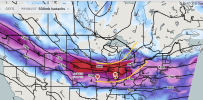
Then the morning MCS would’ve stayed well north of the warm sector while staying on the weaker side as it would’ve left behind the forcing mechanism earlier. The surface low in tandem would’ve been deeper via the higher amplitude.
This is what the both the operational and CAM models showed just the day before, which is why I was one of the few to say that this was pretty much a Palm Sunday redux starring us in the face.
Thankfully, the trough in reality stayed low amplitude enough to where the jet streak was orientated in a way, that when it came in, the initial forcing that spawned the morning MCS was placed right over the OWS.
This orientation also ment that the MCS stayed in the forcing area for longer, which is why it was so much more expansive then what the CAMS showed initially the day before.
By the time we went into the night before the event, it was obvious the ceiling for this had fell well below that of a Palm Sunday level outbreak.

WeathermanLeprechaun
Member
It was amazing how I was the one calling for a major event then excrement on it right after lmfaoJune 17th was just a minor orientation of the jet streak away from becoming a Palm Sunday redux.
Had the jet streak been a little bit more amplified, like this.
View attachment 55647
Then the morning MCS would’ve stayed well north of the warm sector while staying on the weaker side as it would’ve left behind the forcing mechanism earlier. The surface low in tandem would’ve been deeper via the higher amplitude.
This is what the both the operational and CAM models showed just the day before, which is why I was one of the few to say that this was pretty much a Palm Sunday redux starring us in the face.
Thankfully, the trough in reality stayed low amplitude enough to where the jet streak was orientated in a way, that when it came in, the initial forcing that spawned the morning MCS was placed right over the OWS.
This orientation also ment that the MCS stayed in the forcing area for longer, which is why it was so much more expansive then what the CAMS showed initially the day before.
By the time we went into the night before the event, it was obvious the ceiling for this had fell well below that of a Palm Sunday level outbreak.
In general, this trough was already very favorable. The fact we seen sigtors into almost 3am with these cells shows how just potent it could d been had we seen that full warm sector scenario.
Yeah, perhaps I was downplaying the ceiling of the event. There was a VERY scary picture on models in the couple of days leading up to it.June 17th was just a minor orientation of the jet streak away from becoming a Palm Sunday redux.
Had the jet streak been a little bit more amplified, like this.
View attachment 55647
Then the morning MCS would’ve stayed well north of the warm sector while staying on the weaker side as it would’ve left behind the forcing mechanism earlier. The surface low in tandem would’ve been deeper via the higher amplitude.
This is what the both the operational and CAM models showed just the day before, which is why I was one of the few to say that this was pretty much a Palm Sunday redux starring us in the face.
Thankfully, the trough in reality stayed low amplitude enough to where the jet streak was orientated in a way, that when it came in, the initial forcing that spawned the morning MCS was placed right over the OWS.
This orientation also ment that the MCS stayed in the forcing area for longer, which is why it was so much more expansive then what the CAMS showed initially the day before.
By the time we went into the night before the event, it was obvious the ceiling for this had fell well below that of a Palm Sunday level outbreak.
DanLarsen34
Member
Good write-up.Recently I was thinking about Palm Sunday 1965, and the amount of violent tornadoes that occured within that outbreak. This led me to search the SPC's Violent Tornadoes webpage for single-day events with a VItor count in the double digits. This is the list I got, ignoring the fact that these are from very different eras with very different practices and attitudes about ratings.
1- March 21, 1932 (10).
2- March 21, 1952 (10).
3- April 11, 1965 Palm Sunday outbreak (17).
4- April 3, 1974 Super outbreak (30).
5- April 27, 2011 Super outbreak (15).
There are also a couple of edge cases that, while I can't reliably add to the list, do deserve to be mentioned for various reasons.
The first is the May 31, 1985 tornado outbreak (9). This outbreak was one tornado away from my 10 tornado limit, and it's fully in the realm of possibility that one of the W PA tornadoes was one of those cases where a violent tornado doesn't hit anything.
The other two are Feb 19, 1884 and March 27, 1890. I'm mentioning these because Tornado Archive has 10 violent tornadoes for each of these. Historic Events like these are notoriously iffy when it comes to record keeping, and new information that's being uncovered makes older records redundant (Including the SPC webpage, which IMO could use an update, inclduing adding violent tornado days post-2014).
If there's anything to take away from this litte exercise, it's to get an idea of the scale of these events. Even normally High-end outbreaks like 5/3/99 or 5/24/2011 only reach a fraction of the intensity of even the smaller events on this list. Sometimes I struggle to comprehend how an outbreak like 4/27 is even possible, and that's an event that has both a wide variety of meida of the outbreak and memories that are still fresh for a lot of people. An outbreak double that one feels impossible, yet it's happened.
I think the chance of another event like these might as well be one in a billion, but the fact that we've had 5 in the last 100 years means that it's still a one and not a zero. And we've definitely had some close calls. If those HRRR runs leading up to 3/15 verified, it might have ended up on this list. Calling for a Palm Sunday redux on June 17th this year may have been a little hyperbolic, but that event had some very dangerous potential.
Does this mean that we should call for a day 2 CIG 3 60% high risk the next time the HRRR throws 20 discreete supercells in the 30 STP warm sector? Of course not, becuase like on all of these events, the true extent of any day will only be known after the tornadoes touch down.
A sneaky event I would include as an edge case even though it’s more recent than the ones you listed as edge cases was the June 2-3, 1990 outbreak. That outbreak produced 7 violent tornadoes and shattered Indiana’s state record for tornadoes in a single day, beating out the 1974 Super Outbreak. I would say it’s maybe the most underdiscussed major outbreak of the past 50 years?
I also suspect that events that can produce 10 or more violent tornadoes occur more often than we think and aren’t just “generational” events. After all, we had two outbreaks that would be considered “generational” or “super” within a decade of each other (Palm Sunday 1965, then April 3, 1974). A major condition for us to achieve an event of that caliber is unfortunately populated areas being impacted by the tornadoes of that caliber and that often doesn’t happen even during higher end events below the threshold you talked about.
As you mentioned, both March 14 and March 15 last year held that potential and likely would have been of that caliber if a few subtle factors had broke differently. Another example that fizzled before it happened this decade was the following trough from the March 31, 2023 outbreak. Models were honing in on that being an upper echelon event in the days immediately following the 31st, but fortunately the warm sector got messed up in the days preceding the trough ejection and we ended up with a much more run of the mill event.
There are a lot of arguments to be made for edge cases like 6/2/1990. The lack of plains cases on this list makes that even more apparent. At the end of the day, I didn't want to get into too much speculation, so I chose 5/31/1985 becuase it's easier to argue for one missed violent rating than say, three or four, and tossed in a couple others where there was enough reason to include them.Good write-up.
A sneaky event I would include as an edge case even though it’s more recent than the ones you listed as edge cases was the June 2-3, 1990 outbreak. That outbreak produced 7 violent tornadoes and shattered Indiana’s state record for tornadoes in a single day, beating out the 1974 Super Outbreak. I would say it’s maybe the most underdiscussed major outbreak of the past 50 years?
I also suspect that events that can produce 10 or more violent tornadoes occur more often than we think and aren’t just “generational” events. After all, we had two outbreaks that would be considered “generational” or “super” within a decade of each other (Palm Sunday 1965, then April 3, 1974). A major condition for us to achieve an event of that caliber is unfortunately populated areas being impacted by the tornadoes of that caliber and that often doesn’t happen even during higher end events below the threshold you talked about.
As you mentioned, both March 14 and March 15 last year held that potential and likely would have been of that caliber if a few subtle factors had broke differently. Another example that fizzled before it happened this decade was the following trough from the March 31, 2023 outbreak. Models were honing in on that being an upper echelon event in the days immediately following the 31st, but fortunately the warm sector got messed up in the days preceding the trough ejection and we ended up with a much more run of the mill event.
While I haven't been in this hobby that long, I've read through a lot of the other event threads over here, and I find it crazy how there was an event that looked to dwarf an event even as big as 3/31.
On the subject of dodged bullets, Nothing beats the 20z outlook on 4/7/2006. A discussion that states "SEVERAL Long lived violent tornadoes now appear increasingly likely" is something I never want to see.

Eoline
Member
Doing some stuff rn