• Welcome to TalkWeather!
    We see you lurking around TalkWeather! Take the extra step and join us today to view attachments, see less ads and maybe even join the discussion.
    CLICK TO JOIN TALKWEATHER

Severe Weather 3/15 - 3/16

Re: tomorrow. Maybe I’ll eat crow, nothing more liberating than admitting you’re wrong, but I still think the HRRR/CAMS still aren’t handling the presentation/environment well.

You have a 120+ kt 500 MB isotach nose impinging and then directly punching into the warm sector, and then further overlapping it. At peak heating. That kind of perfect timing is a rare thing in set ups. Some of the models are hinting at a Mesolow, which was infamously present during the 3/28/84 Carolinas outbreak. Not sure I buy that yet.

There is still the question of WAA crapvection and clouds, but synoptically this set up is pretty apparent. If you had a proper EML and a cold front draped further back to the west and not bearing down on the warm sector with a line of storms, this would be a high ceiling event. Regardless of Ifs, for this part of the US, this is a rare synoptic set up.
 
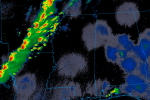
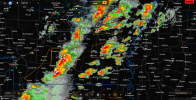
Way too many firing ahead of the line for comfort. The line itself has some big discrete cells itself, for now.

1773616352714.png
 
UOTE="ColdFront, post: 197298, member: 1728"]
Re: tomorrow. Maybe I’ll eat crow, nothing more liberating than admitting you’re wrong, but I still think the HRRR/CAMS still aren’t handling the presentation/environment well.

You have a 120+ kt 500 MB isotach nose impinging and then directly punching into the warm sector, and then further overlapping it. At peak heating. That kind of perfect timing is a rare thing in set ups. Some of the models are hinting at a Mesolow, which was infamously present during the 3/28/84 Carolinas outbreak. Not sure I buy that yet.

There is still the question of WAA crapvection and clouds, but synoptically this set up is pretty apparent. If you had a proper EML and a cold front draped further back to the west and not bearing down on the warm sector with a line of storms, this would be a high ceiling event. Regardless of Ifs, for this part of the US, this is a rare synoptic set up.
[/QUOTE]
Oh i totally agree. I think tomorrow still has potential to be a pretty significant event. THE HRRR has caught on to a significant environment and it does still note through parameters of a potentially impactful prefrontal event. It is looking concerning. But I would say the ceilings definitely lower than the NAM initially suggested.
 
Re: tomorrow. Maybe I’ll eat crow, nothing more liberating than admitting you’re wrong, but I still think the HRRR/CAMS still aren’t handling the presentation/environment well.

You have a 120+ kt 500 MB isotach nose impinging and then directly punching into the warm sector, and then further overlapping it. At peak heating. That kind of perfect timing is a rare thing in set ups. Some of the models are hinting at a Mesolow, which was infamously present during the 3/28/84 Carolinas outbreak. Not sure I buy that yet.

There is still the question of WAA crapvection and clouds, but synoptically this set up is pretty apparent. If you had a proper EML and a cold front draped further back to the west and not bearing down on the warm sector with a line of storms, this would be a high ceiling event. Regardless of Ifs, for this part of the US, this is a rare synoptic set up.
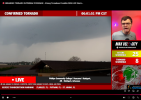
I'll take your prognostications over modelling any day of the week, personally. One thing I think some folks are forgetting is that the area under the gun tomorrow isn't really used to major tornado events. There *will* be a tornado threat even if all it ends up being is QLCS spam. So I think it's prudent to sound a reasonable alarm for this setup.
 
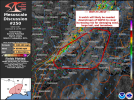
MD #250 says "eastern MS" but I think they meant West lol

1773616604589.png

Mesoscale Discussion 0250
NWS Storm Prediction Center Norman OK
0611 PM CDT Sun Mar 15 2026

Areas affected...portions of far southeastern Texas...central
Louisiana...eastern Mississippi

Concerning...Severe potential...Watch likely

Valid 152311Z - 160115Z

Probability of Watch Issuance...80 percent

SUMMARY...Thunderstorm activity is increasing in coverage and
intensity this evening. Supercells capable of large hail, damaging
wind, and a couple of tornadoes.

DISCUSSION...Thunderstorm activity is increasing along the cold
front moving east across far eastern TX into western LA. Comparison
of 18z to 20z sounding from SHV showed lifting of the MLCIN layer
between 850 and 700mb with the influence of the trough moving
eastward. Though some MLCIN remains across southeast Texas into
central Louisiana, the environment ahead of these storms is
characterized by MLCAPE around 1500-2000 J/kg and deep layer shear
around 40-45 kts. Cooling aloft will continue to erode MLCIN through
time this evening. This environment will support line embedded
supercells, capable of damaging wind, large hail, and couple of
tornadoes. Storms to the north have a history of 1-1.5 inch hail and
winds up to 65 mph. A new watch will be needed to cover this threat
over the next couple of hours.
 
Back
Top