

Navigation
Install the app
How to install the app on iOS
Follow along with the video below to see how to install our site as a web app on your home screen.
Note: This feature may not be available in some browsers.
More options
-
Welcome to TalkWeather! We see you lurking around TalkWeather! Take the extra step and join us today to view attachments, see less ads and maybe even join the discussion. CLICK TO JOIN TALKWEATHER
You are using an out of date browser. It may not display this or other websites correctly.
You should upgrade or use an alternative browser.
You should upgrade or use an alternative browser.
Severe Weather 3/9 - 3/12
- Thread starter CheeselandSkies
- Start date

For the people who have just woken up, CAMs have been a bit finicky regarding the time of storm initiation in the OWS, if initiation happens at all.
Every one of them show the same thing however, a south-to-north orientated bowing band of precip that shows up at around 3-4pm. This feature is crucial on weather OWS convection develops or not.
The reason why this banding forms can be traced back to south western Missouri. Here, a region of strong isentropic lift
develops (at around 9am) and propagates northeastward out ahead of the main forcing mechanism responsible for the later development of dryline/coldfront convenction.
View attachment 51288View attachment 51289
This isentropic lift and its propagation can be seen on these VWPs below.
View attachment 51290View attachment 51295View attachment 51296
It’s just under the inversion layer and depicted by the omega bars to the left. This inversion layer is overblown on the NAM models, but still respectively stout on all other CAMs.
Given the magnitude of surface heating, low to mid 80s, lllr, 7-8c/km, moisture content, 60-mid 60s dew, and lack of fog/low level cloud deck; this lifting front shouldn’t have too much difficulty in initiating convection in the OWS.
Main questions are still the timing of initiation, distribution of initiation (north or south of warm front), or will initiation even happen at all, which heavily depends on magnitude of the inversion layer. Even with or without OWS convection, once the main forcing mechanism arrives, the dryline will unzip and upscale growth capable of producing tornadoes (some strong) and most certainly damaging winds will be the main threat.
Recent HRRR runs have the OWS convection firing early and quite far to the south and east. This would be out of reach for me, and also somewhat removed from the most volatile parameter space which has been consistently shown as pooling right along the warm front just south and east of the Quad Cities area (although parameters there would still certainly support supercells capable of all hazards).
Hrrr is beginning to trend away from a solid squall line to a more semi discrete upscale growth.
Likely due to a slightly more stout inversion layer than previously modeled.
View attachment 51298View attachment 51299
RRFS shows pretty much an exact copy of the same scenario.
View attachment 51300View attachment 51301
12Z HRRR is...something. Two discrete rounds, and just about an ideal chasing scenario for me. Early one is far enough north and holds off just long enough that I could possibly get to it after work, and the late round fires before 23Z and remains discrete for much longer than earlier runs.
View attachment 51307
13z HRRR goes full Nacho Libre on IL/IN, showing multiple discrete OWS cells in the first round, a discrete mode that quickly turns semi-discrete in the second, and perhaps most shockingly, a 3rd mode that starts off near the warm front as supercells before turning upscale. It also shows these cells lasting much longer as they tread eastward into Indiana and Michigan, with a warm front rider or two as well.
Utterly incredible parameter space near the warm front as well.
View attachment 51308
@UncleJuJu98 bumping these awesome forecasts from this morning since they got buried by more Connor Croff Twitter drama.

US_Highway15
Member
All clouds here near South Bend IN so far. Hoping to get some clearing.

Anybody storm chasing today? @CheeselandSkies you chasing? If so where at?
Muwx
Member
It will be interesting to see how the CIG1 is handled… In reality, I think if the atmosphere is conducive for tornadoes, it’s reasonably possible that it produces an EF2 but if they cig1 everything, why cig1 anything? Thats the most interesting part to me.Absolutely 100% agree here. I originally wasn't a fan but I've since came around to it, especially since it isn't for the general public to look at unless they have some sort of baseline understanding of things from a meteorological perspective. We needed the ability to incorporate hatching into risks that constituted a less than 10% since it's honestly not that uncommon of an occurrence at this point, and like you said, seeing the same level of hatched for a day like 4/27/11 being compared to a day like 3/5 this year is hilariously wrong.
I fully believe that this change was very needed. The only thing I'm worried about now is them using the CIG1 hatch a bit too much but that may be me underestimating today's threat. I don't think the CIG1 hatch should have been extended throughout the entire nonzero tornado risk area today.
Kds86z
Member

Tanner
Member
There is a hefty sum of wx people on X that make it clear that they need a reality check. The egotistical anecdotes and lack of positivity can only get him so far.I also vote for no more Connor Croff on this forum unless it's actual tornado pics or video. I couldn't care less about his or any other storm chaser opinions about SPC forecasts and their posts regularly derail these threads.

speedbump305
Member
Wouldn’t be surprised to see an upgrade to a moderate risk now to be honest.
Kds86z
Member
US_Highway15
Member
Trey dropping the goods.

N0mz
Member
not sure what nadocast is up to, now
Man, the CAPE alone almost justifies it. Plus, the parameters across the risk zone are still very impressive despite the doubts about storm mode. I think even QLCS spin ups would have a good chance of being EF2+ in this environment. It probably just seems like it's being overused based on how anomalously juicy the atmosphere has been with the last few systems. There's been a plethora of peak spring season RAP soundings across these risk areas.I don't think the CIG1 hatch should have been extended throughout the entire nonzero tornado risk area today.

Eoline
Member
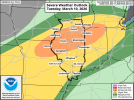
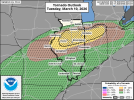
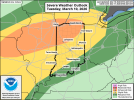
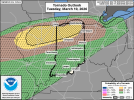
More detailed look of IL and IN towns in the threat area, since I know that's a big concern right now:
Kds86z
Member
US_Highway15
Member
More clouds are forming across N IL/IN. Put the fries in the bag, it's over (sarcasm).
N0mz
Member
Very lake-enhanced boundary setting up:
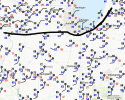
Looking at the 15z hrrr, it's a couple ticks too dry near the front.
Looking at the 15z hrrr, it's a couple ticks too dry near the front.
Eoline
Member
I'm not going to chase, but I might go out and spot for SKYWARN. Depends on what happens in the metro.Anybody storm chasing today? @CheeselandSkies you chasing? If so where at?
Kds86z
Member
We need some clouds potentially. Gotta watch spreads.More clouds are forming across N IL/IN. Put the fries in the bag, it's over (sarcasm).

SmokeEater
Member
Yea, not over Chicago, lol. Chicago is more like the 2% or 5%. Don't get me wrong, not 100 miles, but def not over the city.Man, seeing that little red bullseye right over Chicago sure is ominous.
SmokeEater
Member
It's setup well with SPC's 10%, both of them are south of the city.