• Welcome to TalkWeather!
    We see you lurking around TalkWeather! Take the extra step and join us today to view attachments, see less ads and maybe even join the discussion.
    CLICK TO JOIN TALKWEATHER

January 23-25th Winter Wx

It's certainly beginning to get a handle on it, but is likely still underplaying its westward extent and eroding it too much. This will be a very strong wedge based on the HP feeding it, and it will be very hard to dislodge.
Agreed. Currently, I think the ATL Metro, W SC, and W NC have a chance at over performing in terms of how much ice is forecasted.
 
Agreed. Currently, I think the ATL Metro, W SC, and W NC have a chance at over performing in terms of how much ice is forecasted.
Yep - I’m here in the ATL metro and I can’t decide how worried to be lol. FFC did raise my ice projection slightly Definitely agree with you that if the wedge overperforms it won’t be good for our area.
 
Curious what impact the wet ground from this rain might have on things later, if any. It's been quite the steady rain for the past hour or so.
1000004998.gif
 
200w.gif
 

Attachments

  • IMG_3335.jpeg
    IMG_3335.jpeg
    224.6 KB · Views: 0
@slenker Lexington may absolutely get buried in this one.

That warm nose that could save Dixie has pushed that ice right up in the KY/TN border area.
How are things looking in your neck of the woods? Haven't been looking that close at trends up there.
 
How are things looking in your neck of the woods? Haven't been looking that close at trends up there.
A good amount of snow (up to the 6-12 inch range) but now there’s a definitive signal for freezing rain. It really varies model to model and run to run so far, some are a straight up ice storm, others are fairly muted since it wants to push rain through instead. Local NWS office has low-medium confidence on a major ice threat right now, but I’m still staying tuned in.


I’ve got the generator ready just to be safe.
 
As far as the low level warm air pushing north, the only way I could see that going wrong is if the precipice breaks out earlier than shown….the rain free conditions for central Alabama starting Friday into Saturday intro Saturday night makes the air easier to move and displace…however is precip breaks out earlier than modeled, the air will be cooler and more difficult to move, I have seen where this happened and the wedge winds up being stronger, there may be some ductinging/gravity wave scenerio that could tap into the much colder air to the west and north. I am not doubting what the models show, unless things start differently, then all bets are off.
 
A good amount of snow (up to the 6-12 inch range) but now there’s a definitive signal for freezing rain. It really varies model to model and run to run so far, some are a straight up ice storm, others are fairly muted since it wants to push rain through instead. Local NWS office has low-medium confidence on a major ice threat right now, but I’m still staying tuned in.


I’ve got the generator ready just to be safe.
Well, fingers crossed for nothing but some picturesque powder. Either way, stay safe up there as always!
 
Curious what impact the wet ground from this rain might have on things later, if any. It's been quite the steady rain for the past hour or so.
View attachment 50141
Hoping it and the heavy rain on Saturday won't loosen up the trees and make them easier to knock out when the ice comes in. Would love to avoid trees on power lines if we can
 
Hoping it and the heavy rain on Saturday won't loosen up the trees and make them easier to knock out when the ice comes in. Would love to avoid trees on power lines if we can
Yeah, I've got a lot of trees where I'm situated and really would like not to have holes in the roof of my residence.
 
North Alabama through all of middle Tennessee to Kentucky, won’t see anything but rain Saturday. The temps won’t drop below the 40’s. That my story and I’m sticking to it.
 
A little late to the conversation, but I'm failing to see how the models were wrong? The snow, ice, and sleet totals have barely changed. They've just moved North. People who were on the southern edge of the snow have been consistently warned that even a slight move North would turn the snow into freezing rain.

Forecast 4 days ago: "It looks like there's some big snow potential but if the system moves north it'll be freezing rain".

*System moves north and turns into freezing rain*

Weenies: "These models make no sense!!"

Neither the meteorologists or models have been wrong. WX Twitter and hype casters were wrong, and if you listened to them blame yourself.
 
A little late to the conversation, but I'm failing to see how the models were wrong? The snow, ice, and sleet totals have barely changed. They've just moved North. People who were on the southern edge of the snow have been consistently warned that even a slight move North would turn the snow into freezing rain.

Forecast 4 days ago: "It looks like there's some big snow potential but if the system moves north it'll be freezing rain".

*System moves north and turns into freezing rain*

Weenies: "These models make no sense!!"

Neither the meteorologists or models have been wrong. WX Twitter and hype casters were wrong, and if you listened to them blame yourself.
I'm still waiting on my exploding trees though.
 
1769108087725.png


Since these threats often pull in a lot of new folks, here's a quick primer on what we are talking about when we talk about CAD or "the Wedge". As always, smarter folks than me please correct anything I oversimplified or got wrong.

Cold Air Damming – usually called “CAD” – is one of the main reasons winter weather in Georgia and Alabama so often refuses to behave.

At its core, CAD is simple. A strong high-pressure system settles in to our north or northeast, usually over the Mid-Atlantic or New England. Cold, dense air spills south and east out of that high and gets funneled down the eastern side of the Appalachians. Once it reaches the Southeast, it piles up against the mountains and spreads southwestward into Georgia and Alabama like water flowing downhill. In this case, it's coming from our big arctic high.

That’s the “wedge.”

Cold air is heavy and stubborn. When it arrives from the east, it doesn’t mix well with warmer air above it. Instead, it hugs the ground, sometimes only a few thousand feet deep, while warmer, moist air rides up and over the top. From the surface, it can look calm and cold. Aloft, the atmosphere is doing something very different.

This is why CAD matters so much for winter weather here.

In Georgia and Alabama, CAD often sets the stage for freezing rain and sleet rather than snow. Surface temperatures stay near or below freezing thanks to the wedge, but temperatures above that shallow cold layer rise just enough to melt falling snowflakes. Those drops then refreeze on contact with roads, trees, and power lines – or partially refreeze into sleet before reaching the ground.

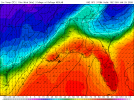
The image here shows that process well. Notice the sharp temperature gradient across the Southeast, with colder air wedged southwestward from the Carolinas into Georgia while warmer air pushes north from the Gulf. Winds near the surface flow in from the east and northeast, reinforcing the cold air instead of scouring it out. As long as that easterly flow holds, the wedge holds.

CAD events are notorious for outlasting model expectations. Forecasts often assume the cold air will erode quickly once precipitation begins or winds turn southerly. In reality, wedges frequently linger hours longer than expected, especially at night and in valleys. That difference can mean cold rain instead of ice – or ice instead of rain – and the impacts are dramatically different.

For the Deep South, this is why winter storms are rarely straightforward. Snow is possible, but ice is often the bigger threat. When cold air comes in from the east instead of the north, it’s a signal to slow down, watch surface observations closely, and be wary of quick warm-ups that never quite arrive.
 
View attachment 50143


Since these threats often pull in a lot of new folks, here's a quick primer on what we are talking about when we talk about CAD or "the Wedge". As always, smarter folks than me please correct anything I oversimplified or got wrong.

Cold Air Damming – usually called “CAD” – is one of the main reasons winter weather in Georgia and Alabama so often refuses to behave.

At its core, CAD is simple. A strong high-pressure system settles in to our north or northeast, usually over the Mid-Atlantic or New England. Cold, dense air spills south and east out of that high and gets funneled down the eastern side of the Appalachians. Once it reaches the Southeast, it piles up against the mountains and spreads southwestward into Georgia and Alabama like water flowing downhill. In this case, it's coming from our big arctic high.

That’s the “wedge.”

Cold air is heavy and stubborn. When it arrives from the east, it doesn’t mix well with warmer air above it. Instead, it hugs the ground, sometimes only a few thousand feet deep, while warmer, moist air rides up and over the top. From the surface, it can look calm and cold. Aloft, the atmosphere is doing something very different.

This is why CAD matters so much for winter weather here.

In Georgia and Alabama, CAD often sets the stage for freezing rain and sleet rather than snow. Surface temperatures stay near or below freezing thanks to the wedge, but temperatures above that shallow cold layer rise just enough to melt falling snowflakes. Those drops then refreeze on contact with roads, trees, and power lines – or partially refreeze into sleet before reaching the ground.

The image here shows that process well. Notice the sharp temperature gradient across the Southeast, with colder air wedged southwestward from the Carolinas into Georgia while warmer air pushes north from the Gulf. Winds near the surface flow in from the east and northeast, reinforcing the cold air instead of scouring it out. As long as that easterly flow holds, the wedge holds.

CAD events are notorious for outlasting model expectations. Forecasts often assume the cold air will erode quickly once precipitation begins or winds turn southerly. In reality, wedges frequently linger hours longer than expected, especially at night and in valleys. That difference can mean cold rain instead of ice – or ice instead of rain – and the impacts are dramatically different.

For the Deep South, this is why winter storms are rarely straightforward. Snow is possible, but ice is often the bigger threat. When cold air comes in from the east instead of the north, it’s a signal to slow down, watch surface observations closely, and be wary of quick warm-ups that never quite arrive.
Also, a difference between what we were looking at several days ago and now is low placement, which meant that CAD wasn't as much of the main story at the time due to southerly low pressure position. It's now the star of the show with that warm nose interacting.
 
A few of the WFOs in TN and KY have begun to upgrade their winter storm watches to warnings.

I have never paid any attention to the duration of those products in the past, but I did notice Louisville has most of their CWA under a winter storm warning for over 48 hours (1am ET Saturday - 7am ET Monday).
 
Back
Top