• Welcome to TalkWeather!
    We see you lurking around TalkWeather! Take the extra step and join us today to view attachments, see less ads and maybe even join the discussion.
    CLICK TO JOIN TALKWEATHER

Volcano thread

Afar TV got a really good video of MErapi (Java) doing its thing last night:


I learned while reading up on this Decade Volcano that, all around the world, volcanoes that push up real sticky lava which accumulates at the summit in a crumbly dome that regularly sheds pyroclastic flows are said to be having Merapi-style eruptions.

Merapi does this most of the time, in the midst of millions of people. The summit area is a no-go zone but sand miners go up there anyway because volcanic ash is a very good source of silica for electronic chips and poverty is widespread here. They frequently lose their equipment and sometimes their lives, but many are willing to risk it.

(PS: These days I'm not active at Patreon, despite the note at that link.)
 
I have no idea who the author of this letter to the editor is, and a quick online search isn't helpful. Given the content -- an in-depth discussion of the tsunami risk from Kick-'em-Jenny, it sounds like someone who knows what they're talking about.

Note that the Gulf Coast isn't mentioned. <Layerson speculation> Certainly islands and other land close to the volcano are most at risk. The only context where I've seen the US brought in is for a Hunga Tonga-style megablast, but from other reading my impression is that volcagenic tsunamis, when recognized as a risk at all, aren't well understood; neither are submarine volcanoes.

For that matter, neither is Hunga Tonga's big boom. Until that is figured out, chances of another one at another submarine volcano that, like HT, is frequently active in a "normal" way, must be considered as not zero. </Layperson speculation>
 
As far as I know, this study doesn't announce anything really new, despite the dramatic and IMO rather misleading headline, but it does report a welcome new proof of technology that could greatly improve volcano monitoring.

Again, I have done no in-depth reading on the Cascades, but of course I looked them up when I moved here. It's a surprisingly complex picture but my general impression is that scientists know about the bodies of partial melt that the headline refers to as giant magma bodies.

Those in the Cascades have their own properties, but basically there is partial melt under probably all dormant volcanoes and elsewhere, too -- say, between Albuquerque and Socorro in New Mexico.

But that doesn't mean that it will erupt. It just means that hot stuff from the depths has found its level of neutral buoyancy. Much more often than not, it just stays there and freezes into rock.

The processes that can bring it up are a whole 'nother story, and as this layperson understands things, not completely known.

Also, it's expensive to monitor volcanoes and that's why only known troublemakers are likely to get networks.

Mexico's El Chichon and Pinatubo in the Philippines were not known troublemakers before they went off. Neither was Vesuvius, dormant some eight centuries before its Pompeii eruption.

There must be other volcanoes out there -- dangerous because no one knows about them. The success of receiver functions in this study, if verified, means that volcano monitoring costs at individual volcanoes can drop and so more possible troublemakers can be monitored.

This is pushing past my knowledge envelope, but it might also mean that preeruption processes can be studied in greater detail, too. That would improve eruption forecasting a lot.
 
There has been some sensational media coverage about a volcano, relatively dormant for 700,000 years (GVP notes two possible active episodes, in 1902 and 1993, but with ??), suddenly waking up and showing signs of an impending massive eruption.

Fact-checking shows that some scientists tested a type of InSAR monitoring on a long-dormant volcano in southeast Iran that is the only member in its volcanic field still emitting fumaroles, and they picked up a transient episode of inflation from 2023 to 2024 with it, which was indeed scientifically exciting.

In their report they say that it could be due to either hydrothermal processes or a minor and very deep magma intrusion that affected Taftan's big hydrothermal system.

That's all.

But they included an image that someone with no background in volcanology and who hadn't fully read or understood the technical text -- I don't understand the details sometimes but usually get the gist -- could interpret as a "massive explosion" when it's really just a diagram of the ongoing fumarolic activity (image is CC BY-ND-NC-SA 4.0):

grl70906-fig-0004-m.png


This baby is only dormant, not extinct, and it's one of the few Pleistocene volcanoes that GVP lists despite it not having a confirmed eruption since the last ice age ended.

But it doesn't sound to this layperson that any magmatic trouble is brewing there in the foreseeable future.
 
This article is a good factual reference in case you see tabloid news about "the huge volcano off Oregon's coast about to blow."

Yes, as this layperson understands it, Axial is big, but it is very deep underwater and does not affect the surface. Also, it goes off every ten years or so, per information at that link. -- not a big deal for daily life on land nearby.

I didn't fully realize until now that it's a hotspot volcano. Cool!

The article describes some really neat science they're doing at Axial (and for geonerds, it gets into a possible explanation of those puzzling occurrences of silica-rich magma where it shouldn't be, like Iceland and this hotspot, because those places are fed by basaltic mantle stuff that's high in iron and magnesium but not silica).

As for actual volcanic hazard in Oregon, just off the top of my head, Hood, Three Sisters, Newberry, and the basaltic field around VERY quiet Jefferson across the valley are here, as are many, many others but all are sleeping fairly soundly right now AFAIK. This is the case up in Washington, too, even at Mount Adams just now, and as far as I know, BC's volcanoes are also not under any alerts.
 
Well, this is never a good thing to see in a live webcam:


The current livestream is ashy, too.

AP reports no casualties, but I think they are following the official media only. With Indonesian eruptions, it helps to keep an eye on social media, too (JALIN Merapi is a classic example), especially in the early hours of an eruption, and per X, there are casualties.


How could there not be?

Darwin VAAC reports ash to 59,000 feet.

This is big, for Semeru (I did a post on it a while ago, which I will update after this). First reports I see call it a lava dome collapse, but it seems unusually large for that.

It's early on, and I'll try to find out more for the post updates.
 
Yeah, this is a biggie. Tephra fall , posted about 20 minutes ago. Will follow news for a while before doing the updates; am not a good multitasker.


Airline flights are affected, too.
 
PS: Hope it didn't sound like a disparagement of Indonesian officials. They are superb and they saved tens of thousands of lives during Merapi's 2010 VEI 4 by getting them away from the volcano just before its climactic blast.

It's just that there is a delay in putting information out. An Indonesian research paper I read for a Krakatau post attributed that to siloing.

All I know from following Indonesian volcanoes (which are amazing) is that government information to the outside world is not always timely. Organizations like JALIN Merapi aren't perfect, either.

But what is cool is that you can get solid information quickly if you follow both gov and social sources. You just have to work at it a little.
 
Well, this is never a good thing to see in a live webcam:


The current livestream is ashy, too.

AP reports no casualties, but I think they are following the official media only. With Indonesian eruptions, it helps to keep an eye on social media, too (JALIN Merapi is a classic example), especially in the early hours of an eruption, and per X, there are casualties.


How could there not be?

Darwin VAAC reports ash to 59,000 feet.

This is big, for Semeru (I did a post on it a while ago, which I will update after this). First reports I see call it a lava dome collapse, but it seems unusually large for that.

It's early on, and I'll try to find out more for the post updates.

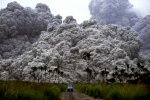
Good grief, that pyroclastic flow looks like something from Pinatubo. Seriously reminds me of this photo from the Pinatubo eruption in 1991.
7e2a4-150611_pinatubo_eruption01_albertg.jpg
 
Incredibly, the only casualties I've heard about thus far are a married couple that stood on a bridge and watched a pyroclastic flow come right at them (others did, too, but not directly in the strike zone).

However, I don't know what Semeru is doing. The rain and storms were already affecting flights and causing floods and landslides before this happened, and nobody can see the volcano through the weather, and now, ash.

Darwin VAAC still reports ash to 59,000 feet but that is by model and, I guess, the safety principle (better safe than sorry).

Badan Geologi tweeted a few hours ago that the pyroclastic flows are continuing.

And I've seen no stories yet about ashfall, weighted down by rain, collapsing roofs, as that one tweet from a reliable source shows.

Daylight will break there in a few hours, and maybe we will get more news.
 
Incredibly, the only casualties I've heard about thus far are a married couple that stood on a bridge and watched a pyroclastic flow come right at them (others did, too, but not directly in the strike zone).

However, I don't know what Semeru is doing. The rain and storms were already affecting flights and causing floods and landslides before this happened, and nobody can see the volcano through the weather, and now, ash.

Darwin VAAC still reports ash to 59,000 feet but that is by model and, I guess, the safety principle (better safe than sorry).

Badan Geologi tweeted a few hours ago that the pyroclastic flows are continuing.

And I've seen no stories yet about ashfall, weighted down by rain, collapsing roofs, as that one tweet from a reliable source shows.

Daylight will break there in a few hours, and maybe we will get more news.
 
Incredibly, the only casualties I've heard about thus far are a married couple that stood on a bridge and watched a pyroclastic flow come right at them (others did, too, but not directly in the strike zone).

However, I don't know what Semeru is doing. The rain and storms were already affecting flights and causing floods and landslides before this happened, and nobody can see the volcano through the weather, and now, ash.

Darwin VAAC still reports ash to 59,000 feet but that is by model and, I guess, the safety principle (better safe than sorry).

Badan Geologi tweeted a few hours ago that the pyroclastic flows are continuing.

And I've seen no stories yet about ashfall, weighted down by rain, collapsing roofs, as that one tweet from a reliable source shows.

Daylight will break there in a few hours, and maybe we will get more news.
 
Many people are interpreting this awesome image as volcanic lightning, but there were T-storms in the area and it looks like cloud-to-ground lightning:


Darwin VAAC, two and a half hours ago, reported continuous emissions to a much lower level -- much closer to but not quite yet at typical Semeru levels, in this layperson's opinion -- and that the high cloud (to 45,000 feet) had dissipated.

Reuters reports that Semeru erupted ten times yesterday. They don't mention casualties one way or the other; I hope, if it had to be, that it was only those who stayed on the bridge, like rabbits fascinated by a snake. About 900 villagers reportedly were evacuated. Also some 170 people were stranded ON the mountain, but reportedly they are all okay and are being rescued at last report (about an hour ago).

No word on economic losses yet. And the aftereffects and perhaps more casualties will continue on from future lahars during this rainy season. :(

So, in sum, it was basically a repeat of the escalation in 2021, not a sudden switch to sustained major explosive activity, but those cam images are amazing.

Just for the sake of misconception clearing, some headlines declare the volcano is close to Bali. Well, perhaps when compared to how close I am to Bali, up here in Oregon, but there is quite some distance between Java, even eastern Java, and the island of Bali, which might even be in another time zone.

I didn't realize how big this archipelago called Indonesia is until I started to follow some of the volcanoes there. It has three time zones.

Its people are just as varied as its geography (and, BTW, I read yesterday that they are going to start buying natural gas from us; Corvallis's NuScale is also trying to interest them in small nuclear reactors). Fascinating place.

The Bali reference, of course, comes in because of restless Lewotobi that has been erupting recently on Flores Island and occasionally shutting down nearby Bali's air traffic.
 
Already lahars are occurring:


No human lives lost, but some livestock were, and there is the property damage.


Here's how it looked from the ground:


That's a little explosive for a shield volcano in the Erta Ale range, but then I'm a layperson and not at all familiar with this range -- not even famous Erta Ale.

It's probably phreatomagmatic, I guess.

Intelligent comments probably will soon be posted on Hayli Gubbi's GVP page (note: LaMEVE's page has no info on it).

The Toulouse VAAC page currently notes that the eruption has stoped and that the cloud is moving towards India
 
Another source of intelligent comments:

 
For any fellow geonerds, I think that this is the dike formation referred to in the Bsky tweet above.

Fentale is the Ethiopian volcano that has been making the news with earthquakes; there might be some posts in this thread about that. It hasn't erupted; Hayli Gubbi, which erupted, is SW of Fentale a fair ways, per Google Maps, but looks to be closer to populated areas, and the photos of people present and watching the column seems to confirm that, given how rugged the terrain is (Google Maps couldn't find a route between the two volcanoes).

<Layperson speculation> The intense interest in this eruption likely is less about volcanic hazard locally, although that's present whenever there is active volcanism, and more about science.

This is near ground zero for Africa's breaking apart, after all. And unlike Iceland's Reykjanes Ridge, this is not a spreading ridge (although there are some in the region, I understand, most notably perhaps, the Red Sea).

And yet diking seems to be going on, and likely is responsible for Hayli Gubbi's outburst -- perhaps when a dike made contact with water, although I just read that the magma is rhyolitic, which is explosive.

That dike formation is due to the regional mantle plume, as I understand it, but unlike the Hawaiian plume, there is a continent present.

Scientifically fascinating. The ash and sulfur emission present hazards, too. As for further hazard, the InSAR that Dr. Wright mentions will give experts a better idea about what is going on and maybe help them understand the directions that future developments might take. </Layperson speculation>
 
Just an update on Hayli Gubbi. Toulouse has issued no more ash advisories, but a geologist quoted in that linked article says that more eruptions could come until this cycle is over.

PS: The scientists are all over this. Just one reason why;

...
Either way, this eruption is highly unusual. Hayli Gubbi is a shield volcano, like Hawaii’s Mauna Loa. These volcanoes are known for oozing lava flows, not expelling giant columns of ash.


“To see a big eruption column, like a big umbrella cloud, is really rare in this area,” Biggs says....

-- Source

They hit the field immediately! :)


Last edited:
More geonerd "wows" from Hayli Gubbi. There are no more eruptions yet, but it's an unusual situation and the area is densely populated (about 180,000 people live within 70 miles of the place, per the GVP).

Volcano Discovery managed to get there after the eruption and posted this video 18 hours ago:


That white cloud was first noticed on satellite images on July 25th, ten days after Erta Ale had an explosive eruption.

Erta Ale is this baby --


-- and I don't know why it had an explosive eruption this past July.

This might be footage of that, though I don't know the source:


Anyway, per the GVP update on Hayli Gubbi, a line of fissure vents with lava flows opened up outside that vent on Erta Ale the next day (July 16), with some lava flows. Another line of fissure vents opened farther down the rift after that to as far as just 2 km away from Hayli Gubbi (which is close enough to be considered part of the Erta Ale segment of this a-borning mid-ocean ridge; it's a very complex area and I will try to set down my very limited understanding of what I've been reading in a Sunday Morning Volcano blog post this weekend or whenever possible).

The fissure vents stopped erupting after July 18, the GVP reports, but some ground deformation was detected from July 21 to August 3, and starting on July 25th, a white cloud was seen in Hayli Gubbi's crater. It was still there on the last satellite image (I infer) on November 18.

Now it's there again, as Volcano Discovery demonstrates (by the way, it is so difficult and often dangerous to get to Erta Ale that photos and other valid information from the commercial tours that Volcano Discovery runs there -- probably with military escorts -- are used in some of the science papers that I've been reading).

This is not a dramatic "she's gonna blow" situation, not even close, as this layperson understands things. Follow the GVP for reliable information and any links they give with their reports. (Of note, they now list an eruption of Hayli Gubbi in 6250 BC -- so much for the "first time in 10,000 years" thing.)

It's just unusual, in a nerdy way.

As for hazard, Erta Ale occasionally overflows, damaging crops and killing livestock. No human deaths have occurred during any of this (from natural causes; partisans have attacked tourist groups a couple times, hence the military escorts).

The main road between Ethiopia and Djibouti runs through the area somewhere; if it was blocked, there would be supply problems. Also, agriculture downstream could be affected if the nearby Awash River (great name in English ;) ) was affected.

Authorities conduct evacuations whenever trouble looms.

Of course, a pyroclastic flow is not predictable, and the GVP reports that one probably occurred with Hayli Gubbi's recent blast. This layperson guesses that experts are trying to get a handle on what sort of eruption might happen next: runny red lava, which is Erta Ale's usual style and also occurred in the new fissures, or another anomalous boom from either vent, which would be more hazardous to both locals and international air traffic.

I haven't even mentioned the recent seismic swarm at Fentale, which turns out to be north of Erta Ale rather than south of the summit crater like Hayli Gubbi.

Sources and more information will be in the blog post, if I can do one that is coherent and clear.
 
Back
Top