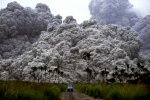
More geonerd "wows" from Hayli Gubbi. There are no more eruptions yet, but it's an unusual situation and the area
is densely populated (about 180,000 people live within 70 miles of the place, per the
GVP).
Volcano Discovery managed to get there after the eruption and posted this video 18 hours ago:
That white cloud was first noticed on satellite images on July 25th, ten days after Erta Ale had an explosive eruption.
Erta Ale is this baby --
-- and I don't know why it had an explosive eruption this past July.
This might be footage of that, though I don't know the source:
Anyway, per the GVP update on Hayli Gubbi, a line of fissure vents with lava flows opened up outside that vent on Erta Ale the next day (July 16), with some lava flows. Another line of fissure vents opened farther down the rift after that to as far as just 2 km away from Hayli Gubbi (which is close enough to be considered part of the Erta Ale segment of this a-borning mid-ocean ridge; it's a very complex area and I will try to set down my very limited understanding of what I've been reading in a Sunday Morning Volcano blog post this weekend or whenever possible).
The fissure vents stopped erupting after July 18, the GVP reports, but some ground deformation was detected from July 21 to August 3, and starting on July 25th, a white cloud was seen in Hayli Gubbi's crater. It was still there on the last satellite image (I infer) on November 18.
Now it's there again, as Volcano Discovery demonstrates (by the way, it is so difficult and often dangerous to get to Erta Ale that photos and other valid information from the commercial tours that Volcano Discovery runs there -- probably with military escorts -- are used in some of the science papers that I've been reading).
This is
not a dramatic "she's gonna blow" situation, not even close, as this layperson understands things. Follow the GVP for reliable information and any links they give with their reports. (Of note, they now list an eruption of Hayli Gubbi in 6250 BC -- so much for the "first time in 10,000 years" thing.)
It's just unusual, in a nerdy way.
As for hazard, Erta Ale occasionally overflows, damaging crops and killing livestock. No human deaths have occurred during any of this (from natural causes; partisans have attacked tourist groups a couple times, hence the military escorts).
The main road between Ethiopia and Djibouti runs through the area somewhere; if it was blocked, there would be supply problems. Also, agriculture downstream could be affected if the nearby Awash River (great name in English

) was affected.
Authorities conduct evacuations whenever trouble looms.
Of course, a pyroclastic flow is not predictable, and the GVP reports that one probably occurred with Hayli Gubbi's recent blast. This layperson guesses that experts are trying to get a handle on what sort of eruption might happen next: runny red lava, which is Erta Ale's usual style and also occurred in the new fissures, or another anomalous boom from either vent, which would be more hazardous to both locals and international air traffic.
I haven't even mentioned the recent seismic swarm at Fentale, which turns out to be north of Erta Ale rather than south of the summit crater like Hayli Gubbi.
Sources and more information will be in the blog post, if I can do one that is coherent and clear.