• Welcome to TalkWeather!
    We see you lurking around TalkWeather! Take the extra step and join us today to view attachments, see less ads and maybe even join the discussion.
    CLICK TO JOIN TALKWEATHER

Severe Weather Threat April 1-4

My areas to watch for today are..

N OK: Why? Potential for a bit more of a discrete mode, with adequate shear overlapping (35-40 kts), low level shear might be able to get it done up here with lesser storm interactions. Failure modes? Potentially elevated storms BUT nice ventilation at play. We will see. This is uptrending into a solid area of interest for tornadoes/all svr hazards.

SW OK: I don't like rapid upscale growth but a isolated tor or two should be possible within any healthy and favorable storm interactions. There is notably stronger shear down here with 55-60 kts of effective shear.

SE KS/W MO: Mini supercells propagating along some sort of WF with minimal storm relative outflow doesn't sound ideal but I suppose a low end tor risk exists. Only issue is storms being messy along this front.

Imo, the best opportunity for tornadoes may lie in N OK with a more discrete mode, stronger venting and has better time discrete compared to stronger forcing down south. Could be a interesting day.
 
True but example of it is today's risk in the Midwest.
View attachment 52409
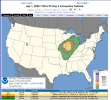
This environment has only 25-30 kts of effective shear, but a decent lack of low level shear. Things can happen and the 2% is fine imo, it's just tagging the CIG onto this setup feels a bit getting ahead. We will see but this really surprised me to see a CIG1 this far east. I don't mind the CIG in the Plains today if the LLJ is timed well with those cells. I know it's early, but these mets are supposed to really convey to the public what it means and every time this very low yet conditional risk doesn't verify (which of course is a reasonable expectation) there's still gonna be backlash over why this "very low strong tornado risk" didn't verify in their backyard. I just worry about how it could hurt broadcasters and public trust. I think the criteria should be more stricter to warrant CIG1 tbh, and then I wouldn't mind it.
Yeah I get that. This one I can definitely agree with and understand. Plains one is justifiable like you said.
 
I know we shouldn't take SIMREF as gospel, but it is nice to have a visual representation of what an event could look like.

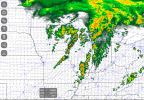
My eyes are now more on Thursday and Friday. The HRRR, RAP, and NAM show generally similar solutions regarding convective mode and coverage, with a few supercells lasting for a few hours before congealing into clusters while more shallow convection forms to the south.

(12z HRRR just for an example)
1775051922134.png

And the models are generally in agreement with there being a solid environment ahead of these cells as well:
1775051995474.png
(09z RAP in north-central Illinois)

The HRRR is more potent with the environment, with noticably more CAPE as well as slightly better backing and low level shear:
1775052243946.png
(12z HRRR in North Central Illinois)

I wouldn't entirely rule out some potential cells popping up ahead of these guys either, but as of now it doesn't look likely. If this specific scenario plays out I could see a couple of strong tornadoes if the cells can mature fast enough before congealing when better forcing arrives later on. Not a particularly potent setup but still one to watch nonetheless.
 
Also I'm really beginning to loathe the CIG system, it's showing up on MANY days that dont really need it. And plus this system has rarely verified significant tornadoes, it seems more like a high false alarm rate then decent verification rate like NW OK earlier on. That was a decent verification that fat north. I thought it was a good idea, and i understand its gonna be used almost every tor risk, i feel like it's more appropriate for wind and hail than tornadoes. I just don't think continously having to message that a strong tornado is possible but it's A VERY LOW chance is ideal as people are just going to tune it out. I think it's being way overused.
They need to remove Cig 1 for tornadoes. All tornadic environments are capable of EF2s. How could they possibly differentiate between an EF1 and EF2 environment? All they needed to do was add a 5% hatched for very specific threat days that only occur a few times a year. Instead, they just made it so everything is hatched. It's very silly.
 
They need to remove Cig 1 for tornadoes. All tornadic environments are capable of EF2s. How could they possibly differentiate between an EF1 and EF2 environment? All they needed to do was add a 5% hatched for very specific threat days that only occur a few times a year. Instead, they just made it so everything is hatched. It's very silly.
I think hatched for 5% can stay, but remove it for 2%. EF2's are categorized as strong tornadoes which is why they have a CIG for those alone.
 
I know we shouldn't take SIMREF as gospel, but it is nice to have a visual representation of what an event could look like.

My eyes are now more on Thursday and Friday. The HRRR, RAP, and NAM show generally similar solutions regarding convective mode and coverage, with a few supercells lasting for a few hours before congealing into clusters while more shallow convection forms to the south.

(12z HRRR just for an example)
View attachment 52415

And the models are generally in agreement with there being a solid environment ahead of these cells as well:
View attachment 52416
(09z RAP in north-central Illinois)

The HRRR is more potent with the environment, with noticably more CAPE as well as slightly better backing and low level shear:
View attachment 52417
(12z HRRR in North Central Illinois)

I wouldn't entirely rule out some potential cells popping up ahead of these guys either, but as of now it doesn't look likely. If this specific scenario plays out I could see a couple of strong tornadoes if the cells can mature fast enough before congealing when better forcing arrives later on. Not a particularly potent setup but still one to watch nonetheless.
10% hatched is definitely getting introduced. Wouldn't be surprised if eventually we get a CIG2 introduced.
 
I think hatched for 5% can stay, but remove it for 2%. EF2's are categorized as strong tornadoes which is why they have a CIG for those alone.
Yeah, but that's the entire point of the risk areas in the first place. When you see a 5% risk for tornadoes, isn't it already implied they could be strong? Most tornadoes are strong. That's their whole thing. The problem with the new system is it's going to give people alarm fatigue. When everything is significant, nothing is.
 
I think a good rule of thumb for people is when your LFC and LCL are seperated, this can mean potential for a conditional event. It indicates that cells are elevated and even hints at prior convection perhaps overrunning the environment. That's why I've held back. If they were connected, this would mean that nothing overran the environment an therefore a mature band of cells is likely. But right now, I can't be certain of a significant tornado threat but it is conditional. I would go 10% hatched soon with this setup. Surface lows can do a lot
 
They need to remove Cig 1 for tornadoes. All tornadic environments are capable of EF2s. How could they possibly differentiate between an EF1 and EF2 environment? All they needed to do was add a 5% hatched for very specific threat days that only occur a few times a year. Instead, they just made it so everything is hatched. It's very silly.
I don't think it needs to be removed but I just can't think of a situation where there's such a volatile environment yet the confidence is so low that it needs to be a 2% CIG1? That can't really be possible. I think it should be 5% and up, because there's where confidence for significant tornadoes is far more believable.
 
I know we shouldn't take SIMREF as gospel, but it is nice to have a visual representation of what an event could look like.

My eyes are now more on Thursday and Friday. The HRRR, RAP, and NAM show generally similar solutions regarding convective mode and coverage, with a few supercells lasting for a few hours before congealing into clusters while more shallow convection forms to the south.

(12z HRRR just for an example)
View attachment 52415

And the models are generally in agreement with there being a solid environment ahead of these cells as well:
View attachment 52416
(09z RAP in north-central Illinois)

The HRRR is more potent with the environment, with noticably more CAPE as well as slightly better backing and low level shear:
View attachment 52417
(12z HRRR in North Central Illinois)

I wouldn't entirely rule out some potential cells popping up ahead of these guys either, but as of now it doesn't look likely. If this specific scenario plays out I could see a couple of strong tornadoes if the cells can mature fast enough before congealing when better forcing arrives later on. Not a particularly potent setup but still one to watch nonetheless.
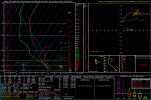
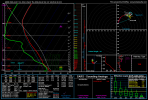
I think two things that jump out to me in these soundings are 1) the hodograph shape is forever meso shaped, so that suggests that any cell that does sustain itself could be tornadic for a long-time, and 2) 3CAPE values are very high as well which is favorable for tornado production. You don’t see 3CAPE values this high that often in a moderately to strongly unstable environment (see 3/31/2023 in Iowa).
 
LATEST SURFACE ANALYSIS SHOWS A WEAK BOUNDARY EXTENDING FROM
SOUTHWEST OK INTO SOUTHEAST KS. THIS BOUNDARY WILL LIFT/MIX
NORTHWARD TODAY, RESULTING IN RAPID MOISTENING/DESTABILIZATION OF
THE AIR MASS. MOST CAM SOLUTIONS SUGGEST THE POTENTIAL FOR THE
DEVELOPMENT OF A FEW EVENING SUPERCELLS IN VICINITY OF THIS
RETREATING BOUNDARY OVER NORTH-CENTRAL OK INTO SOUTHEAST KS. VERY
LARGE HAIL AND A FEW TORNADOES ARE POSSIBLE.
 
I still like the idea of the CIG system as they currently have it, but they’re definitely going way overkill on CIG1 for tornadoes. There’s no reason to outline the entire 2% risk every time. I feel like there’s been more CIG1 covered days than not at this point and it’s very odd.

I'm sure they'll be better about it with time - consequences of it being a brand new system.
 
Last edited:
New Day 2 and it certainly brought the smoke:

"Additional supercells are likely to continue developing
south-southwestward along the trailing dryline, before it is
overtaken by the cold front, toward the lower Missouri Valley.
Embedded within south-southwesterly deep-layer mean flow on the
order of 50+ kts, fast storm motions roughly aligned with the axis
of destabilization could support a couple of long-lived/long track
supercells with potential for strong tornadoes, before convection
weakens Thursday evening."
 
Back
Top