• Welcome to TalkWeather!
    We see you lurking around TalkWeather! Take the extra step and join us today to view attachments, see less ads and maybe even join the discussion.
    CLICK TO JOIN TALKWEATHER

Severe WX Severe Weather 4/11 - 4/15

I always find it funny that “super outbreak” gets thrown around relatively loosely with setups these days. I’ve never been a big fan of the “generational” usage by some either (thinking of times James Spann has done this with subsequent high-end days since 2011, although I notably don’t recall him doing that with March 15 last year) because it might not take another 30-40 years for another one to happen. However, I really only think the super word should be used when you have one of THOSE set-ups.

It’s also worth noting that this isn’t the first setup where we’ve had a model run like this well in advance. April 5, 2023 looked like one 5-8 days out only to downtrend (also, ironically, over a similar area to this potential event).
I agree. I pretty much have a rule (especially after 3/15 last year) that you can’t really say for sure if an event will be a super outbreak until it’s right in the middle of or after the event. Too many factors have to go absolutely right and in perfect synergy at both the storm scale and mesoscale (think Palm Sunday 1965, 4/3/74, 4/27/11). I don’t think that can be properly gauged even the day of.

Edit: @N0mz beat me to it lol
 
Yeah, I'm not really sure you can even call something generational at like noon the day of. Mesoscale factors matter too much and are impossible to pin down before then. See: every dixie high parameter event ever.
To your point: the best example of this, to me, was March 15th last year. It legitimately looked like it may have that potential in the 72-18 hour window beforehand only for things to downtrend towards a more average high risk Dixie alley event because of a variety of factors.

There will be events where the potential for it is obviously there, but ultimately that outcome not something we’ll know until it’s happening.
 
I agree. I pretty much have a rule (especially after 3/15 last year) that you can’t really say for sure if an event will be a super outbreak until it’s right in the middle of or after the event. Too many factors have to go absolutely right and in perfect synergy at both the storm scale and mesoscale (think Palm Sunday 1965, 4/3/74, 4/27/11). I don’t think that can be properly gauged even the day of.

Edit: @N0mz beat me to it lol
I think a lot of people forget the lead up to 5/20/19 all of the models were just mean. And I think what got people’s alarm bells really ringing was seeing that infamous HRRR run with about 8-10 discrete supercells churning up Oklahoma. I remember watching the lead up to that and it looked like a Super Outbreak a day or so out. And IIRC they even issued a 45% tornado risk for OKC.
 
The drought could strengthen the EML and steepen lapse rates, which might actually favor a more classic loaded gun type setup if a cap holds. The only concern would be overmixing if the dry air mixes east too aggressively, it could start eating away at dewpoints and raise LCLs, which wouldn’t be ideal for a higher end tornado threat. Feels like one of those situations where it helps up to a point, but too much influence could end up being detrimental depending on how the moisture holds.

We’re still very far away but that could definitely be a couple pros and cons on how the drought could affect things. Got so much more to cover in the coming days.
 
To what degree do we think the widespread drought across much of the plains and western US may affect any higher-end event next week? I imagine it could strengthen any EML, but I wonder if it could be detrimental as well?
I’m of the opinion that it will be conducive to more significant events right now, especially given the pattern we’re heading into with multiple events that may have strong forcing associated with them, but as the drought gets worse later in Spring it may end up killing more setups than helping them. I really have no idea outside of that though, could be totally off the mark.
 
I’m of the opinion that it will be conducive to more significant events right now, especially given the pattern we’re heading into with multiple events that may have strong forcing associated with them, but as the drought gets worse later in Spring it may end up killing more setups than helping them. I really have no idea outside of that though, could be totally off the mark.
I’ve really changed my thinking over the last few years on the EML. You absolutely need a good EML, with the right amount of dry air, and sometimes a stout EML at that, for a high ceiling event. I’d be more bullish on days where you could have a cap bust vs no EML and an overcrowded crapvection-fest with guaranteed initiation.

A lot of it comes down to timing too. If the jet can start overspreading your parameter space at the right time, it can help lift and cool the cap without too much vertical mixing having taken place. Now, if you have a stout EML that sets there all day waiting on a trough ejection, then you get mixing plus a situation like 5/20/2019.

To be completely honest, I know Trey uses drought in the EML source region as a proxy for season prediction, but has there been any kind of studies done on outbreaks and their correlation to what the drought set up looked like in the southwest? I would imagine in a La Niña season, you’d actually want a stout EML, since the trough geometry would provide synoptic ascent to help lift and cool any capping inversion. Maybe I’m completely wrong here, but are there noted events where we can definitively say “yeah, the drought was just too much and caused this outbreak to have a cap bu$t”?
 
I’ve really changed my thinking over the last few years on the EML. You absolutely need a good EML, with the right amount of dry air, and sometimes a stout EML at that, for a high ceiling event. I’d be more bullish on days where you could have a cap Forecasted Convective Amplification Deficiency vs no EML and an overcrowded crapvection-fest with guaranteed initiation.
Fully 1000% agree. Perhaps this is recency bias on my part, I didn't start getting super into tornadoes and weather until the 12/10/21 outbreak, and I didn't fully start paying attention to severe weather in general until about 11/4/22. With that being said, the majority of under-performing significant events I've seen thus far are the result of this. Was 4/28 last year a cap-related underperformance? If so, that may be the last one I recall tracking. I cannot remember.
A lot of it comes down to timing too. If the jet can start overspreading your parameter space at the right time, it can help lift and cool the cap without too much vertical mixing having taken place. Now, if you have a stout EML that sets there all day waiting on a trough ejection, then you get mixing plus a situation like 5/20/2019.

To be completely honest, I know Trey uses drought in the EML source region as a proxy for season prediction, but has there been any kind of studies done on outbreaks and their correlation to what the drought set up looked like in the southwest? I would imagine in a La Niña season, you’d actually want a stout EML, since the trough geometry would provide synoptic ascent to help lift and cool any capping inversion. Maybe I’m completely wrong here, but are there noted events where we can definitively say “yeah, the drought was just too much and caused this outbreak to have a cap bu$t”?
That's a good question. I imagine that Trey has some good resources that support the idea of the state of drought in the EML source region being significant for predicting how a season's tornado output will go, it would be uncharacteristic of him to not have any papers or studies displaying how they are related. But I definitely haven't seen any of it myself and I imagine it's very difficult to tie any given cap-related underperformance (or overperformance) strictly to the degree of drought in the southwest.
 
Fully 1000% agree. Perhaps this is recency bias on my part, I didn't start getting super into tornadoes and weather until the 12/10/21 outbreak, and I didn't fully start paying attention to severe weather in general until about 11/4/22. With that being said, the majority of under-performing events I've seen thus far are the result of this. Was 4/28 last year a cap-related underperformance? If so, that may be the last one I recall tracking. I cannot remember.
I can't remember if it was cap-related, but I do know that storms just failed to fire off for some reason (was the capping too strong?). Most of the risk area was clear.


Gabe Garfield's analysis of the threat Tuesday is quite bullish, and worth a watch. He's already making comparisons to May 24th, 2011, which I think is a bit ridiculous this far out, but the hype is certainly contagious.
 
Gabe Garfield's analysis of the threat Tuesday is quite bullish, and worth a watch. He's already making comparisons to May 24th, 2011, which I think is a bit ridiculous this far out, but the hype is certainly contagious.
Very irresponsible comparison right now IMO. There's just too high of a model spread to parrot this right now. If you had every operational agreeing on the GFS or ICON's presentation at 500 mb, then I'd be more accepting of it. People are going to run with this comparison now and that's just the nature of weenie forecasting unfortunately. Not saying Gabe Garfield is himself a weenie, but people are going to take this out of context, have sky-high expectations, then be upset when it isn't 5/24/11 again.
 
Very irresponsible comparison right now IMO. There's just too high of a model spread to parrot this right now. If you had every operational agreeing on the GFS or ICON's presentation at 500 mb, then I'd be more accepting of it. People are going to run with this comparison now and that's just the nature of weenie forecasting unfortunately. Not saying Gabe Garfield is himself a weenie, but people are going to take this out of context, have sky-high expectations, then be upset when it isn't 5/24/11 again.
People get way too worked up about what WXTwitter and chasers in general think of a set up. If the general public is getting their information from chasers or WXtwitter, that is on them.
 
With that being said, the majority of under-performing significant events I've seen thus far are the result of this. Was 4/28 last year a cap-related underperformance? If so, that may be the last one I recall tracking. I cannot remember.
Trey has a good video on it. Essentially messy storm mode, limited destabilization, plus “neutral” jet speed winds (the jet wind speeds essentially stayed the same throughout the day).

 
I know its getting hammered to death but the hype around this system and storm systems in general is out of control. Seems like every single enhanced or mod risk setup is getting "generational" or "extreme parameters" or "historic" now.
its cause its been so dry recently everybodys all perked up now that theres something coming up...

there definitely is a threat but it isn't like we haven't seen this before imo
 
Very irresponsible comparison right now IMO. There's just too high of a model spread to parrot this right now. If you had every operational agreeing on the GFS or ICON's presentation at 500 mb, then I'd be more accepting of it. People are going to run with this comparison now and that's just the nature of weenie forecasting unfortunately. Not saying Gabe Garfield is himself a weenie, but people are going to take this out of context, have sky-high expectations, then be upset when it isn't 5/24/11 again.

Spot on. Idk why people are so enthusiastic about making these impossible comparisons. Surely, it's basically guaranteeing a loss of credibility, which hurts them in the long run. I like his meteorological breakdowns a lot though. Feel like I've learned a lot in just a few videos. Lots of similarities to CC.
 
its cause its been so dry recently everybodys all perked up now that theres something coming up...

there definitely is a threat but it isn't like we haven't seen this before imo
This is a very good point, there’s a lot of people out there waiting for one of “those” days to come on the horizon. This system has the possibility of being that, but people jump to too many conclusions because they see a thermodynamic, or synoptic detail that is similar to past infamous events. You could have a detail like 5/24/11 whether that’s the trough geometry or having 3000-4000 CAPE. The reason why those bold conclusions are being thrown around is because we have had such a long and quiet drought without any significant severe weather, and frankly, any severe weather at all.
 
We haven't had any strong tornadoes in the state since 2024. Looks like that streak might end with a bang.

Patiently waiting to see @jiharris0220 and @CheeselandSkies thoughts on Monday/Tuesday
I don't have a whole lot at this point, tons of model spread. Unfortunately the last chase day of the tour is Sunday. I'll probably chase Monday on my own on the way home, especially if Iowa continues to look good for that day. That's the upside of missing out on the first few days of the tour and driving all day yesterday, is I'll be in my vehicle and can chase rather than spending Monday on a plane.

Tuesday is my mom's birthday (she's turning 75) so I'll be heading home to celebrate with family. Despite the impressive trough structure on the 12Z GFS, the EHI values aren't overwhelming. Haven't had a chance to look in detail as to why that might be.
can't wait for a inevitable CC upload as we get much closer to our 2 big big days
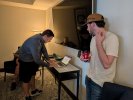
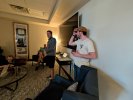
In-person forecast update before leaving the hotel this morning:

PXL_20260409_130559363.jpgPXL_20260409_130455579.jpg
 
I know its getting hammered to death but the hype around this system and storm systems in general is out of control. Seems like every single enhanced or mod risk setup is getting "generational" or "extreme parameters" or "historic" now.
Exactly. It’s “2011 this, 2011 that”. If this whole thing pans out like how it’s shaping up to be, it will probably end up as one of the big days of 2026. However, we’ve had a day 5 30% already this year, and look how it went…
 
Back
Top