• Welcome to TalkWeather!
    We see you lurking around TalkWeather! Take the extra step and join us today to view attachments, see less ads and maybe even join the discussion.
    CLICK TO JOIN TALKWEATHER

Severe Weather 3/9 - 3/12

Messages
4,535
Reaction score
13,144
Location
Madison, WI
Given the notable nature and resulting extensive discussion of the activity Thursday evening through yesterday, a number of people expressed support for the idea that the next round of severe weather for early-mid next week should be split off into its own thread.

Perhaps the title for @Sharpy's thread could be changed to 3/4 - 3/8 (continuing through tomorrow) and we'll pick up the discussion for Monday and beyond in here.

Tuesday 3/10 has been the main day of interest for some time, with a broad 15% Day 4 contour now outlined by SPC from south-central Texas northeastward to eastern Indiana and most of Illinois.
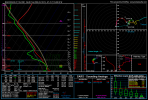
 
12Z NAM forecast soundings on the warm front in northern Illinois are pretty intriguing. First chase of the year for me, or another tease?

Meanwhile, another, more wound-up surface low in the Panhandles will provide a separate area of focused severe potential in parts of the southern Plains, including perhaps some of the same areas impacted over the last two days.

nam_2026030712_081_41.71--88.92.png
 
12Z NAM forecast soundings on the warm front in northern Illinois are pretty intriguing. First chase of the year for me, or another tease?

Meanwhile, another, more wound-up surface low in the Panhandles will provide a separate area of focused severe potential in parts of the southern Plains, including perhaps some of the same areas impacted over the last two days.

View attachment 51129
This same run except for NW OK is practically a chasers dream. It IS the NAM after all.
 
This same run except for NW OK is practically a chasers dream. It IS the NAM after all.

The NAM is a double-edged sword. It has a bias to be too cool, and as a result under-mix and leave the moisture looking richer/deeper than reality, so depending on the situation it can either under or over-estimate the instability by quite a lot.
 
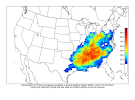
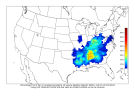
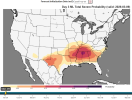
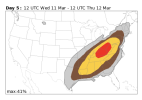
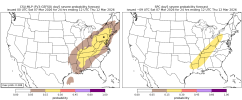
CIPS is very interested in March 11 across the Deep South into the Tennessee, Mississippi and even Ohio Valleys. Those are some particularly strong values. The NSSL's experimental severe probabilities are also honed in to the South. Other solutions are looking at a more broad threat, geographically speaking, including the SPC's own delineated D5 area. However, there are still plenty of questions I have about things like trough ejection and low placement. We could end up having the low jetting off to the north into the Great Lakes and Canada, which could serve to diminish a more robust threat down south, favoring a more limited, straight-line wind threat. There's also a chance of having a more strung-out system that is less conducive to severe convection. It's still far too early to get more specific about Wednesday, and that's reflected in the SPC's discussion for D5.
The large-scale upper trough and attendant surface cold front will
continue to progress eastward on Wednesday. Uncertainty does
increase, especially with north and east extent of severe potential.
How far east convection develops on Tuesday and how much downstream
destabilization occurs is somewhat unclear. Nevertheless, a
deepening surface cyclone is forecast to develop northeast from the
Great Lakes into Ontario and Quebec, while strong deep layer
southwesterly flow overspreads a moist warm sector ahead of the
surface front. This should set the stage for at least isolated to
scattered severe thunderstorm potential along the length of the cold
front through Wednesday evening.

Given uncertainties mentioned above, these areas are likely to be
adjusted in coming days as details become better resolved, but the
overall pattern should support a couple of active severe weather
days over a broad area.
1772905160995.png1772905166978.png1772905273820.png1772905298652.png1772905306669.png1772905500254.png1772905504809.png
 
Last edited:
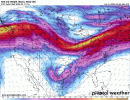
Pretty intrigued by the (sudden) trend among the global models (notably ECM and GFS) towards the upper low being phased with the jet into a more consolidated upper level low as it crosses the US ~11th March. This is more akin to what the models were showing before (ICON actually kept it) and more favourable of significant severe weather.

Early days still obviously, but at the moment the kinematic profiles for parts of the OH valley regions catch my eye for Wednesday afternoon. Potentially issues with thermodynamics especially as the system is slightly faster than current peak heating - but would watch this closely as there are scenarios, such as the UKMET, which would favour multiple strong tornadoes if they were to verify.

Plenty of uncertainty though, but concern/interest in this system certainly increased compared to 48 hours ago. Possibly severe potential the day before, as well, as latest RRFS suggested...

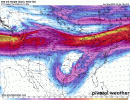
trend-gfs-2026030712-f105.500wh.conus.gif
 
Pretty intrigued by the (sudden) trend among the global models (notably ECM and GFS) towards the upper low being phased with the jet into a more consolidated upper level low as it crosses the US ~11th March. This is more akin to what the models were showing before (ICON actually kept it) and more favourable of significant severe weather.

Early days still obviously, but at the moment the kinematic profiles for parts of the OH valley regions catch my eye for Wednesday afternoon. Potentially issues with thermodynamics especially as the system is slightly faster than current peak heating - but would watch this closely as there are scenarios, such as the UKMET, which would favour multiple strong tornadoes if they were to verify.

Plenty of uncertainty though, but concern/interest in this system certainly increased compared to 48 hours ago. Possibly severe potential the day before, as well, as latest RRFS suggested...

View attachment 51147
Hey there! Good to see ya
 
Pretty intrigued by the (sudden) trend among the global models (notably ECM and GFS) towards the upper low being phased with the jet into a more consolidated upper level low as it crosses the US ~11th March. This is more akin to what the models were showing before (ICON actually kept it) and more favourable of significant severe weather.

Early days still obviously, but at the moment the kinematic profiles for parts of the OH valley regions catch my eye for Wednesday afternoon. Potentially issues with thermodynamics especially as the system is slightly faster than current peak heating - but would watch this closely as there are scenarios, such as the UKMET, which would favour multiple strong tornadoes if they were to verify.

Plenty of uncertainty though, but concern/interest in this system certainly increased compared to 48 hours ago. Possibly severe potential the day before, as well, as latest RRFS suggested...

View attachment 51147
One of the best on the platform for synoptic analysis and glad to see your return here!

Wednesday has certainly uptrended and at the moment does look favorable for some significant severe.
 
GFS wants intense kinematics around 00z Wednesday in KS/OK. I would not be surprised if this is another one of those late rooting type events and supercells move through nocturnal CIN. The Plains does it better than any other area in this type of environment. Strong low level shear plus strong instability aloft a nocturnal inversion = instant watch. Those kinematics can get a bit nasty..

I would definitely watch S TX too for a sleeper threat Tuesday. Large hodographs with nice venting plus plenty of instability to go with. Seems like the typical issue would be some sort of remnant EML that just keeps storms contained.

The Midwest may have large return of instability but admittedly, CURRENTLY, strong kinematics isn't well present with this. But after yesterday, I'm not trusting any sleeper Midwest setup.

Regarding Dixie on Wednesday, this is a day of big interest due to strong and impressive venting for Dixie standards and enlarged hodographs already within 18z. The Ohio Valley also exists as a threat as mentioned by @UK_EF4. There is pretty significant kinematics across these two areas as of now. There isn't much increase in the LLJ by 21z but robust kinematics remain and one thing that's also key: instability. This threat will sit close to the Gulf as usual so moisture return will be there. 77/64 on some soundings I took but of course, things will still likely change with this.


Tuesday/Wednesday are days to watch out for.
 
GFS wants intense kinematics around 00z Wednesday in KS/OK. I would not be surprised if this is another one of those late rooting type events and supercells move through nocturnal CIN. The Plains does it better than any other area in this type of environment. Strong low level shear plus strong instability aloft a nocturnal inversion = instant watch. Those kinematics can get a bit nasty..

I would definitely watch S TX too for a sleeper threat Tuesday. Large hodographs with nice venting plus plenty of instability to go with. Seems like the typical issue would be some sort of remnant EML that just keeps storms contained.

The Midwest may have large return of instability but admittedly, CURRENTLY, strong kinematics isn't well present with this. But after yesterday, I'm not trusting any sleeper Midwest setup.

Regarding Dixie on Wednesday, this is a day of big interest due to strong and impressive venting for Dixie standards and enlarged hodographs already within 18z. The Ohio Valley also exists as a threat as mentioned by @UK_EF4. There is pretty significant kinematics across these two areas as of now. There isn't much increase in the LLJ by 21z but robust kinematics remain and one thing that's also key: instability. This threat will sit close to the Gulf as usual so moisture return will be there. 77/64 on some soundings I took but of course, things will still likely change with this.


Tuesday/Wednesday are days to watch out for.
i’ll have to see the dixie threat materialize to believe it. i’m torn between “we’re due” and a material climatological change in weather patterns.
 
GFS wants intense kinematics around 00z Wednesday in KS/OK. I would not be surprised if this is another one of those late rooting type events and supercells move through nocturnal CIN. The Plains does it better than any other area in this type of environment. Strong low level shear plus strong instability aloft a nocturnal inversion = instant watch. Those kinematics can get a bit nasty..

I would definitely watch S TX too for a sleeper threat Tuesday. Large hodographs with nice venting plus plenty of instability to go with. Seems like the typical issue would be some sort of remnant EML that just keeps storms contained.

The Midwest may have large return of instability but admittedly, CURRENTLY, strong kinematics isn't well present with this. But after yesterday, I'm not trusting any sleeper Midwest setup.

Regarding Dixie on Wednesday, this is a day of big interest due to strong and impressive venting for Dixie standards and enlarged hodographs already within 18z. The Ohio Valley also exists as a threat as mentioned by @UK_EF4. There is pretty significant kinematics across these two areas as of now. There isn't much increase in the LLJ by 21z but robust kinematics remain and one thing that's also key: instability. This threat will sit close to the Gulf as usual so moisture return will be there. 77/64 on some soundings I took but of course, things will still likely change with this.


Tuesday/Wednesday are days to watch out for.
Yeah these 12z runs today have peeked my interest for sure …..
 
Regarding Dixie on Wednesday, this is a day of big interest due to strong and impressive venting for Dixie standards and enlarged hodographs already within 18z. The Ohio Valley also exists as a threat as mentioned by @UK_EF4. There is pretty significant kinematics across these two areas as of now. There isn't much increase in the LLJ by 21z but robust kinematics remain and one thing that's also key: instability. This threat will sit close to the Gulf as usual so moisture return will be there. 77/64 on some soundings I took but of course, things will still likely change with this.
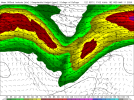
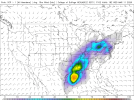
One thing I'd note here is that the SRH currently modelled for Wednesday afternoon to evening isn't particularly eye-popping in the Deep South, see the GFS. Still more than plenty for tornadoes, but not exceptional. However, I want to note that, as we look at model solutions in the coming days, GFS in particular seems to have a bit of a tendency for underestimating kinematics, at least in Deep South events, until you get under the 100-hour mark and closer towards the 80-hour mark, when NAM (lol) comes into range. My assumption is it probably underestimates the impact of the LLJ on Dixie events, but I don't know with any confidence. Wouldn't be surprised to see something bimodal, split between the Southeast and the Ohio Valley, pending destabilization, but I still wanna see significantly more consistency on models before getting comfortable with any particularly solution. I will note that, as @UK_EF4 mentioned, the GFS has changed its synoptic presentation quite significantly. Definitely worth keeping a close eye on how this develops, especially if our system of interest continues to be modelled as more closely integrated into the jet. In any case, this is a very interesting period to watch and I think anyone from Arklamiss through Georgia and up into the Ohio Valley should keep an eye on it.

1772918017666.pngtrend-gfs-2026030712-f108.500wh.conus.gif
 
Back
Top