• Welcome to TalkWeather!
    We see you lurking around TalkWeather! Take the extra step and join us today to view attachments, see less ads and maybe even join the discussion.
    CLICK TO JOIN TALKWEATHER

Severe Weather 3/4 - 3/8

All jokes aside, this has been the most boring, ahem quiet, stretch of severe weather I can recall. Just nil since late June. A couple of weeks ago in Indiana is the only notable event in that time frame it seems.
Most major inactive stretch in years to be honest LOL, just shows you how consistent events have been these past few years.
 
All jokes aside, this has been the most boring, ahem quiet, stretch of severe weather I can recall. Just nil since late June. A couple of weeks ago in Indiana is the only notable event in that time frame it seems.
Yeah - perhaps that may also contribute to people overhyping potential events too far in advance, which includes myself. I've been guilty of it more than a few times on this forum already.
 
That's another COMMON trait of them.


"oh my!"

*shows a 384 hr trough*

"closed low it's over ️️️"

"i never believed I this setup since it came around"

"I like to be conservative when it comes to forecasting"

"I don't do any of that hyping with GFS runs"

"i am NOT a day 1 plains weenie"
1772501946658.png
Yeah - perhaps that may also contribute to people overhyping potential events too far in advance, which includes myself. I've been guilty of it more than a few times on this forum already.
It's definitely part of it, people just get anxious for any threat at all. You can see the opposite happen in active periods, people will get fatigued and basically completely forget about anything lower than an Enhanced Risk. Sometimes FFC will start getting excited about rain in their AFDs if it's been too quiet.
 
Obviously still have to get through the rest of this week, but the GFS has been mighty persistent in the idea of an interesting evolution for the early to middle part of next week (3/9-11) where what starts out as a cut-off low over the Southwest gets opened up and pulled into the northern stream, resulting in a nice, amplified trough over the central CONUS. Naturally, the degree to which this actually occurs will determine the ceiling of any resulting severe weather threat.
 
I'm still not quite sure what all goes into calculating CWASP. If I'm going to use a composite parameter I'd prefer one I at least somewhat understand, like EHI, supercell composite, or STP.

Maybe I'm just salty because for a long time (probably 5 years after longtime WCM Rusty Kapela retired in 2013), the MKX NWS office would just cite the forecast CWASP value when mentioning upcoming severe threats in their AFD, in lieu of detailing their own thoughts about the parameters, storm mode, hazards, timing, etc.


NORTH OF THE DALLAS/FORT WORTH METRO NORTHEASTWARD TO FORT SMITH,
ARKANSAS HAVE MLCAPE IN THE 1500 TO 2000 J/K RANGE WITH 0-6 KM SHEAR
UP TO 40 KNOTS. 700 TO 500 MB LAPSE RATES ARE FORECAST TO BE NEAR 8
C/KM. THIS ENVIRONMENT WILL SUPPORT SUPERCELLS AND LARGE HAIL,
ESPECIALLY EARLY IN THE EVENT WHEN CELLS ARE MORE LIKELY TO BE
DISCRETE. DURING THE EARLY TO MID EVENING, THE STORMS SHOULD
ORGANIZE INTO A LINE. THIS MAY RESULT AN INCREASED WIND-DAMAGE
POTENTIAL. A MARGINAL TORNADO THREAT WILL ALSO BE POSSIBLE WITH
SUPERCELLS AND ROTATING CELLS WITHIN THE LINE. THIS LINE SHOULD
PERSIST AND MOVE INTO THE WESTERN OZARKS DURING THE EVENING AS A
LOW-LEVEL JET STRENGTHENS.
 
All jokes aside, this has been the most boring, ahem quiet, stretch of severe weather I can recall. Just nil since late June. A couple of weeks ago in Indiana is the only notable event in that time frame it seems.

There were various tiny but intriguing events from june to august, but otherwise I do agree.
 
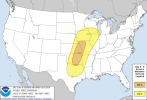
Where are these new outlook changes?
awkward pulp fiction GIF
 
View attachment 50897
prob gonna be our first taste of the cig system come d3 but wow d4 30% when was the last time dat occured?
Fairly decent picture they are painting in terms of the threat.


" Warming surface temperatures and increasing low-level convergence
will support scattered convective initiation to the west of the
moist axis. Storms are expected to grow upscale in the mid to late
afternoon, moving eastward toward an axis of strong low-level flow.
Moderate instability, strong deep-layer shear and steep lapse rates
will be favorable for supercells. Supercells should be capable of
producing tornadoes, large hail and severe wind gusts. The greatest
potential is forecast from near the Red River in north Texas
north-northeastward across eastern Oklahoma into eastern Kansas and
northwestern Missouri, where a 30 percent contour has been added. A
severe threat is also forecast northeastward into parts of the mid
to upper Mississippi Valley, where strong deep-layer shear and
sufficient low-level moisture will be in place for a severe threat."
 
Back
Top