• Welcome to TalkWeather!
    We see you lurking around TalkWeather! Take the extra step and join us today to view attachments, see less ads and maybe even join the discussion.
    CLICK TO JOIN TALKWEATHER

Severe Weather 2026

You say this, but you're using the relatively low data quality to argue for your preferred pattern even though you have even less evidence for that. You've also jumped from the possibility of events in certain places being less detectable to 'only sig events will be recorded outside the plains'. My only suggestion was that making comparisons using sig events could be more robust, though it could be more biased against western areas (less to hit). What data we do have are consistent with the plains being the normal locus of activity.
Which is essentially what you are doing as well on this topic. I don’t think you and I disagree that much on the central point, but let’s not pretend you’re presenting recent peer reviewed research that makes your opinion a case-closed argument either. This is both just conjecture on the part from both of us because neither one of us can prove the other is definitively correct because of the bare bones nature of actual reliable tornadic occurence data. You’ve posted a few of those papers, which I took a look at.

I stated my opinion, you obviously have yours, but neither of us are going to be able to produce points that completely satisfy the bar set by the other. You can point to a paper from 1960, I can point to statements from Rich Thompson and some research from Dr. Gensini at NIU.

Again, I do agree something is janky with the plains over the past decade. However,
we can’t say for certain it’s global warming or just a cyclical pattern. I am hesitant to start saying climate scale changes could already be impacting down at the mesoscale Level.

Edit: this is an earnest question, but has this always been your only user profile on here? I’ve seen that paper you linked above posted a few times. I had this same exact conversation with someone during or after the 2024 Oklahoma high risk bu$t and it may have been you actually
 
Last edited:
Which is essentially what you are doing as well on this topic. I don’t think you and I disagree that much on the central point, but let’s not pretend you’re presenting recent peer reviewed research that makes your opinion a case-closed argument either. This is both just conjecture on the part from both of us because neither one of us can prove the other is definitively correct because of the bare bones nature of actual reliable tornadic occurence data. You’ve posted a few of those papers, which I took a look at.

I stated my opinion, you obviously have yours, but neither of us are going to be able to produce points that completely satisfy the bar set by the other. You can point to a paper from 1960, I can point to statements from Rich Thompson and some research from Dr. Gensini at NIU.

Again, I do agree something is janky with the plains over the past decade. However,
we can’t say for certain it’s global warming or just a cyclical pattern. I am hesitant to start saying climate scale changes could already be impacting down at the mesoscale Level.
I can look at Thompson's published work, or Gensini's, that show a decreasing trend on the plains. Or Graber and Trapp, whose day-based analysis specifically links decreased tornado days and counts on the plains, with the decline being most pronounced in summer (June is no longer the second most active month). Or Moore, who purports to show that if you remove shorter term cycles there is a long-term secular change. Anyone can make comments as they please, but the finding of the trend and that some are examining synoptic or environmental changes or proposing possible mechanisms is beyond mere conjecture.

You're using uncertainties in the data to argue for the position that's less supported by it. What data we have shows the plains as being a focus of activity as far back as records allow (say, about 1890) regardless of the variation elsewhere. Better data would be nice, but one can still make inferences. I see little suggesting cycles comparable to the current decrease. Doesn't mean there mightn't be an increase in the future, but one would have to show a mechanism. Unanswerable questions along the lines of 'what about the early 19th century' aren't useful.

Edit: this is an earnest question, but has this always been your only user profile on here? I’ve seen that paper you linked above posted a few times
No. As lots of people have noticed this, it's not surprising they come across the same sources.
 
My take on the movement of tornado alley is if PBS is talking about it, the scientific consensus on the matter must be pretty rock solid. They just published this video 3 weeks ago.

 
I can look at Thompson's published work, or Gensini's, that show a decreasing trend on the plains. Or Graber and Trapp, whose day-based analysis specifically links decreased tornado days and counts on the plains, with the decline being most pronounced in summer (June is no longer the second most active month). Or Moore, who purports to show that if you remove shorter term cycles there is a long-term secular change. Anyone can make comments as they please, but the finding of the trend and that some are examining synoptic or environmental changes or proposing possible mechanisms is beyond mere conjecture.

You're using uncertainties in the data to argue for the position that's less supported by it. What data we have shows the plains as being a focus of activity as far back as records allow (say, about 1890) regardless of the variation elsewhere. Better data would be nice, but one can still make inferences. I see little suggesting cycles comparable to the current decrease. Doesn't mean there mightn't be an increase in the future, but one would have to show a mechanism. Unanswerable questions along the lines of 'what about the early 19th century' aren't useful.


No. As lots of people have noticed this, it's not surprising they come across the same sources.
I am not disagreeing with you that there has been a shift. Or that there has been a noticeable downward trend in the plains, which again, that I myself have commented on numerous times. That is blatantly obvious to anyone that follows severe weather or studies it as a hobby.

My argument is there are too many uncertainties at play to say this definitely won’t switch back at some point. Or that the plains have always been the central foci of tornadic activity in the US throughout history with record keeping so sparse and tornadic data so recent. Hence, my “multiple” tornado alley comment.

You and I are just going to have to agree to disagree.
 
I could start a war with making this thread but here you go....


I am not disagreeing with you that there has been a shift. Or that there has been a noticeable downward trend in the plains, which again, I myself have commented on numerous times. That is blatantly obvious to anyone that follows severe weather or studies it as a hobby.

My argument is there are too many uncertainties at play to say this definitely wont switch back at some point. Or that the plains have always been the central foci of tornadic activity in the US throughout history with record keeping so sparse and tornadic data so recent.

You and I are just going to have to agree to disagree.
I know i just said about my thread, but it is important to note that via "Tornadoes Of Yesteryear Vol 1" A book that documents all tornadoes since the beginning of archived history or reports, up to the 1900s, that Utah used to regularly get January tornadoes. This makes me wonder whether certain areas just have active recurrence intervals every once in a while. I don't believe Utah has recorded a January tornado in a long while so this does lead me to the "interval" side of things on this subject. Certain areas peak, and then they die down for a while. That might be what the Plains is at, but we can not definitively answer that right now.
 
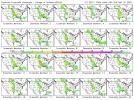
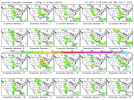
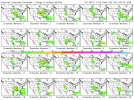
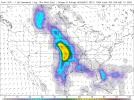
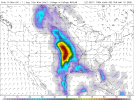
Looking at the supercell composite on the GFS is just depressing. There aren't even any GEFS ensemble members hinting at anything until the 2nd week of June. It's worth noting the CFS goes crazy for most of June, and i've seen people here talk about how analogous years had above average activity in June, so we'll just have to wait and see. Going to be very quiet for the next few weeks at the very least.
 
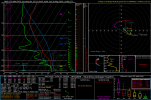
GEFS is hinting at a potential system from May 30th to June 1st. CIPs is picking up on it too (albeit in the wrong location). It looks like the ridge currently in place over the Western US is gonna tear apart any low pressure systems that try to cross the rockies for a while.

1779915304657.png1779915393125.png1779915327754.png


1779915587099.png1779915606533.png1779915633509.png

1779916045756.png1779916074485.png
 
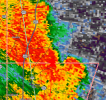
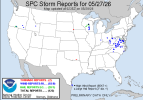
Southward-moving central WI storms were severe warned into far northwest Dane County, but sputtered into Madison on fumes and have now ceased to exist. Decent little string of wind/hail reports for a marginal risk.

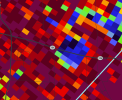
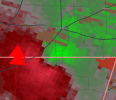
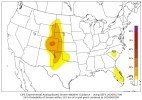
...also, somehow, there was apparently a tornado in Oklahoma today.

today.png
 
Looking at the supercell composite on the GFS is just depressing. There aren't even any GEFS ensemble members hinting at anything until the 2nd week of June. It's worth noting the CFS goes crazy for most of June, and i've seen people here talk about how analogous years had above average activity in June, so we'll just have to wait and see. Going to be very quiet for the next few weeks at the very least.
Seen Reed trimmer post that . Thinks gets very sctive
Mid June super cell activity . We will see
 
Southward-moving central WI storms were severe warned into far northwest Dane County, but sputtered into Madison on fumes and have now ceased to exist. Decent little string of wind/hail reports for a marginal risk.

...also, somehow, there was apparently a tornado in Oklahoma today.

View attachment 53076
back-door cover to avoid a tornadoless May in Oklahoma
 
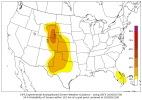
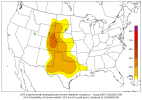
Yeah, it gets old seeing these maps all the time. You might as well give a 3 year old a map and a set of crayons of how accurate it ever is.


This Nino is really amping up even stronger as we move along . Should play a big part with the weather pattern .. we are really headed towards unknown territory with this Nino. Time will tell
 
Back
Top