• Welcome to TalkWeather!
    We see you lurking around TalkWeather! Take the extra step and join us today to view attachments, see less ads and maybe even join the discussion.
    CLICK TO JOIN TALKWEATHER

Enhanced Fujita Ratings Debate Thread

It’s already well established that trenching is not a violent tornado indicator, but we just keep getting more nails in the coffin. The most recent one was this EF1 in Delray Beach, FL. It produced trenching on a golf course. There’s absolutely no room to say maybe it was violent in just this one spot either, because look at the trees in the direct path, they’re virtually undamaged. I will say this is one of the few instances of trenching I have observed that didn’t happen on maintained pasture grass. But the main takeaway is still very apparent: trenching is not indicative of any specific intensity, it’s simply indicative of a strong vortex interacting with soft ground and a loose sod layer. It’s a phenomenon linked to ground/soil composition and nothing more. It’s kinda crazy how much my opinion on it has changed, since I used to rank Philadelphia, MS within my top 5 most violent tornadoes.
View attachment 55696
I think it's important to recognize the differences between things like astroturf, moss, and deep-rooted plants being removed in clumps. This is seemingly a private neighborhood (I'm guessing a golf course), so it's probably using turf, which historically is much easier to remove. Generally speaking, the trenching we see produced by Tornadoes like Philadelphia, Mayfield, and Henryville is done because wind clutches up deep-rooted vegetation or up on the side of hills where it's able to remove the total top layer, which typically is much rarer. Also, the more sandy a soil is, the less likely it's able to cling to plants. As opposed to the clays we see in the Mid-South. There are a lot of factors people simply do not think about and tend to equate one with another; when we compare case by case the tornadoes in these regions, an idea of intensity becomes much clearer.
 
I think it's important to recognize the differences between things like astroturf, moss, and deep-rooted plants being removed in clumps. This is seemingly a private neighborhood (I'm guessing a golf course), so it's probably using turf, which historically is much easier to remove. Generally speaking, the trenching we see produced by Tornadoes like Philadelphia, Mayfield, and Henryville is done because wind clutches up deep-rooted vegetation or up on the side of hills where it's able to remove the total top layer, which typically is much rarer. Also, the more sandy a soil is, the less likely it's able to cling to plants. As opposed to the clays we see in the Mid-South. There are a lot of factors people simply do not think about and tend to equate one with another; when we compare case by case the tornadoes in these regions, an idea of intensity becomes much clearer.
I think the main point is that you cannot use trenching by itself to determine strong or violent intensities 99% of the time. The only time it is valid is in the extreme cases like you mentioned. The extreme cases like Philadelphia or Smithville had extraordinary context surrounding the trenching, like rootballed and debarked trees, grass scouring, and incredible lofting feats. There’s also clearly a presentation to those instances of trenching that clearly points to extreme intensity in my opinion; it’s a consistent streak following the violent core path, not a patchy look or a peeling of the top layer of soil.

I am also of the opinion that the trenching in Hickman county from the 2021 tornado is fairly overrated in its intensity. It’s definitely more impressive than, say, the trenching from the Mauk, GA EF1, but it isn’t anywhere close to the 4/27/11 EF5s ground obliteration. It’s patchy and not consistent, and the tree damage along that part of the path, while impressive, isn’t high end like it is later in that tornado’s life. It leads me to believe that the trenching in that case was a peeling of a soft top layer of soil rather than the violent core digging into the earth.

And FWIW, I do believe that the Mayfield tornado was every bit as violent as a high tier EF5 along some points of its path, particularly in Bremen. But that early in the path, I’m not convinced of extreme intensity, more of a low-end EF4 level.
 
I think it's important to recognize the differences between things like astroturf, moss, and deep-rooted plants being removed in clumps. This is seemingly a private neighborhood (I'm guessing a golf course), so it's probably using turf, which historically is much easier to remove. Generally speaking, the trenching we see produced by Tornadoes like Philadelphia, Mayfield, and Henryville is done because wind clutches up deep-rooted vegetation or up on the side of hills where it's able to remove the total top layer, which typically is much rarer. Also, the more sandy a soil is, the less likely it's able to cling to plants. As opposed to the clays we see in the Mid-South. There are a lot of factors people simply do not think about and tend to equate one with another; when we compare case by case the tornadoes in these regions, an idea of intensity becomes much clearer.
I am not sure what you are trying to say here to be honest, because the phenomenon of trenching is quite simple and there aren’t many “differences” to recognize, because it almost always happens as a result of the same scenario (tornado + pasture = trenching). You’re mentioning something about “deep rooted vegetation or up on the sides of hills” in relation to trenching in Philadelphia, Mayfield, and Henryville but I’m not clear on what you’re getting at. If you’re trying to say that trenching CAN be a violent indicator depending on geography and soil type, that isn’t true either.

Let’s break it down:

Philadelphia: What kind of grass was scoured here? Pasture grass. In my studies, this is THE kind of ground that produces trenching 90% of the time. Yes Philadelphia was extremely violent, but it still produced its trenching in the most trench-prone type of ground there is. If you are trying to assert that the Philadelphia tornado scoured deep rooted, hard to scour surface vegetation, that assertion is false. Look at the many instances of trenching, and you will find that a vast majority happened on maintained grazing pasture. That is the main link we see between most cases.

Mayfield: Same as Philadelphia. More classic pasture grass trenching and it did not occur while the tornado was in a particularly violent stage of its life cycle. Again, it occurred in a highly trench-prone pasture, and there was no “deep rooted vegetation” or “up on the side of hills” in play here. So again I’m not sure how that factors into what you’re saying.

Henryville: No clue what you’re talking about here. As far as I know, Henryville did not produce trenching. The closest thing I can think of were the areas of dirt and grass that got gouged out of a grassy roadside embankment, caused by pieces of scoured asphalt slamming into it. That is not trenching.

While it is important to recognize that there are variables in ground composition, my little statistical study below shows that trenching is not as variable dependent as one would think, and is a very simple phenomenon that largely comes down to one thing: pasture grass. I know you’re probably tired of me saying that, but that’s seriously the main factor here. ANY form of maintained pasture is prone to trenching, and it doesn’t matter where it happens or if the soil is more sandy or clay laden. Let’s go over the list:

Tri-State 1925: Mix of natural meadows and pasture grass

Gans, OK 1957: Naturally occurring meadow, not pasture grass

Arnold, NE 1975: Pasture grass

Lawrence County, TN 1998: Pasture grass

Philadelphia, MS 2011: Pasture grass

Smithville, MS 2011: Pasture grass

Cordova, AL: Pasture grass

Coleridge, NE 2014: Plowed agricultural field

Ponte Alto do Norte, BR 2016: Pasture grass

Tescott, KS 2018: Pasture grass

Mayfield, KY 2021: Pasture grass

Mauk, GA 2022: Either pasture grass or saturated lawn grass, not 100% sure

Caldwell Parish, LA 2022: Pasture grass

Tylertown, MS 2026: Pasture grass

Pirai Do Sol, BR 2026: Pasture grass.

Delray Beach, FL 2026: Golf course turf
 
Last edited:
See what I mean? We can squabble about soil composition and geographical location all we want, but the statistical correlation is very clear: The phenomenon of trenching is more linked to the pasture ground than it is any kind of specific intensity, and this linkage persists despite various differences in world location and soil composition.

Why? I’m not 100% sure but I infer that this has to do with maintained pasture land having a loose sod layer that has a tendency to peel back and disintegrate into chunks when impacted by intense vortices. As long as that loose sod layer is present, the soil composition or tornado intensity does not really matter. This is probably why we see trenching across multiple intensity levels and multiple soil types.

The bottom line: Trenching is not a violent tornado indicator, is not really affected by varied soil types, and the only consistent statistical linkage that can be established across most cases is the presence of pasture grass.
 
Last edited:
Didn't Philadelphia also wipe out a well anchored home? Also in its defense the trenching it did was a foot high and the trenching tracked a while.
No, Philadelphia did not wipe out a well-anchored home. This is a false claim that is spreading like wildfire among young tornado enthusiasts, and it just isn’t true. The only frame home it wiped out was a very old farmhouse that was wiped off of its wooden floor platform/subfloor. In fact, the floor wasn’t even fully swept clean, and a fairly large debris pile remained.

The assertion that the Philadelphia, MS tornado wiped out a well-anchored home is likely a “cover our butts” statement issued by Alan Gerard of NWS Jackson as an attempt to “attach” the EF5 rating to actual structural damage. What Gerard doesn’t realize though, is that I remember the rating process for Philadelphia in great detail, and i know for a fact that the house was RATED EF4! In fact, the Philadelphia tornado was rated EF4 until they found the trenching days later. A local property owner contacted NWS Jackson and asked them to check out his pasture, because the tornado had “plowed it up”. NWS Jackson realized they missed this area, went back out to survey the pasture, found the trenching, and only upgraded the tornado to EF5 pretty much entirely based on the trenching. So why would NWS Jackson years later basically start asserting that the Philadelphia tornado produced EF5 house damage? Because the main basis for the rating was trenching, and they don’t want to admit that. Why? Because in the following years, trenching was revealed to be a phenomenon that can, and does occur well below EF5 intensity. By tying the rating to a structure (the house), the Jackson office can avoid the discourse of an EF5 rating based on a phenomenon that isn’t unique to EF5 events, and can avoid calls for a downgrade by tying the rating to house.

Conveniently, NWS Jackson has removed all of their Philadelphia damage pics from the survey page. So a lot of young tornado enthusiasts just took Gerard’s word that the Philadelphia tornado produced EF5 house damage without questioning it. A lot of people who are buying the “Philadelphia tornado produced EF5 house damage” narrative are too young to remember the actual Philadelphia rating process, the fact that the house was rated EF4, or the fact that the upgrade was based on trenching that was found well after the initial survey. Also, since most of the Philadelphia damage photos have been pulled from the internet, these young people are probably picturing a slabbed house with anchor bolts that was wiped clean. But that simply isn’t the case.

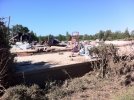
Thankfully, I do have one photo of the house in question. Old, not wiped clean, wooden floor platform, no concrete slab, no anchor bolts. Anyone who knows their stuff would tell you this is NOT EF5 house damage, in any way shape or form (because it’s not).
IMG_4261.jpeg

The bottom line is NWS Jackson is using a highly questionable damage point that most people haven’t even seen pictures of to “prop up” the EF5 rating. If more people saw the pic above, more people would be questioning this narrative. Thankfully for NWS Jackson, most tornado enthusiasts are too young to question it, too young to remember the actual Philadelphia rating upgrade as it happened, and haven’t actually seen pics of the so-called “EF5 house” from Philadelphia. Oh and again, the house above was rated EF4 back in 2011. The attempts to tie the house to the EF5 rating only began a couple years ago.
 
Last edited:
No, Philadelphia did not wipe out a well-anchored home. This is a false claim that is spreading like wildfire among young tornado enthusiasts, and it just isn’t true. The only frame home it wiped out was a very old farmhouse that was wiped off of its wooden floor platform/subfloor. In fact, the floor wasn’t even fully swept clean, and a fairly large debris pile remained.

The assertion that the Philadelphia, MS tornado wiped out a well-anchored home is likely a “cover our butts” statement issued by Alan Gerard of NWS Jackson as an attempt to “attach” the EF5 rating to actual structural damage. What Gerard doesn’t realize though, is that I remember the rating process for Philadelphia in great detail, and i know for a fact that the house was RATED EF4! In fact, the Philadelphia tornado was rated EF4 until they found the trenching days later. A local property owner contacted NWS Jackson and asked them to check out his pasture, because the tornado had “plowed it up”. NWS Jackson realized they missed this area, went back out to survey the pasture, found the trenching, and only upgraded the tornado to EF5 pretty much entirely based on the trenching. So why would NWS Jackson years later basically start asserting that the Philadelphia tornado produced EF5 house damage? Because the main basis for the rating was trenching, and they don’t want to admit that. Why? Because in the following years, trenching was revealed to be a phenomenon that can, and does occur well below EF5 intensity. By tying the rating to a structure (the house), the Jackson office can avoid the discourse of an EF5 rating based on a phenomenon that isn’t unique to EF5 events, and can avoid calls for a downgrade by tying the rating to house.

Conveniently, NWS Jackson has removed all of their Philadelphia damage pics from the survey page. So a lot of young tornado enthusiasts just took Gerard’s word that the Philadelphia tornado produced EF5 house damage without questioning it. A lot of people who are buying the “Philadelphia tornado produced EF5 house damage” narrative are too young to remember the actual Philadelphia rating process, the fact that the house was rated EF4, or the fact that the upgrade was based on trenching that was found well after the initial survey. Also, since most of the Philadelphia damage photos have been pulled from the internet, these young people are probably picturing a slabbed house with anchor bolts that was wiped clean. But that simply isn’t the case.

Thankfully, I do have one photo of the house in question. Old, not wiped clean, wooden floor platform, no concrete slab, no anchor bolts. Anyone who knows their stuff would tell you this is NOT EF5 house damage, in any way shape or form (because it’s not).
View attachment 55734

The bottom line is NWS Jackson is using a highly questionable damage point that most people haven’t seen pictures of to “prop up” the EF5 rating. If more people saw the pic above, more people would be questioning this narrative. Thankfully for NWS Jackson, most tornado enthusiasts are too young to question it, too young to remember the actual Philadelphia rating upgrade as it happened, and haven’t actually seen pics of the so-called “EF5 house” from Philadelphia.

That does look like a little grass scouring and defoliation of those front shrubs, though. Would need to see a few more pictures to make any definitive conclusions about the house.

You've done some seriously thorough research on this topic and I applaud all the receipts you brought for all the trenching examples. Very interesting pattern. You've definitely changed my opinion on that DI. Don't see it as a violent indicator at all like I used to, and I think the phenomenon for sure warrants some further study.
 
Didn't Philadelphia also wipe out a well anchored home? Also in its defense the trenching it did was a foot high and the trenching tracked a while.
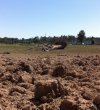
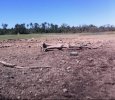
Plenty of tornadoes have produced trenching to a foot or more in depth, and they were not even close to EF5 intensity. Philadelphia was very violent but the depth of trenching was not unique to that tornado. The Mauk, GA tornado trenched the ground about a foot deep, and that was an EF1. The trenching from the recent Delray Beach, FL tornado wasn’t a full foot deep, but that was also an EF1. Now just imagine if the ground from both of those examples got hit by an EF4. What would that look like? Probably just like Philadelphia, and it wouldn’t take an EF5 to do it.

Also I don’t understand why people feel the need to “defend” the Philadelphia rating. Science changes as data changes. Things that seem certain and solid initially, can later be undermined by contradictory data, and the Philadelphia rating is a perfect example of that. There’s no point in digging one’s heels in and trying to cling to a rating basis that has shown to be questionable many times over. I guess people don’t want to “lose an EF5” and want to cling to the wonder and amazement of a tornado that dug a literal trough into the earth. I get that, but you can still have that wonder and amazement while recognizing that it didn’t take EF5 strength winds to make it happen.

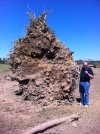
But interestingly enough, and speaking of how science changes, Philadelphia may still have basis for EF5 based on new science! What would that basis be? Root ball displacements. The Philadelphia tornado produced some of the most insane root balling ever documented. Some of these huge trees were thrown so far that the survey team couldn’t even figure out where they originated. When Philadelphia happened, while the root balling was noted, nobody had any idea how significant it was. Root balling was only tied to EF5 intensity in the past few years, so while everyone was amazed by Philadelphia’s trenching at the time, a potentially more solid basis for EF5 was being overlooked.
IMG_4264.jpegIMG_4263.jpegIMG_4262.jpeg
 
That does look like a little grass scouring and defoliation of those front shrubs, though. Would need to see a few more pictures to make any definitive conclusions about the house.

You've done some seriously thorough research on this topic and I applaud all the receipts you brought for all the trenching examples. Very interesting pattern. You've definitely changed my opinion on that DI. Don't see it as a violent indicator at all like I used to, and I think the phenomenon for sure warrants some further study.
Thanks! Contextual damage and it’s statistical correlation is sort of the main thing I study. I used to be amazed by trenching too, but I’ve been forced to “drop it” as a violent tornado indicator. There’s just been too many examples to the contrary.

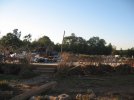
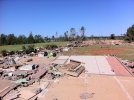
Also good eye on the house pic. There definitely was some contextual vegetation evidence of extreme intensity there, but the house itself was way too poorly built, and the sweep wasn’t even close to clean enough for what is needed for EF5. I just dug up the old NWS Jackson survey pics using Archive. This below is more pics of the house that they are somehow trying to tie the EF5 rating to. The more you look, the sillier that narrative becomes. No poured concrete slab, no anchor bolts, and not a clean sweep. I’d go as far as to say that Philadelphia’s recent “EF5 house damage” narrative hinges on young tornado enthusiasts largely not having access to these images. If they had access to them, they’d be nit picking the heck out of them.
IMG_4265.jpegIMG_4266.jpeg
 
Back
Top