• Welcome to TalkWeather!
    We see you lurking around TalkWeather! Take the extra step and join us today to view attachments, see less ads and maybe even join the discussion.
    CLICK TO JOIN TALKWEATHER

Enhanced Fujita Ratings Debate Thread

Um..NWS Grand Forks just altered their official path of the 2010 Almora, MN EF4 tornado and added new tornadoes from that event based on Nick K’s findings…

Hmm, what happened the “ban” on records changes? It’s almost like it doesn’t exist in any official capacity, almost like it’s a statement that WFOs can throw out there any time they are proven wrong but don’t want to change anything. What’s the term for that…hmmmmm uh “lying to people” I think it’s called???

In all seriousness, that is so ridiculous. This just motivates me to double down and carry on with my own personal research. I can’t interpret this any other way besides WFOs finding new creative ways to dodge accountability, and side step any attempt to set the record straight amid the growing influx of “armchair” tornado damage researchers as they bring forth more and more evidence of the NWS getting things wrong. It seems they have a created a blanket statement to shoo away amateur tornado event/damage researchers when they do anything that rocks the boat or challenges the official record. The takeaway? Don’t back down, and keep working on getting info out there that promotes truth and accuracy, even if it’s not “official”. Sorry but this one has me heated big time. It really sounds like the records change ban is a big fat lie.

Agree with EF5, I think this is more WFO dependent nonsense. Kinda funny that it's the upper midwestern offices with less experience with tornado events that have gotten away with more loose processes for ratings and analysis (IMO this is a good thing).
 
Not necessarily. Sometimes businesses just throw them in a parking lot without anchoring them and there’s usually no governing body or code to make sure they are attached to the pavement. They’re only potentially significant if they are anchored. The ones in Vilonia weren’t anchored at all and subsequently aren’t significant. I also recall an EF2 in Florida years ago that hit a correctional facility parking lot while clearly below EF5 intensity, and parking stops were moved despite the tornado absolutely and conclusively not being violent. You can’t automatically assume parking stops are an EF5 damage indicator, because they often aren’t. But if the Greenfield ones were anchored it is potentially significant.


Like they broke before they left the ground? If so, they weren’t actually lofted from their anchors intact. This is different than what happened in Joplin. What you’re describing here screams “broken apart by debris impacts” rather than actual intact lofting and removal. I’d really need to see some detailed pics to fully understand what happened there though.

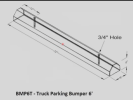
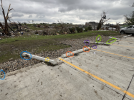
Sorry for the late reply. Was a busy weekend. But yes, they were actually ripped from their anchors with explosive force. The anchors were left behind protruding from the ground, and there are visible edge breakouts on the the stops, as well as exposed rebar from where the anchoring was horizontally reinforced. This perfect aligns with engineering standards for BMP6T 6-foot precast concrete truck parking bumpers which are

1. Made from high-strength, rebar-reinforced concrete.
2. Designed specifically for trucks and heavy vehicle parking spaces. (it was a hospital parking lot I believe)
3. Measures 6 feet in length to withstand heavy impact and weathering.

1785698070016.png

Due to the height of the stops, them being broken from the anchors was the result of pure sheer force, rather than tensile load like you normally get with failed anchors in walls.

The fact the damage occurred uniformly across at least 5 stops means a single debris impact is impossible, and it's more likely it was a uniform wind load. You'd also expect debris impacts to cause far more catastrophic damage to the entire stop, making them look smashed, rather than perfect tear-outs right where the anchors are located.

The parking lot was also brand new, which means it was uncracked concrete. Google earth imagery from August 2023 shows it was not there yet, so it was a few months old at the most.

When Ethan used the K factor for uncracked concrete in his equation his final wind speed estimate was 283 mph. He thought that was unrealistic, so he changed the K factor to "pre-cracked concrete" and ended up at the widely used 247 mph. I personally believe it's far more unrealistic all of them had been cracked already within months of install.

1785697149943.png
 
Last edited:
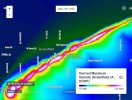
And to reiterate. The DOW teams final report concluded 300 mph+ winds were sustained throughout the entire town. The fact the damage occurred uniformly across all of the stops in a consistent fashion is strongly supportive of these findings. There would likely be far more variance if their movement was primarily caused by debris impacts. I understand people being hesitant to use something so atypical for rating tornadoes, but understand that hesitancy is the exact precedent being used to dismiss the Enid findings. What makes the church in Mayfield, the oil drum in Vilonia, The debarking and scouring in Enid, the rail bridge in Tuscaloosa, etc. any more significant than these parking stops? At least the parking stops have near ground level wind speed readings from Doppler Radar. It's instances like Greenfield that set the precedent for the more extreme damage to be ignored from tornadoes higher on the "EF5 snub" list.

1785698842808.jpeg
 
I do want to add: If I recall correctly, Ethan Moriarty did state that the parking stops in Greenfield were valid to him for granting an EF5 rating, at least in his video (as GPB stated above). Perhaps his stance changed over time, but I seem to remember that quite well. If I'm being honest, I struggle to see a reason why parking stops wouldn't be an incredibly good indicator of EF5 intensity if the calculations support it, since they are extremely low to the ground and have a very simple shape (of course, if we assume that the wind is the only thing affecting it, and that the construction of them is up to par, w/ rebar and all).

The only thing holding me back from being fully on-board with an EF5 upgrade is when you compare Greenfield's damage to other previously rated EF5 tornadoes. If the damage from those is what they are looking for in an EF5, it's difficult for me to say it deserves it, because the rest of the DIs in there really aren't up to that level. I think the benchmark for EF5 is pretty set-in-stone and we should mend the scale itself rather than the rating of this particular tornado to accurately reflect what really happened in this instance. There has to be a good reason why Greenfield didn't inflict "textbook" EF5 level damage in town despite containing windspeeds exceeding 300 mph that isn't just "quality of structures." Whatever that reason may be, it could support an upgrade to EF5 for it, or it could be entirely against it.

EDIT: When I say "set-in-stone" I am not referring to the maddening inconsistency of the scale's application, I'm referring to "the look."
 
Last edited:
I do want to add: If I recall correctly, Ethan Moriarty did state that the parking stops in Greenfield were valid to him for granting an EF5 rating, at least in his video (as GPB stated above). Perhaps his stance changed over time, but I seem to remember that quite well.
He's taken this back since and even regrets bringing up the parking stops because now everyone uses them as EF5 evidence when in his own words they absolutely aren't a reliable indicator.
 
He's taken this back since and even regrets bringing up the parking stops because now everyone uses them as EF5 evidence when in his own words they absolutely aren't a reliable indicator.
I’d be very interested to hear why, especially since they were directly used as support for Joplin’s EF5 rating. I understand Joplin had a lot more contextuals in support of EF5 though, it may just boil down to that.
 
Back
Top