
@SweptSlab5
Here is Lyza’s paper on the 200 MPH debacle and more generally, his takedown of the EF scale at large.
Here is Lyza’s paper on the 200 MPH debacle and more generally, his takedown of the EF scale at large.
Follow along with the video below to see how to install our site as a web app on your home screen.
Note: This feature may not be available in some browsers.

here is more info / images of this spot.when it comes with debris messing up the EF scale rating for some tornadoes .... the tornado that bothers me the most is bowling green on 2021.
a brick home was mostly all swept clean and it wasn't even the lowest resistance class , yet it got rated ... 120 (or 130) MPH EF2 ....
what im hearing is that they did this because there MIGHT of been a small chance debris hit the home ...
View attachment 49363
View attachment 49364
and there is a other swept clean home nearby that never got survey.
again .. why EF2 and not 165 mph EF3?
this seems very high end EF3 or low end EF4 to me.
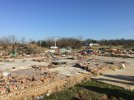


The bigger issue here is them using the wrong DOD.

Theres a few examples of debris loading that ISN'T just lofted objects against another, that mainly being parkersburg's concrete wall, as far as I remember, it was hit by a huge sum of debris. Unless you don't count that as debris loading and instead debris impacting.To sum it up:
What IS debris loading: Goldsby mobile home, Bowling Green duplex that got an entire warehouse smashed into it (still rated too low), that one Rochelle house that got hit by bits of the other nearby house
What IS NOT debris loading: E Wicker Street
There are two valid scenarios in which debris loading/impacts can exacerbate damage and thus lower ratings:Theres a few examples of debris loading that ISN'T just lofted objects against another, that mainly being parkersburg's concrete wall, as far as I remember, it was hit by a huge sum of debris. Unless you don't count that as debris loading and instead debris impacting.
Parkersburg was arguably one of the most violent tornadoes ever, especially with the homes in the golf course subdivision being essentially evaporated.I just looked at the Parkersburg basement wall photo for the first time in a while. Yeah, there’s actually less debris accumulation than I remember, and a good amount of it honestly appears to be mud and scoured grass. The claim that it was “hit by a huge sum of debris” does not appear to be an accurate statement at all. Pretty much any EF5 rated home ends up getting pummeled by debris, and there’s nothing to suggest that this particular home got it any worse than others. Honestly, it probably received a milder debris pummeling than any of the EF5 homes from Moore 2013. Also, the assertion that this debris accumulation is directly connected to the failure of the basement wall is far from conclusive, especially after taking a closer look. There’s just no real compelling evidence to suggest that.

Parkersburg is firmly in my top 10 most violent tornadoes ever recorded. The golf course damage was as extreme as it gets and was well above and beyond at EF5 intensity there. I mean, one home literally had no traceable debris left! Can’t say that happens too often.Parkersburg was arguably one of the most violent tornadoes ever, especially with the homes in the golf course subdivision being essentially evaporated.

It's on my Top 10 as well, tied with Greensburg which has its own assortment of incredible feats.Parkersburg is firmly in my top 10 most violent tornadoes ever recorded. The golf course damage was as extreme as it gets and was well above and beyond at EF5 intensity there. I mean, one home literally had no traceable debris left! Can’t say that happens too often.
What’s your top 10 looking like right now?It's on my Top 10 as well, tied with Greensburg which has its own assortment of incredible feats.
#1 PiedmontWhat’s your top 10 looking like right now?
What did Catalina do that was extreme? I haven’t heard much on that tornado and would put San Justo higher.#1 Piedmont
#2 Tri-State
#3 Jarrell
#4 Bridge Creek
#5 Bakersfield Valley / Stratton
#6 Smithville
#7 Matador
#8 Greensburg / Parkersburg
#9 New Richmond / Moore
#10 Catania
It took what was, by all accounts, an extremely well built house and literally reduced it to a pile of rubble, and not a particularly large pile either. There was also apparently some extreme contextual damage. I've seen it referred to as "Woldegk if all the legends about it were true".What did Catalina do that was extreme?
Oh not just one home! It annihilated multiple extremely thick homes, with the villa being the most well built, and actually the most well built structure to ever be hit by a tornado! That is if you exclude orthodox indicators like CC117.It took what was, by all accounts, an extremely well built house and literally reduced it to a pile of rubble, and not a particularly large pile either. There was also apparently some extreme contextual damage. I've seen it referred to as "Woldegk if all the legends about it were true".
Wow! That sounds extremely violent! No wonder it was upgraded to If5.Oh not just one home! It annihilated multiple extremely thick homes, with the villa being the most well built, and actually the most well built structure to ever be hit by a tornado! That is if you exclude orthodox indicators like CC117.
I have sent feats of Catania here, but I could send them again. Here.
The structure was purely a two story villa that had 1.3 meter thick walls, very heavy timber joists, with floors having strong connections and were made of tile roofs, and this structure specifically was heavily damaged, despite it having inconceivable levels of construction, with its walls overturned onto the streets in compact masses of several cubic meters in volume.
Various descriptions by Damiano Macaluso's Survey (approved by numerous academics, and even by ESWD and ESSL, link is: https://www.uni-met.it/trombedaria/documents/1884_Macaluso.pdf )
- A garden between Civali and Borgo had the topsoil removed revealing a volcanic lava layer below.
- Multiple stone and/or brick homes with walls up to 1 meter thick partially and/or entirely destroyed, with their marble slabs being displaced as well, all of which had very heavy timber joists, with floors having strong connections and were made of tile roofs, these homes were two story.
- A two story villa with inconceivable levels of construction and had walls greater than 1 meter was completely leveled, with its walls overturned onto the streets in compact masses of several cubic meters in volume.
- Laid brick roads scoured or lifted away.
- Orange, Lemon and Olive trees snapped at the base or twisted, some lofted extreme distances.

I’m not too sure about it myself. I feel like this being put into practice would make achieving an EF5 rating too easy, honestly. But I don’t know enough about the way such construction compares to anchor bolted UB homes, specifically with wind resistance. If a guy like LaDue is saying this and is in support of it when it comes to applying a high end rating, I can’t really say I would ultimately disagree with it either.Not to open a whole new can of worms, but what is your guys’s opinion on the fairly recent Jim LaDue presentation on current day EF scale application? It was posted on this forum not too long ago.
The thing that I’ve been having a hard time wrapping my brain around is the part where he essentially describes some of the bare subfloor EF4 homes in Elkhorn as being rated too low, and he provides a scenario for EF5 ratings at bare subfloor homes. The scenario is either extensive toe-nailing of the wall studs, OR extensive sheathing (that green stuff you see on homes under construction) that overlaps with the side of the floor platform. What’s mind boggling to me is how this essentially provides a scenario for an EF5 house rating in which anchor bolts are not visible and seemingly not directly in play. It has me thinking, would this be applicable to a boltless slab foundation home too?
If extensive sheathing or toe-nailing alone is enough to make a home an EF5 candidate, it would lower the bar for EF5 house damage significantly, but I just can’t see that being put into practice. I’m unsure as to whether this is something that is currently becoming widely accepted, or if it’s just something that Jim LaDue is proposing but hasn’t “caught on” yet?
The idea of an EF5 house rating without any kind of visible bolting has been making my head spin, and I’d love to hear from others about the viability of this concept (paging @Saltical Wx)
That’s the thing. Between Elkhorn and Marion, we’ve seen an uptick in violent ratings assigned to bare subfloor homes, which makes me think something is going on behind the scenes. But high-end EF4 and especially EF5 feels hard to accept without anchor bolts directly anchoring the walls.I’m not too sure about it myself. I feel like this being put into practice would make achieving an EF5 rating too easy, honestly. But I don’t know enough about the way such construction compares to anchor bolted UB homes, specifically with wind resistance. If a guy like LaDue is saying this and is in support of it when it comes to applying a high end rating, I can’t really say I would ultimately disagree with it either.
My question is does Marion 2025 apply to the descriptions listed by LaDue?

