
Beachwalker
Member
Well that event verified! End of story
Follow along with the video below to see how to install our site as a web app on your home screen.
Note: This feature may not be available in some browsers.
I’m not a particularly nice guy. That’s a trait I have, and it’s probably my biggest flaw. But the key thing here is, it only comes out when there’s a pattern of behavior from another individual that is indicative of ignorance or incessantly irritating behavior. So when it comes to a rebuttal that boils down to “Yeah well you’re a d**k who goes off on people”…yeah I know, and I don’t care because if someone is on the receiving end of it, they did something to bring it forth. I simply do not believe in unconditional respect, nor that everyone’s opinions or statements are valid and deserving a kind approach no matter what. The way I treat others is entirely dependent on how they behave and what they say.I've seen multiple people claim NWS Chicago is a liberal office. Mainly due to the fact they rated a tornado from the April outbreak EF3 when it looked more like an EF2. Looking back, I think I saw the majority of that commentary somewhere else. I can see why you are confused now, so that's my bad.
But also... I have done an exhaustive amount of research on tornadoes and tornado science, written dozens of summaries of scientific articles/research/reports and shared them here, and I've plotted data across multiple spreadsheets and charts. You've got a lot of nerve calling me ignorant when the extent of your sources are "I've done a TON of research, so you're just gonna have to trust me ok?"
Plus, we agree on almost everything, so the fact you can't handle the first potential disagreement we've had in a long while with good faith and respect instead of flying off the handle says more about you than it does me.

I’m not a particularly nice guy. That’s a trait I have, and it’s probably my biggest flaw. But the key thing here is, it only comes out when there’s a pattern of behavior from another individual that is indicative of ignorance or incessantly irritating behavior. So when it comes to a rebuttal that boils down to “Yeah well you’re a d**k who goes off on people”…yeah I know, and I don’t care because if someone is on the receiving end of it, they did something to bring it forth. I simply do not believe in unconditional respect, nor that everyone’s opinions or statements are valid and deserving a kind approach no matter what. The way I treat others is entirely dependent on how they behave and what they say.
Plus, don’t for a second try to claim that just because I’m not waving a bunch of papers, academic journals, and links to studies all over the forum is indicative of some kind of lesser credibility. The main reason I don’t do that, is because myself, and many others here have already delved into and read much of that stuff before it even gets posted here, so there’s no point in posting it over and over. As a tornado intensity estimation nerd, you bet I’m going to read/watch anything that gets put out related to that topic, so almost everything I say has external basis. The only real “original research” that I claim is related to contextual stuff like grass scouring. So your implication that I operate on a “because I said so” basis is completely false. Besides, posting more papers and links does not automatically equate to having a better grasp on things like construction, the science behind surveying, and the relationship between tornado intensity and damage. It’s a flashy false equivalency, and at the end of the day, my username isn’t one of the go-to’s on this forum for EF scale/damage surveying questions for no reason. That’s something you earn over time via real life examples and discussions, not just by waving links and studies around.
The bottom line is I’ll play nice until you give me a reason not to…and when I don’t, don’t expect that pointing out that I’m being a jerk will be some personal revelation for me, because trust me, I already know that.

I'm not dipping my toes in this today.Summoning @buckeye05 @TH2002. I agree with this statement. I could be fine with either HE EF3 or LE EF4 honestly. Theres a very reasonable possibility that there could be 2 violent ratings before we’re done with the outbreak.
The thing is, I don’t actually disagree with the crux of many of your points at this stage. There’s a good chance you won’t have to tell me anything because I’m probably already in agreement. My only issue is that you seem to have a mindset that seeks any opportunity to criticize the rating process, the people involved, and the NWS when it comes to surveying procedures. It’s a clear pessimistic bias, and that is more what I was getting at.This is fair.
I just want you to know, when the research comes out proving everything I've been saying the last two years is correct, I won't say I told you so. I'll be super humble and chill about it.

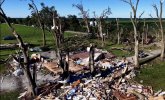
EF3. All I'm going to say without getting dogged.Also related to the topic of surveys and ratings, I’m seeing the first possible caveat here for an EF4 rating for the Kouts tornado. It looks like the entire floor platform slid off of the basement intact, which could be indicative of a weak connection between the foundation and floor. In addition, there’s a lack of debarking, but that could be attributed to the tree species or a lack of debris loading. However, truly violent tornadoes can debark trees in rural areas no problem. So this one probably isn’t a slam dunk, but EF4 is still definitely on the table. Keep in mind though, it also could come down to the transmission tower rather than the house. Bowdle 2010 does set a precedent that shouldn’t be ignored.
View attachment 53358
The thing is, I don’t actually disagree with the crux of many of your points at this stage. There’s a good chance you won’t have to tell me anything because I’m probably already in agreement. My only issue is that you seem to have a mindset that seeks any opportunity to criticize the rating process, the people involved, and the NWS when it comes to surveying procedures. It’s a clear pessimistic bias, and that is more what I was getting at.
That’s probably the likely outcome given the factors I mentioned. But at the same time I wouldn’t jump to that conclusion with full confidence just yet. Enid’s highest rated damage point was a largely unanchored farmhouse, and we have the transmission tower to consider, which would meet the 170 MPH criteria under the proposed scale update and was the primary EF4 damage point for Bowdle.EF3. All I'm going to say without getting dogged.
Significant debarking (especially rurally) is an EF5 DI, not an EF4 one. We gotta try to remember that, even with all the bad precedent around it. Contextually, this level of de nuding is enough to support a low-end EF4 rating when paired with the damage presentation of the house. When you add the mangled trailer, and cycloidal marks, it becomes practically a slam dunk low-end EF4.Also related to the topic of surveys and ratings, I’m seeing the first possible caveat here for an EF4 rating for the Kouts tornado. It looks like the entire floor platform slid off of the basement intact, which could be indicative of a weak connection between the foundation and floor. In addition, there’s a lack of debarking, but that could be attributed to the tree species or a lack of debris loading. However, truly violent tornadoes can debark trees in rural areas no problem. So this one probably isn’t a slam dunk, but EF4 is still definitely on the table. Keep in mind though, it also could come down to the transmission tower rather than the house. Bowdle 2010 does set a precedent that shouldn’t be ignored.
View attachment 53358
The thing is, I don’t actually disagree with the crux of many of your points at this stage. There’s a good chance you won’t have to tell me anything because I’m probably already in agreement. My only issue is that you seem to have a mindset that seeks any opportunity to criticize the rating process, the people involved, and the NWS when it comes to surveying procedures. It’s a clear pessimistic bias, and that is more what I was getting at.
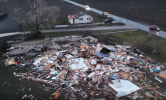
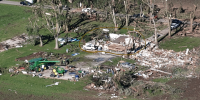
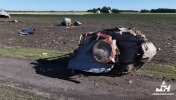



YeahWow? I don’t even see a severe thunderstorm warning lol and looks like a tornado, not landspout.
 I didn’t either saw it on my Facebook feed but agreed
Significant debarking (especially rurally) is an EF5 DI, not an EF4 one. We gotta try to remember that, even with all the bad precedent around it. Contextually, this level of de nuding is enough to support a low-end EF4 rating when paired with the damage presentation of the house. When you add the mangled trailer, and cycloidal marks, it becomes practically a slam dunk low-end EF4.
170 mph would even be acceptable as a compromise for uncertainty, but I personally think the winds required to cause this damage are in the 185 range (that's an unpopular opinion, I know).
When you compare this house to the one in Kankakee it becomes clearer. Notice how the tree next to the house barely lost any branches, and how large the pieces of the house are. Plus the absence of any soil disturbances or cycloidal marks in the vicinity.
View attachment 53359
Here's another angle of the Washburn house. Much more granulated. And the thrown objects.
View attachment 53361
View attachment 53362View attachment 53364
