

The answer, broadly-speaking, is multiple things. But the biggest thing usually has to do with timing, and the wedge. Wedge is self-explanatory, timing has to do with systems very frequently getting to us well after dark, and there's also probably some geography at play. But we do have our moments, significant outbreaks can and do happen in the state, but they are far less frequent and severe than in, say, Alabama.Genuine question what is it about Georgia that makes storms collapse as soon as they cross the state line? I assume it's because we don't have direct access to the moisture advecting from the Gulf, but it happens so consistently and in all seasons that it makes me wonder if there's something more at play. I have no interest in tornadoes to be sure, but occasionally it would be nice to get something more exciting than another 2:45am severe warning that immediately dissolves into a Special Weather Statement as soon as it crosses I-285 outside the Metro.
Navigation
Install the app
How to install the app on iOS
Follow along with the video below to see how to install our site as a web app on your home screen.
Note: This feature may not be available in some browsers.
More options
-
Welcome to TalkWeather! We see you lurking around TalkWeather! Take the extra step and join us today to view attachments, see less ads and maybe even join the discussion. CLICK TO JOIN TALKWEATHER
You are using an out of date browser. It may not display this or other websites correctly.
You should upgrade or use an alternative browser.
You should upgrade or use an alternative browser.
Severe Weather 3/15 - 3/16
- Thread starter CheeselandSkies
- Start date

tornado examiner
Member
I’ve never seen a 45% risk issued for any day 3 outlook before. Is this a first?
Is that new.
Is that new.

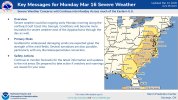
Messaging from the NWS for 3/16

WhirlingWx
Member
Here's the updated chunk of the SPC outlook:
AMENDED TO EXPAND D4/MONDAY THREAT AREAS
...DISCUSSION...
...Updated discussion for D4...
The majority of deterministic and ensemble model guidance agree on a
deep midlevel trough and associated cold front that will move
eastward across the Appalachians and to the Atlantic coast by
Tuesday morning. Severe storms could be ongoing at the beginning of
the period along the northeast Gulf coast into GA. The warm sector,
characterized by boundary-layer dewpoints in the 60s, will expand
northward (generally east of the Appalachians) through the day as
far north as PA. Though clouds could limit downstream surface
heating somewhat, very strong wind profiles and focused forcing for
ascent will favor a continuation of convection along the front, as
well as pre-frontal convection, with the potential to produce
relatively widespread damaging winds and several tornadoes.
AMENDED TO EXPAND D4/MONDAY THREAT AREAS
...DISCUSSION...
...Updated discussion for D4...
The majority of deterministic and ensemble model guidance agree on a
deep midlevel trough and associated cold front that will move
eastward across the Appalachians and to the Atlantic coast by
Tuesday morning. Severe storms could be ongoing at the beginning of
the period along the northeast Gulf coast into GA. The warm sector,
characterized by boundary-layer dewpoints in the 60s, will expand
northward (generally east of the Appalachians) through the day as
far north as PA. Though clouds could limit downstream surface
heating somewhat, very strong wind profiles and focused forcing for
ascent will favor a continuation of convection along the front, as
well as pre-frontal convection, with the potential to produce
relatively widespread damaging winds and several tornadoes.

The 18z nam is a big uptick in parameters in Alabama and Georgia

Bulkshear
Member
How does the threat look for TN? We tend to get lost up here in Dixie eventsThe 18z nam is a big uptick in parameters in Alabama and Georgia
18z NAM is again an outbreak across the SE Sunday night and the Mid Atlantic on Monday. High end shear profiles overlapping at times moderate instability. Not only that, but the convective signal looks much more like a broken line than a solid squall.

Kds86z
Member
Me
also
Ozonelayer
Member
18z NAM is basically a tornado outbreak mixed with a major wind event stretching from the southeast all the way through the piedmont/mid-atlantic reigon stretching all the way into central Pennsylvania.
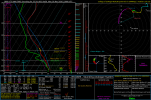
My gosh. This is Birmingham late Sunday night in early Monday morning.
No, it's happened several times. First time under this new probabilistic regime, however.I’ve never seen a 45% risk issued for any day 3 outlook before. Is this a first?
Is that new.
Ozonelayer
Member
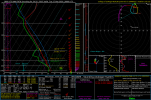
Taken on the NC/SC border. The windshear in the low levels is utterly remarkable. Not to mention CAPE is continuing to uptrend.

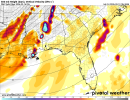
That is not a look on mid level vertical velocity that would indicate only a line. That is very cellular.
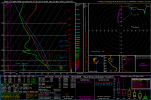
Ozonelayer
Member
Broken line 3/14 style? (Not the madnitude but the storm mode)View attachment 51755
That is not a look on mid level vertical velocity that would indicate only a line. That is very cellular.
The overall threat for long track strong tornadoes are increasing across the whole area honestly.
Rarely do you see such a impressive low level curvature like that. That's jaw dropping.AL/GA state line near La Grange. Pristine hodograph and ample instability. This is not your typical nighttime setup.
View attachment 51754
Kds86z
Member
Potentially closing out the month with most widespread of all…
