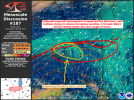
Certainly an interesting day for severe potential. Tomorrow certainly trended down as the cut-off low somewhat lagged back to earlier forecasts - but definitely compensated by the environment this afternoon/evening across IL/IN that has become fairly volatile for tornadoes.
Seems as if storms will initiate just along and to the NE of the nose of the instability axis, probably in Western IL or SE IA around ~22z. While upper level support is somewhat removed, a prominent 700mb jet will begin to nose in during a similar timeframe, which probably reflects some sort of disturbance in the mid-levels which might add a 'kick' of synoptic support for initiation.
As such it seems there will be no shortage of storms along the frontal zone, with a very strong signal from HREF for clusters of supercells in the risk areas by 00z.
View attachment 51334View attachment 51335
The biggest uncertainty as we are all aware is how many of these storms will be on the warm side of the front so that they become surface based and take advantage of the high STP environment (~3-5, more than supportive of intense tornadoes). Most CAMS do now support at least one-two dominant supercells on that side of the boundary. I wouldn't be surprised if it really is just one storm that manages to stay discrete and surface based - but its entirely possible that even a singular cell could take advantage of the environment and produce EF3+ tornado(es).
View attachment 51336
Also worth noting that while STP is very helpful in distinguishing how favourable an environment is for tornadoes, today is the type of day where storm scale features the models can't really anticipate become very important as a potential 'extender' of the ceiling of tornado intensity. Vorticity will be very plentiful near the frontal zone and where any outflow/lake breeze boundaries develop. Additionally, these hypothetical baroclinic vorticity zones would be orientated E-W in line with the front (largely). This is interesting as storm motions will be nearly due E for RM supercells - making ingesting and utilising this hypothetical vorticity quite efficient. You just have to look at last week to see how an intense tornado can be produced in a somewhat benign environment when enhanced by a frontal boundary.
There are still however multiple fail modes - certainly one where all storms quickly get undercut and turn elevated (I think at least one storm will remain surface based, especially as the strengthening LLJ will reinforce the position of the boundary and attempt to transfer moisture north).
The other would be concerns about outflow dominance and upscale growth. Some soundings from near CI do have fairly large dew point depressions and hodographs are smaller due to being earlier in the day - so don't be surprised especially with large CAPE values if storms are large, HP, monster supercells but perhaps shorter lived tornado potential. Especially as the initiating direction and storm motions are parallel, you can can also see how upscale growth occurs earlier than expected (it will inevitably at some point) and transitions to more of an MCS feature. One caveat to this is that profiles appear very well ventilated - which in my opinion will result in pretty classic supercells, and this is true from the get go.
View attachment 51337View attachment 51338
So overall a lot to look at from the tornado side of things - and that's just in the northern risk zone. Tornadoes possible all the way down to the US/Mexico border so potentially multiple reports over a large area type of day. Also, an outbreak of hailers seems pretty much a given too. Hopefully everyone stays safe and weather aware, regardless of what happens!