• Welcome to TalkWeather!
    We see you lurking around TalkWeather! Take the extra step and join us today to view attachments, see less ads and maybe even join the discussion.
    CLICK TO JOIN TALKWEATHER

Severe Weather 2026

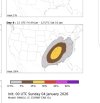
D6/Friday still appears to have the best relative severe potential,
despite the pair of GEFS-based ML guidance trending lower and in
areal extent of 5 percent peak probs. Neither of these have any
appreciable overlap with the preferred ECENS-based 5 percent areas
from NCAR. In any case, an amplified upper trough appears likely to
shift from around the Rockies to the Great Plains. Most EC-AIFS ENS
members now support central states cyclogenesis. But predictability
remains low regarding the spatiotemporal details and amplitude of
cyclogenesis, which is likely related to the handling of shortwave
impulses embedded within the broader trough. An area-of-interest for
a future 15 percent severe highlight roughly includes the Lower MS
to TN Valleys and Deep South.
 
The NCAR ensembles seem to hone in on the TN vicinity being the main area this event. Many ensembles show moisture reaching up to to this area so my confidence is increasing regarding this threat but can't say what magnitude. Still surprised Memphis threw out extreme event last night
 

Attachments

  • Screenshot_2026-01-04-15-04-21-202.jpeg
    Screenshot_2026-01-04-15-04-21-202.jpeg
    43.6 KB · Views: 0
The NCAR ensembles seem to hone in on the TN vicinity being the main area this event. Many ensembles show moisture reaching up to to this area so my confidence is increasing regarding this threat but can't say what magnitude. Still surprised Memphis threw out extreme event last night
Happened to have a website where you can view this?
 
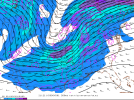
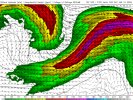
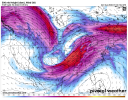
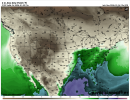
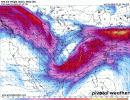
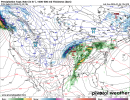
I know it's ridiculous to make these comparisons, and it means nothing, but boy do these troughs sure look similar. First image is 12/10/21

View attachment 49548
View attachment 49549
Which is why I really don’t buy the low instability yet that the long range models are depicting. You don’t get a trough and jet presentation like what is being modeled with this more low amplitude and zonal look without some appreciable instability somewhere. If it trends into a more negative tilt, which can make surface cyclogenesis more intense and deepen, that would only serve for a better CAA and WAA response.

Still a ton of model disagreement though as the SPC noted. Model disagreement seems to be the rule now and not the exception lol. I’ve almost gotten to the point where I like the trough and attendant system to come onshore before locking in on geometry and presentation, but the models can still get it right/give clues.

Now, with it being January, there is an instability “ceiling” somewhat due to the sun angles. However, even 1000 k/j of CAPE is sufficient this time of year due to the overwhelming kinematics. We can’t really draw many conclusions on some of the smaller scale details until the medium range models come into view, but this synoptic look is definitely “setting the table”. Which is why MEG mentioned “extreme event”, some of these trough depictions are pretty significant in my opinion.
 
All signs point to a potential severe weather setup on Friday asthis system continues east, but several caveats exist. The bestforcing with this system remains displaced to our north, awayfrom the greatest dewpoints. In addition, ensembles struggle withadvecting appreciable CAPE into our region with the GEFS onlyshowing a 10% chance of >500 J/kg of SBCAPE reaching into northMississippi. This would yield a high shear, low CAPEenvironmental setup, which is typical for this time of year. I will note that the latest EFI/SOT did increase slightly fromyesterday, meaning there is a tad more confidence in severepotential Friday. In addition, both CSU and CIPS machine learningmodels are beginning to pick up on this potential. For now,expect the end of the week to be rainy with thunderstorms.Further severe weather details will be ironed out in the comingdays.

Memphis AFD
 
Which is why I really don’t buy the low instability yet that the long range models are depicting. You don’t get a trough and jet presentation like what is being modeled with this more low amplitude and zonal look without some appreciable instability somewhere. If it trends into a more negative tilt, which can make surface cyclogenesis more intense and deepen, that would only serve for a better CAA and WAA response.

Still a ton of model disagreement though as the SPC noted. Model disagreement seems to be the rule now and not the exception lol. I’ve almost gotten to the point where I like the trough and attendant system to come onshore before locking in on geometry and presentation, but the models can still get it right/give clues.

Now, with it being January, there is an instability “ceiling” somewhat due to the sun angles. However, even 1000 k/j of CAPE is sufficient this time of year due to the overwhelming kinematics. We can’t really draw many conclusions on some of the smaller scale details until the medium range models come into view, but this synoptic look is definitely “setting the table”. Which is why MEG mentioned “extreme event”, some of these trough depictions are pretty significant in my opinion.
Hello everyone, happy New Year!

The instability question in these setups often ends up being more about distribution and efficiency than raw magnitude, especially when the synoptic forcing and wind field are this strong. Even if models are underdoing CAPE right now, it wouldn’t be surprising to see a narrow but meaningful instability axis develop as the trough sharpens and the surface response becomes clearer.

Until the trough is better sampled, the guidance is going to struggle with details like low placement, warm front position, and convective evolution. That uncertainty cuts both ways we’ve seen plenty of cold-season events where the models look unimpressive at range, only to trend toward a more favorable thermodynamic/kinematic overlap as the event gets closer.

“Setting the table” is a good way to put it. The large-scale pattern clearly supports something impactful if the mesoscale lines up, and I think I can say that confidently.
 
...and just like that the 12Z GFS has uptrended on the instability. Not by much, but enough for some shenanigans IMO especially near the triple point of that 998mb low depicted over or just north of St. Louis at 21Z Friday.

Edit: Thread created.

 
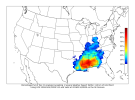
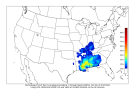
Well hello, hello! CIPS seems to have pretty high confidence in a potentially significant severe risk late next week. Can't say I disagree. IF GFS holds its current presentation on the latest run, you're looking at a pretty classic, substantial cold season severe setup. Low placement is "perfect" as one can get for the South. Moisture return modelled is a little squished but I'm not sure I totally buy that with the strength of the system itself. Again, if it continues to uptrend like it has, feels like we could definitely see something pretty significant out of this.
1767550571051.png1767550581958.png
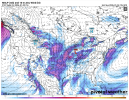
trend-gfs-2026010412-f126.500wh.conus.gif1767550707980.png
 
There's been only 4 severe weather/tornado outbreaks during the January 8th-11th timeframe since 1643:
1975
2008 (Slight Risk)
2020 (Moderate Risk)
2024 (Enhanced Risk)
 
Back
Top