• Welcome to TalkWeather!
    We see you lurking around TalkWeather! Take the extra step and join us today to view attachments, see less ads and maybe even join the discussion.
    CLICK TO JOIN TALKWEATHER

Volcano thread

It's continuing to erupt but at a lower intensity. However, as Vulkane.net notes today, the ash from previous emissions, plus this ongoing stuff, is indeed a major problem. Darwin VAAC (1430Z) notes that there is still ash present at 50,000 feet and:

RMK: HIGH LEVEL VA TO FL500 IS DETACHED FROM THE VOLCANO AND MOVING SW. CONTINUOUS VA EMISSION TO FL150 MOV SE, WITH REMNANTS OF VA FROM EARLIER ERUPTION STILL PRESENT. VA HEIGHT AND FORECAST BASED ON SATELLITE IMAGERY AND MODEL GUIDANCE.

Badan Geologi tweets confirm that the volcano can't be seen visually.

It's worth noting that Indonesia, and particularly Java, is having a terrible time with wildfires, including peat fires. The last I read, children were staying indoors at home, doing online learning because of bad air quality. I haven't read anything about a potential ash-wildfire smoke combo air pollution crisis but wonder if this might become an issue with wind shifts -- maybe not, if AK keeps to lesser intensity activity and the wind shift clears out the ash.
 
No changes; just came across this video, which is gorgeous.

 
This one's not pretty, but wow! That eruption column was amazing.


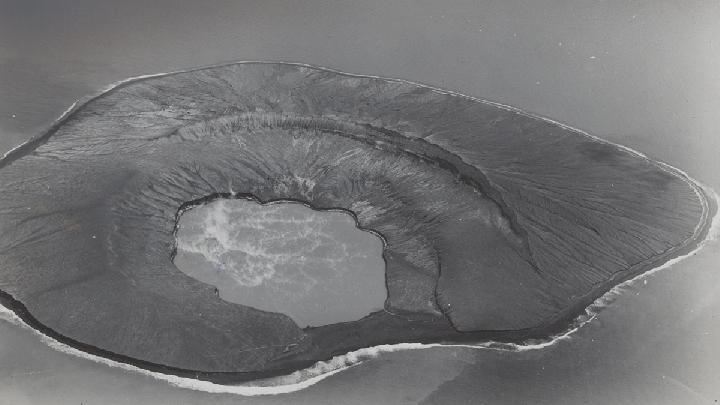
Some videos that are more current show Anak Krakatau now sputtering fireworks and having other strombolian activity as it typically does...and as it was doing, though more intensively, on the night that it collapsed in 2018.

Everyone is still watching it very closely.

The three main things this layperson is wondering:

  • What caused the outburst (paroxysm)?
  • Did that violent outburst weaken the edifice?
  • Will it go back to recent baseline or escalate again?
 
Darwin VAAC reports (1430Z on the 7th) that the ash at 50,000 feet has dissipated, and continuous emissions to 15,000 feet are ongoing.

That is probably AK's typical strombolian activity.

The boffins went out for a look; I think this X account is legit (in many countries, I've noticed, official sources update slowly, if at all, and sometimes, as in Japan and Indonesia, knowledgeable people step up to fill the gap):


Badan Geologi still reports a lot of seismicity; it is of various kinds, too.

So the Son of Krakatoa has not yet settled down, apparently, but at the moment it is not tantruming.
 
Vulkane.net's blog is a good source of ongoing news about Krakatoa and other tetchy volcanoes (although they haven't yet mentioned Furnas in the Azores, which is a little restless and deserves watching -- of note from my reading, most restless calderas don't erupt, but all of their eruptions are preceded by unrest).

The Vulkane blogger notes, among other things:

...Several social media users described it [AK's September 4-5 paroxysm] as the strongest eruption since the 1883 cataclysm—an assessment I don't share. This superlative is likely still held by the eruption of December 22, 2018, when a flank collapse triggered a tsunami . The ash cloud reached a height of 18 kilometers. The eruption was classified as VEI 4, while I estimate the paroxysm from September 4th to 5th at VEI 3. Such eruptions have only occurred twice in the history of Anak Krakatau...

LaMEVE database puts the 1883 convulsion at magnitude 6.7 and VEI 6. (They only include VEI 4 and above; magnitude is more precise and is based on estimates of the amount of magma that erupted, while VEI includes the total volume of eruption deposits.)


Anak Krakatau is calmer now and at least superficially seems back to baseline, but the seismicity is still quite high. As the blogger notes, it still needs careful watching.
 
Not directly related, but here is an update on the missing journalists the Vulkane blogger mentions, from ANTARA News, who employed at least one of them.

In his book on Krakatoa, Simon Winchester describes going out to AK during its pre-2018 behemoth period. He was in a speedboat, and he writes that they had to be extremely careful crossing the Strait because of the heavy maritime traffic through this important transit point. Those ships are big and they move fast. I wonder if perhaps the journalists' pilot wasn't as skillful or, more likely, as lucky as Winchester's was. Still, you'd think there would be wreckage if they did go down in a collision...
 
Back
Top