• Welcome to TalkWeather!
    We see you lurking around TalkWeather! Take the extra step and join us today to view attachments, see less ads and maybe even join the discussion.
    CLICK TO JOIN TALKWEATHER

Significant Tornado Events - Global Edition

It hasn't been mentioned but the viotor in Italy earlier today was literally the result of a Jarrell-eque zipper effect. Obviously not to the same extent of intensity but absolutely had the hallmarks of pre existing boundary/rapid vorticity stretching in the vertical leading to very violent tornado. What a wild setup.
 
It hasn't been mentioned but the viotor in Italy earlier today was literally the result of a Jarrell-eque zipper effect. Obviously not to the same extent of intensity but absolutely had the hallmarks of pre existing boundary/rapid vorticity stretching in the vertical leading to very violent tornado. What a wild setup.
Given tornadoes like this one, Cisco, and Roanoke, it does seem like these slow nasty mesoscale tornadoes do actually vary quite a bit in intensity. Will say though this one visually looked pretty insane, resembled Enid and St Libory of this year. Also, gotta wonder if those waterspouts on the same storm were also tornadoes like the one in Marsala, given they were attached to the same storm.
 
Given tornadoes like this one, Cisco, and Roanoke, it does seem like these slow nasty mesoscale tornadoes do actually vary quite a bit in intensity. Will say though this one visually looked pretty insane, resembled Enid and St Libory of this year. Also, gotta wonder if those waterspouts on the same storm were also tornadoes like the one in Marsala, given they were attached to the same storm.
I got st libory vibes too
 
For a while now, during my free time I've been working on mapping out some Super Outbreak tornadoes (but that's a topic for another post) and something I informally call 'The Worldwide Tornado Documentation Project' - with a simple goal, to dig up and shed light on as many international tornadoes as possible. While there are multiple weather services around the world that keep a good tab on their tornadoes including the Japan Meteorological Agency, South African Weather Service, Trinidad and Tobago Weather Center and Italian Meteorological Service, some countries don't have the resources to properly maintain a functioning weather service - and thus many tornadoes get lost in the void unless they are documented by an international organization or photographed/filmed by an individual.

Regardless, I've managed to track down tornadoes in over 110 countries, including some exceptional occurrences:
  • Tornadoes that hit Ishango, Democratic Republic of the Congo in 2007 and Tumbaco, Ecuador in 2014 occurred approximately 9 and 15 miles south of the equator, respectively.
  • Tornadoes have occurred as far north as southern Iceland, northern Norway, the Bering Sea in Alaska and the Northwest Territories in Canada; these occurrences (along with previously mentioned tornadoes in La Rinconada, Peru) make me firmly believe that waterspouts/weak tornadoes are absolutely possible in southern Greenland, although it's one of the few places in the world where a tornado has yet to be documented.
  • The southernmost tornadoes I know of occurred in Ashburton, New Zealand and Puerto Montt, Chile; both towns have been hit at least twice.
Some notable events I've come across recently:
  • A probable tornado struck Akim Oda, Ghana on May 5, 1968. Masonry homes had their roofs ripped off and some had exterior walls partially collapsed. (source)
  • Guyana started keeping tabs on its tornadoes not too long ago, officially recording its first funnel cloud on August 16, 2019 and its first tornado on October 13, 2021. Another tornado was recorded in Black Bush Poulder on May 22, 2022. It's probable that earlier tornado events have gone unreported, nonetheless it's still great to see more countries attempting to keep track of their tornadoes. One possible example of such is a pair of twin waterspouts recorded on August 23, 2011, reportedly in Guyana (although other sources say the video is from the Bahamas, calling this into question).
  • A tornado in Oman in May 2021 (source) and a 2014 tornado in Goyang-si, South Korea (source) are some rare examples of tornadoes outside of North America and Japan being observed with radar imagery.
  • A funnel cloud and possible brief tornado formed in the northern part of San Salvador (and on the slopes of the nearby volcano of the same name) on August 20, 2013. (source)
There's many more to cover, including some in detail but I'll save those for follow up posts. On a somewhat related note, the way a lot of international news outlets classify tornadoes remains a pet-peeve of mine:
mini-tornado.jpg
This is quite interesting, can I have a link to all the countries and the tornadoes please (only if you want to). Also regarding a tornado in Greenland, there was a waterspout in Qaqortoq in 2007.
 
I would like to contribute information regarding two tornadoes in the Iberian Peninsula that are often overlooked and I believe are worth mentioning.
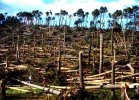
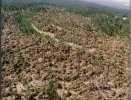
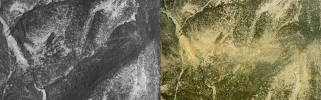
The first one is the F3 tornado that devastated the pine forests near Mosqueruela, Fortanete, and Cantavieja. With an estimated maximum width of 700 meters, it completely destroyed the terrain around the Masía del Dominé and Masico de Patirás.
Subsequent studies suggested that the tornado required horizontal wind speeds in the order of 90 m/s to knock down that type of pine tree that made up the forests, which translates to about 325 km/h (190 mph).
What stands out is the clear turn it made towards the northeast in the upper right part of the image.

I am not entirely convinced by the rating for several reasons, but mainly because the measurements and weight of a tree of the same type that was knocked down were used for the study, rather than one from the actual location itself.
Why not take measurements of one of the specific trees from there instead of using a standard prototype of that species?
Furthermore, it is not specified whether the trees were uprooted or snapped in half, and it is important to clarify this, because a tornado that knocks them down almost at the base is not the same as one that brings them down halfway, and consequently, the speed required for both cases is different.
 

Attachments

  • Screenshot_2026-10-29-16-19-32-672_com.android.chrome-edit.jpg
    Screenshot_2026-10-29-16-19-32-672_com.android.chrome-edit.jpg
    338.7 KB · Views: 12
  • Screenshot_2026-10-29-16-47-07-005_com.android.chrome-edit.jpg
    Screenshot_2026-10-29-16-47-07-005_com.android.chrome-edit.jpg
    325.3 KB · Views: 9
  • Tornado de Mosqueruela, 28 Agosto 1999, (Trayectoria Inicial Fixed).png
    Tornado de Mosqueruela, 28 Agosto 1999, (Trayectoria Inicial Fixed).png
    1.5 MB · Views: 9
  • Daños Severos Mosqueruela 1999 (3).png
    Daños Severos Mosqueruela 1999 (3).png
    39.1 MB · Views: 21
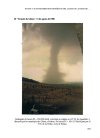
The second tornado I want to highlight is the Agua Dulce - Gilena tornado. It was a severe Category F3 tornado that formed near Agua Dulce. Upon reaching the outskirts of Gilena with great force, it suctioned and uprooted 60 centuries-old holm oaks. Two minutes later, it struck a house, lifting off the entire roof and partially collapsing the exterior walls of the dwelling. Two nearby cars were displaced 50 meters from the site (not thrown).


With F-2 intensity, it struck an electrical installation, knocking down more towers and affecting and tearing up several olive trees along the way.


The tornado then entered the urban area of Gilena, affecting homes with F-2 intensity, tearing off roofs, street trees, and causing severe damage to the power lines. An ice cream truck in the southeast of the town was lifted and thrown 10 meters away.


A nearby RV park suffered serious damages when the vehicles were overturned.


A nearby car was swept several meters.


It weakened to F-1 intensity, causing minor damage to the trees on the outskirts of the town, and the funnel touched down intermittently for three minutes, lifting off on several occasions.


Finally, it dissipated after traveling 20 kilometers and lasting 10 minutes.


I would like to know if there are any photos of the damage to the house or the cars.


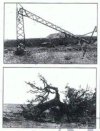
I have managed to find photos of the towers and the damaged trees near the town.

The only image of the funnel is found shortly after its formation, at its maximum intensity as it passed through the area where the house was located.
 

Attachments

  • Screenshot_2026-10-31-11-06-14-706_cn.wps.moffice_eng-edit.jpg
    Screenshot_2026-10-31-11-06-14-706_cn.wps.moffice_eng-edit.jpg
    119.6 KB · Views: 11
  • Screenshot_2026-10-31-21-50-04-541_com.google.android.apps.photos-edit.jpg
    Screenshot_2026-10-31-21-50-04-541_com.google.android.apps.photos-edit.jpg
    168.8 KB · Views: 11
Europe’s most recent IF4, South Moravia, was a great example of how strong European construction is. The contextual evidence (grass scouring, cobblestone scoured from the ground, massive concrete slabs shifted, extreme tree and vehicle damage) made it clear that it was a high-end violent event, but very few homes along the path were fully leveled. Also I have to say, Catania is not only one of the most violent European tornadoes I have ever looked into, but honestly some of the most violent damage I’ve heard of in general. Montville also seems like it could have been extremely violent, but I don’t have as much info on that one. Overall, I don’t think it’s common knowledge here in the states just how incredibly well thick masonry construction holds up in violent tornadoes (which is also why Mayfield needs an upgrade based on that church).

By the way, does anyone remember a potential IF5 candidate from coastal Spain (or maybe Portugal?) that occurred centuries ago? I can’t remember the exact year or location, but recall that it formed over the ocean, moved inland, and leveled very large masonry buildings like monasteries, root balled and lofted large trees through the air, and hurled huge chunks of masonry walls long distances. I also recall eyewitnesses saying the tornado was massive and accompanied by an all consuming nighttime-like darkness, just like Joplin. Does that ring a bell for anyone?
I think the event you are referring to is the Great Cádiz Tornado on March 15, 1671. It came in as a massive waterspout through the bay and made landfall, causing violent damage—likely on the F-4 scale—uprooting sturdy trees, knocking down the walls of a large portion of the homes and hurling them over 50 meters away. It severely deformed the structure of a Christian monastery and threw trees over long distances, ripping them up by their roots and completely debarking them, sending them traveling tens of meters.
The tornado was shrouded in darkness primarily because it occurred in the early hours of the morning.

In the port, it very severely damaged large ships and merchant vessels, going so far as to sink three commercial ships.
 
Back
Top