• Welcome to TalkWeather!
    We see you lurking around TalkWeather! Take the extra step and join us today to view attachments, see less ads and maybe even join the discussion.
    CLICK TO JOIN TALKWEATHER

Significant Tornado Events - Global Edition

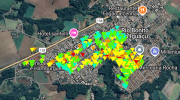
Did they combine it with the Robecco Pavese tornado? They're near-unanimously considered one tornado, but ESWD still had them separate.

If they were combined, this is officially the first photographed F5 in European history IIRC.
The Robecco Pavese tornado is listed in a seperate entry and has been rerated to IF3 but is being reviewed to see if a higher rating is necessary
 
Seems there was another one on 24 November in a remote section of national park near Gympie, Qld:


(tried to upload a seperate image but it wasn't having it)

And another barely perceptable one from last year:


Notably seems to be a nudger event, notice the small cell to the hook echo's left. First one I've seen internationally!
 
The Robecco Pavese tornado is listed in a seperate entry and has been rerated to IF3 but is being reviewed to see if a higher rating is necessary
Hmm.....

...

@TH2002, if this holds, it's going to be a very, very unique kind of botched survey - one where the right decision was actually made, but somehow the survey was still screwed up.

As to how, I'll just say this - the most likely IF5 damage from the tornado (NOT tornadoes as ESWD says) was in the segment they rated IF3.
 
Hmm.....

...

@TH2002, if this holds, it's going to be a very, very unique kind of botched survey - one where the right decision was actually made, but somehow the survey was still screwed up.

As to how, I'll just say this - the most likely IF5 damage from the tornado (NOT tornadoes as ESWD says) was in the segment they rated IF3.
100% correct. The most convincing IF5 damage I've seen from that tornado was a masonry home swept away in Robecco Pavese.

The death toll listed by the ESWD is also incorrect. They list six fatalities when it should be seven.
 
So far, I have not seen valle scuropasso be upgraded in the ESWD website. Its still at IF4. I don't believe whatever the image about valle scuropasso being upgraded is. 1766653462174.png
Don't believe in the valle scuropasso upgrade yet, its still being reviewed.
 
So far, I have not seen valle scuropasso be upgraded in the ESWD website. Its still at IF4. I don't believe whatever the image about valle scuropasso being upgraded is. View attachment 49264
Don't believe in the valle scuropasso upgrade yet, its still being reviewed.
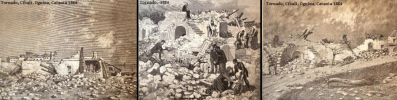
The person on Twitter posting about the upgrade is quite reliable and finds a lot of events for Italy for the ESSL. His post also tagged ESSL and talked about the 1884 Catania tornado being upgraded so I do think it is legit,
 
The person on Twitter posting about the upgrade is quite reliable and finds a lot of events for Italy for the ESSL. His post also tagged ESSL and talked about the 1884 Catania tornado being upgraded so I do think it is legit,
It never was upgraded actually, it has been IF4 since the post was last posted. We do not have any sources about it being rated IF5 either by the ESSL or ESWD. ESSL usually has sources if it hasn't been upgraded in ESWD. Like Neede as an example.
 
European construction is much different than ours, stronger in some ways while weaker in others. Their brick walls are structural, being 2 layers wide with "bond" coursing, where bricks tie both walls together. The same construction is used for many or all interior walls too. Their fenestration is also stronger and the latching mechanisms more robust. And many of their homes are poured concrete, usually reinforced though that may be to a lesser standard than what we do. They also still use plaster in most homes, and it offers a lot more stiffness to a ceiling than drywall as well as having far more mass to add to the weight of ceiling joists, helping prevent them from being blown away. Often those joists will be set in "pockets" in those strong masonry walls, with floors being done similarly.. So essentially the "box" below the roof is very wind resistant. Their roofs are frequently tile, and those are far less wind resistant than ours; we've all seen aftermath pics with only the roof framing left behind. This might be an advantage since once the tiles blow away there's almost no wind loading to deal with in the roof system. I'm not sure how well those tiles carry in the wind- I certainly wouldn't want to be hit by one.

To build a house like theirs over here would cost double or more and you really couldn't do it as those roofs don't meet code. A car being thrown into either one will level it, so you decide.

Phil
To correct you on this, the roof covering is tile, not the roof system itself. The roof system is equal to US roof systems mostly if not a little bit stronger. European residential construction as a whole is much stronger than typical US construction, part of that is because masonry bearing and or concrete structures are naturally stronger than wooden frame homes, and also because cutting corners on a wooden frame home has a huge impact on structural integrity. Even a weaker brick structure is fairly strong. Most modern high rise and or institutional buildings are built similarly though.
 
Europe’s most recent IF4, South Moravia, was a great example of how strong European construction is. The contextual evidence (grass scouring, cobblestone scoured from the ground, massive concrete slabs shifted, extreme tree and vehicle damage) made it clear that it was a high-end violent event, but very few homes along the path were fully leveled. Also I have to say, Catania is not only one of the most violent European tornadoes I have ever looked into, but honestly some of the most violent damage I’ve heard of in general. Montville also seems like it could have been extremely violent, but I don’t have as much info on that one. Overall, I don’t think it’s common knowledge here in the states just how incredibly well thick masonry construction holds up in violent tornadoes (which is also why Mayfield needs an upgrade based on that church).

By the way, does anyone remember a potential IF5 candidate from coastal Spain (or maybe Portugal?) that occurred centuries ago? I can’t remember the exact year or location, but recall that it formed over the ocean, moved inland, and leveled very large masonry buildings like monasteries, root balled and lofted large trees through the air, and hurled huge chunks of masonry walls long distances. I also recall eyewitnesses saying the tornado was massive and accompanied by an all consuming nighttime-like darkness, just like Joplin. Does that ring a bell for anyone?
 
Last edited:
Europe’s most recent IF4, South Moravia, was a great example of how strong European construction is. The contextual evidence (grass scouring, cobblestone scoured from the ground, massive concrete slabs shifted, extreme tree and vehicle damage) made it clear that it was a high-end violent event, but very few homes along the path were fully leveled. Also I have to say, Catania is not only one of the most violent European tornadoes I have ever looked into, but honestly some of the most violent damage I’ve heard of in general. Montville also seems like it could have been extremely violent, but I don’t have as much info on that one. Overall, I don’t think it’s common knowledge here in the states just how incredibly well thick masonry construction holds up in violent tornadoes (which is also why Mayfield needs an upgrade based on that church).

By the way, does anyone remember a potential IF5 candidate from coastal Spain (or maybe Portugal?) that occurred centuries ago? I can’t remember the exact year or location, but recall that it formed over the ocean, moved inland, and leveled very large masonry buildings like monasteries, root balled and lofted large trees through the air, and hurled huge chunks of masonry walls long distances. I also recall eyewitnesses saying the tornado was massive and accompanied by an all consuming nighttime-like darkness, just like Joplin. Does that ring a bell for anyone?
I did some sleuthing and couldn't find it. Might be a very poorly documented case i would assume given how it happened a long while ago. You're confident this is Spain/Portugal and you're not mixing any other country up here? A extremely violent landfalling tornado is very interesting given most landfalling tornadoes typically weaken.
 
Hello, first of all, thank you for accepting me on this forum and sorry for my limited English. I'm from Belgium, and with my friends, we created a group specializing in the study of thunderstorms, called Belgorage.

I'm very interested in the 1967 storm that affected France, Belgium, and the Netherlands.
After visiting the affected areas and meeting with numerous witnesses, I haven't found any concrete evidence to support an F5 intensity in Palluel. An F4 level appears to have been reached in Ecourt.

For the 60th anniversary, I will be publishing reports on each tornado case.
 
Hello, first of all, thank you for accepting me on this forum and sorry for my limited English. I'm from Belgium, and with my friends, we created a group specializing in the study of thunderstorms, called Belgorage.

I'm very interested in the 1967 storm that affected France, Belgium, and the Netherlands.
After visiting the affected areas and meeting with numerous witnesses, I haven't found any concrete evidence to support an F5 intensity in Palluel. An F4 level appears to have been reached in Ecourt.

For the 60th anniversary, I will be publishing reports on each tornado case.
Welcome to the forum! That outbreak was without a doubt unusual. There's one particular outbreak I find very interesting in how it happened and it was basically some sort of extratropical outer band event in Germany!
 
Hello, first of all, thank you for accepting me on this forum and sorry for my limited English. I'm from Belgium, and with my friends, we created a group specializing in the study of thunderstorms, called Belgorage.

I'm very interested in the 1967 storm that affected France, Belgium, and the Netherlands.
After visiting the affected areas and meeting with numerous witnesses, I haven't found any concrete evidence to support an F5 intensity in Palluel. An F4 level appears to have been reached in Ecourt.

For the 60th anniversary, I will be publishing reports on each tornado case.
Do you happen to know the figures for injuries/deaths from the Oostmalle tornado? I've seen injuries ranging from 20-200 and some sources report 1 or 2 deaths while others say none.
 
Regarding the tornado of June 24, 1967, in Palluel-Ecourt, I haven't found any evidence to classify it as an F5. In Ecourt, some buildings with thick brick walls were practically razed, which, in my opinion, justifies the F4 classification. However, I still need to meet with people in Palluel who may be able to provide me with further information.
 
Back
Top