

JBishopwx
Member
Won't be surprised the current WPC Excessive Rainfall Outlook for Friday sees an extension of the slight risk. NWS Jackson has bumped up totals up to inches for much of North Mississippi.
Follow along with the video below to see how to install our site as a web app on your home screen.
Note: This feature may not be available in some browsers.

There's some instability left over. I'd be concerned over a inversion there, and that inversion could also be prominent on Friday in Mississippi too so even that's not all a slam dunk. A early morning tornado threat likely will exist Saturday maybe in SE MS, i have some confidence in that. But the Delta round is conditional in itself. spinup tornadoes would be possible with this band if not elevated. Line orientation would need to be favorable though and the HRRR is depicting NE-moving streaks. We will see. Could see something interesting to start tye year in Oklahoma...Totally forgot the 18Z HRRR goes to 18Z Thursday. It's actually more extreme than the Nam in terms of MU cape and (rear flank?) Supercells. Never seen anything like that before.
View attachment 49680View attachment 49681
View attachment 49684
It actually has MUCAPE peaking at 1500 J/kg as the first line passes over.
View attachment 49682View attachment 49683
Very interested in what the 00Z says in a couple hours.

Thanks for the info! I think I understand now. Is the initial line of storms is cooling the upper layers more than the surface, and that increased change with height is creating more instability? Is this a result of how fast the low pressure system is moving, and humid air being harder to cool than dry air? Any deeper analysis is much appreciated! Same to you @ColdFrontThe dry line is lagging back behind the initial line of storms it initiated, the reason why there’s higher cape is because of the colder air above the surface behind the line of storms.
On the right sounding you can see the dryline is slanted in height (normal), and again, theres higher cape due to the steeper temp profile and slightly warmer surface temps due to WAA being stronger near the dryline.
View attachment 49677View attachment 49678

It’s colder (above the surface) towards the dryline because it’s simply closer to the cold core low, this combined with the higher surface temps along the dryline is the reason for the higher cape.Thanks for the info! I think I understand now. Is the initial line of storms is cooling the upper layers more than the surface, and that increased change with height is creating more instability? Is this a result of how fast the low pressure system is moving, and humid air being harder to cool than dry air? Any deeper analysis is much appreciated! Same to you @ColdFront
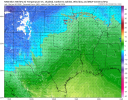
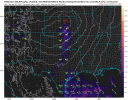
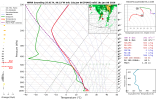
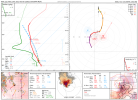


lets hope this synoptic set up type thing doesn't stick as we don't need a repeat of of last year where most events have the setup but no actual thermos then one hits and boom outbreakCertainly an impressive synoptic setup that is being modeled, but mesoscale features seem to be lacking to make this a widespread outbreak. I'd shift/shrink the SPC probability to have a bullseye on the ArkLaMiss area, but I don't see the northern part of the current highlighted area getting anything significant.

The history of severe events in the southern US during winter is so rife with low CAPE/high shear events, so I am still surprised some people still discount them.NWS Memphis in their updated discussion mentions 60kt bulk shear, but CAPE probability of exceeding 500 is 10%.
Here's the thing: that shear can compensate for lack of CAPE. I've mentioned this many times on here as well as others. Basically your classic low CAPE/high shear setup.
That makes very good sense! Thank you. I haven't followed many winter set ups this closely, so it's interesting seeing CAPE manifested this way.It’s colder (above the surface) towards the dryline because it’s simply closer to the cold core low, this combined with the higher surface temps along the dryline is the reason for the higher cape.
View attachment 49685View attachment 49686
This is the typical synoptic set up for the majority of extratropical cyclones. The highest cape will be near the cold front/dry line naturally due to proximity from the CCL and the highest surface temps due to WAA being the most substantial along the front.
Although sometimes the highest cape will be along the warm front section since the greatest vertical temp gradient is located there.
During spring and summer months, the highest cape usually will be away from the front and further south in the OWS, simply because the shear amount of moisture and heat present compared to near the CCL.
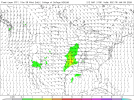
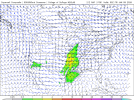
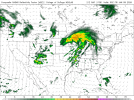
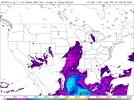
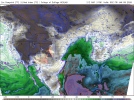

Tends to happen this way, wait until the HRRR gets into range.21Z RAP continues the uptrend across mesoscale models with an even crazier Thursday evening. My goodness. CAPE wasn't supposed to get this high until around sundown on Friday. I guess the main question is if convection is going to outrun the stronger synoptics?
View attachment 49690 View attachment 49691
View attachment 49692View attachment 49693
View attachment 49694

Here's a sounding from the HRRR in the area of interest.
View attachment 49687
And this is the closest analog I could find in my collection. It's from a very photogenic 2015 "cold core" tornado outbreak in Colorado
View attachment 49689
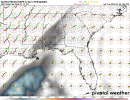
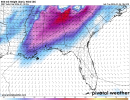
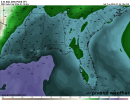
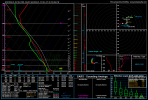
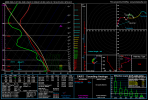
Think the more minimal instability and surface inversion would limit the ceiling here. Thursday and Saturday looking somewhat alright for severe Wx, Friday a bit questionable to me0Z HRRR actually has a decent environment in southwest to central Arkansas at 0Z Friday, only problem as depicted verbatim it seems is the most robust storms fire on the eastern edge and are already tracking out of it. However...
View attachment 49699
Long time lurker here, and I hate to come out of the shadows to be a stickler.It’s important to keep in mind that dew point is measurement of moisture RELATIVE to temperature. Dew points at or below 60 by itself doesn’t indicate lack of moisture.
A dew point of 13 with a temp of 20 is just as moist as a dew point of 70 over 77.
Models aren’t showing a lack of instability due low moisture, but rather because the vertical temperature profile is rather flat, temps don’t go below freezing until around 650mb, which wouldn’t be a big deal if it wasn’t combined with the mid level inversion layer and it’s no surprise cape doesn’t even break 500j/kg.
This can largely be negated if surface temps are at least in the mid 70s to 80s, this will depend on how cloud free the warm sector is. Obviously, low cape doesn’t thwart tornadoes, but the full potential will definitely be limited if the cumulus field doesn’t evaporate quickly.
View attachment 49675View attachment 49676
0Z HRRR actually has a decent environment in southwest to central Arkansas at 0Z Friday, only problem as depicted verbatim it seems is the most robust storms fire on the eastern edge and are already tracking out of it. However...
View attachment 49699
Think the more minimal instability and surface inversion would limit the ceiling here. Thursday and Saturday looking somewhat alright for severe Wx, Friday a bit questionable to me
