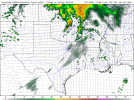
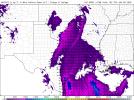
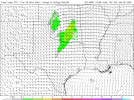
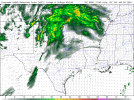
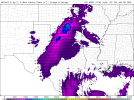
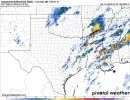
18z nam rolling out, should get a better look at Friday into Saturday with the secondary lows evolution
Follow along with the video below to see how to install our site as a web app on your home screen.
Note: This feature may not be available in some browsers.


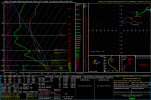
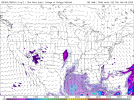

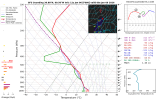
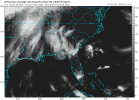
The dry line is lagging back behind the initial line of storms it initiated, the reason why there’s higher cape is because of the colder air above the surface behind the line of storms.Can anyone explain why Northern OK would be producing a sounding like this AFTER the initial line of storms moves through? It's presenting like the system is leaving SB CAPE directly in its wake. Does this have something to do with outflow boundaries?
View attachment 49672
View attachment 49673View attachment 49674
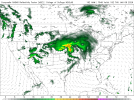
GFS is showing something similar but in a different area and to a lesser extent.
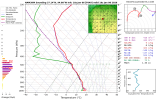
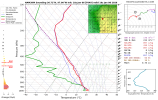
@jiharris0220 already nailed the answer for this, but on your second part:Can anyone explain why Northern OK would be producing a sounding like this AFTER the initial line of storms moves through? It's presenting like the system is leaving SB CAPE directly in its wake. Does this have something to do with outflow boundaries?
View attachment 49672
View attachment 49673View attachment 49674
GFS is showing something similar but in a different area and to a lesser extent.

You're one of few in the US to have a tornado shelter. Stay alert!That is right over my area. Better start readying my go-bag. I'll always be so thankful I have a tornado shelter in my backyard.
Yeah, admittedly i became WXTwitter that whole day and pretty much dismissed even professional offices opinions just because i simply couldn't see a reason why the high risk was warranted. It wasn't really due to the surface low, but more so a reliance on CAMs which o have lessened since then. They're more a guidance or potential depiction, and they do not forecast CFs well. I got proven wrong that day very hard. It's a reason why i try to be straight to the point but trying not to overdo my opinion of certain setups. I, called a pretty obvious bait setup in November in SE MO potential for a strong tornado lol.Yep. On surface low placement, while it’s very important, if other factors are present, they can compensate for that. Look at 4/2/25 last year with the surface low that far north around Minnesota.
That is something I thought incorrectly about for years, that the surface low needed to be in very close proximity to the outbreak region. As long as there are pressure falls to back the low-level winds ahead of the front, as well as height falls aloft, low location doesn't always matter. If you still have a catalyst to cause pressure falls and large scale ascent aloft, placement isn’t a make or break.
This is different than the situation we are discussing for Friday, but it’s something I learned last year after reading up on the 4/2 event since I would almost write events off if they weren’t in near proximity to the surface low.


Supercell printer go brrrrrrThis is an absolutely EXCELLENT replacement over the NAM, the RRFS is so accurate and brilliant. Would you guys agree? /s
I feel like the RRFS is literally just that one guy on YouTube who calls every storm the "largest he's ever seen" mixed in with a little sprinkle of WXTwitter weenies. Genuinely trying to take that run seriously, I'm very curious WHY the RRFS depicts such a robust supercell in Eastern AR. Seems to be riding some sort of boundary on that run or something at least. It may be a major outlier but always fun to pick apart anywaysSupercell printer go brrrrrr
It's something to do with its parameter scheme, I'd bet. They can also mean hail tracks but that's a stupidly large UH track LOL. Definitely gives a idea of what maybe more instability up north could do...In all seriousness, though, I do honestly question why the RRFS is always extremely bullish on supercells and helicity tracks. It’s so funny to me that it just always spits out the highest end solution 99% of the time.
That NAM quirk in S KS/N OK honestly would be a decent early cold core eque event if it were to verify. If that trend maintains, I might start watching that area.
A quick note about CAPE is while low level thermodynamics do matter, it is how it is distributed vertically throughout the atmosphere. There's reasons events like 3/5/2022 worked. You had fairly cold temps for a significant event, but the nice mid level thermodynamics contributed to strong instability above. If it was all focused in the low levels or depended on, then events where storms would need to break a stable layer or inversion, they wouldn't really happen. Strong instability above the stable layer is key in those nocturnal events. 2/26/23, 5/4/07, 5/18/25, 6/20/25. A few events of note where storms had a strong inversion to deal with but rapidly became mature so they sustained due to well mixed mid levels aloft allowing a balance of shear. That's a bit steering from the main question at hand. A profile like that, even if 62/59, would be pretty nice to sustain convection out of